At Sunnyside High, Washington Supreme Court justices field questions on interpreters, school discipline and race in admissions
May 16, 2024 | Supreme Court, Judicial , Washington
This article was created by AI summarizing key points discussed. AI makes mistakes, so for full details and context, please refer to the video of the full meeting. Please report any errors so we can fix them. Report an error »
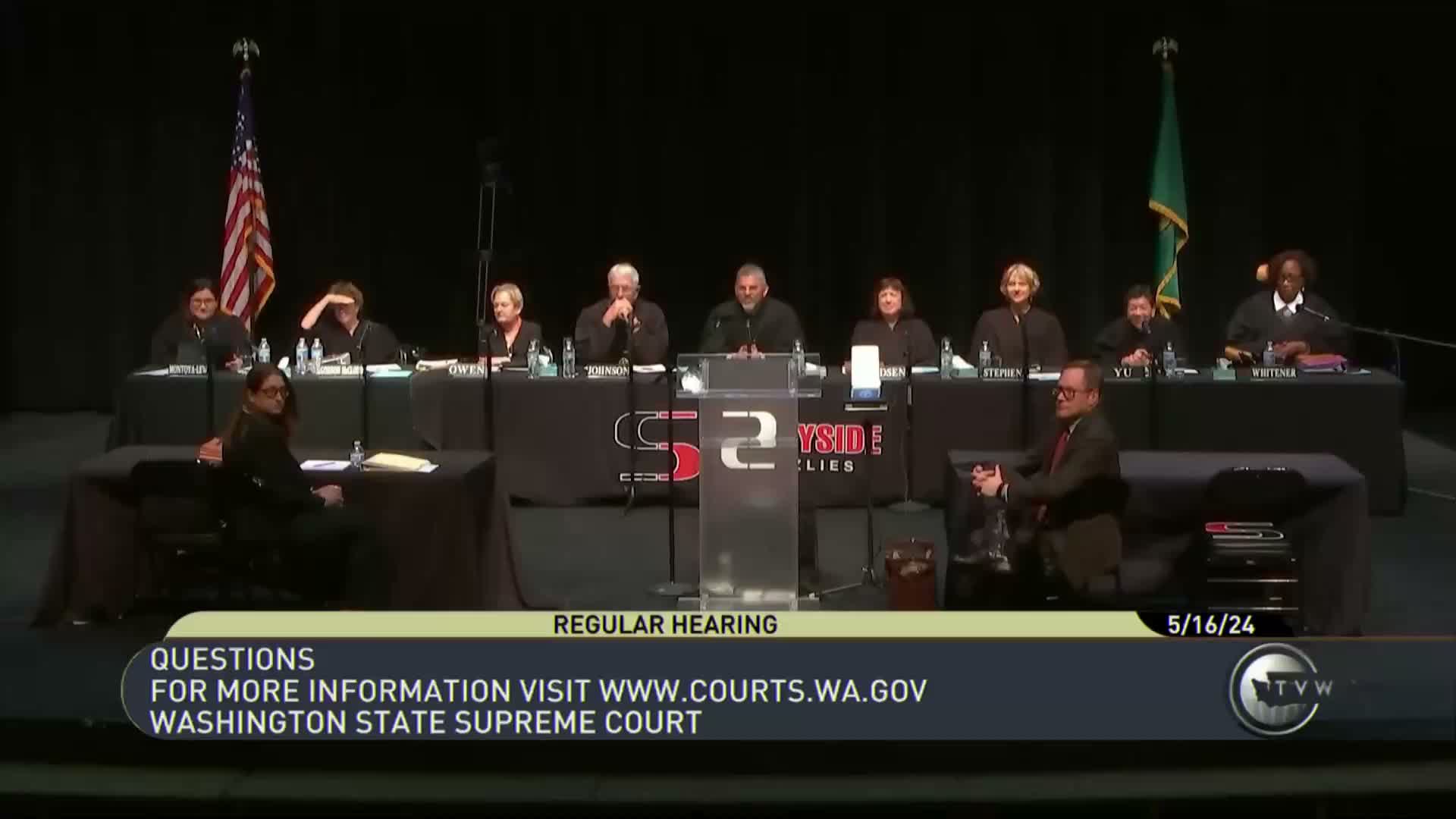
Following oral argument in State v. Smith, the Washington Supreme Court held a public question-and-answer session at Sunnyside High School on May 16, during which students and community members asked justices about language access, school discipline, career paths, precedent and the role of race in admissions.
Esi Asi, a former high-school educator and medical interpreter, asked how the court views interpreter availability. Chief Justice Steven Gonzales said language access is vital and that the court’s language-access commission works to secure funding and coordination for interpreters and translated materials. "It's important to have adequately trained and available interpreters, and the ideal is to have them in person, not remote," he said.
A local attorney, Graciela Navarro, thanked the court for bringing the program to the community and asked how long it takes to prepare for an argument. Counsel at the bar described concentrated preparation and the interruptive nature of questions at nine-justice arguments.
Camille Tree, a deaf-education teacher and advocate with Washington Hands & Voices, asked whether a truly unbiased jury is possible. A justice said jurors can set aside predispositions and that jury selection, rehabilitation by questioning, and instructions are the tools courts use to identify and address bias.
Raquel Lopez, a registered nurse, described local concerns that Sunnyside School District disciplines Latino students at disproportionately high rates and asked about legal recourse. A justice described a recently published case in which the court found in favor of a student, and stressed that statutes and due-process protections guide judicial review of school discipline policies.
Students asked practical questions about legal careers and court processes. Justices encouraged students to seek mentorship, explore clerkships, and bring diverse perspectives to the law: "We need young people, particularly young people from different races and ethnicities and abilities, to become engaged in the law," one justice said.
The session concluded with thanks from the court; the justices left the bench open to informal conversation with students and community members.
Why it matters: The court’s traveling sessions aim to demystify the judiciary, highlight access issues such as interpretation services, and show students how courts think about precedent and public institutions.
Esi Asi, a former high-school educator and medical interpreter, asked how the court views interpreter availability. Chief Justice Steven Gonzales said language access is vital and that the court’s language-access commission works to secure funding and coordination for interpreters and translated materials. "It's important to have adequately trained and available interpreters, and the ideal is to have them in person, not remote," he said.
A local attorney, Graciela Navarro, thanked the court for bringing the program to the community and asked how long it takes to prepare for an argument. Counsel at the bar described concentrated preparation and the interruptive nature of questions at nine-justice arguments.
Camille Tree, a deaf-education teacher and advocate with Washington Hands & Voices, asked whether a truly unbiased jury is possible. A justice said jurors can set aside predispositions and that jury selection, rehabilitation by questioning, and instructions are the tools courts use to identify and address bias.
Raquel Lopez, a registered nurse, described local concerns that Sunnyside School District disciplines Latino students at disproportionately high rates and asked about legal recourse. A justice described a recently published case in which the court found in favor of a student, and stressed that statutes and due-process protections guide judicial review of school discipline policies.
Students asked practical questions about legal careers and court processes. Justices encouraged students to seek mentorship, explore clerkships, and bring diverse perspectives to the law: "We need young people, particularly young people from different races and ethnicities and abilities, to become engaged in the law," one justice said.
The session concluded with thanks from the court; the justices left the bench open to informal conversation with students and community members.
Why it matters: The court’s traveling sessions aim to demystify the judiciary, highlight access issues such as interpretation services, and show students how courts think about precedent and public institutions.
Don't Miss a Word: See the Full Meeting!
Go beyond summaries. Unlock every video, transcript, and key insight with a Founder Membership.
✓
Get instant access to full meeting videos
✓
Search and clip any phrase from complete transcripts
✓
Receive AI-powered summaries & custom alerts
✓
Enjoy lifetime, unrestricted access to government data
30-day money-back guarantee
