Courts’ Blake Refund Bureau urges outreach after vacatur ruling; $31 million still unclaimed
March 02, 2026 | Board Council Commission Agencies , Executive, Washington
This article was created by AI summarizing key points discussed. AI makes mistakes, so for full details and context, please refer to the video of the full meeting. Please report any errors so we can fix them. Report an error »
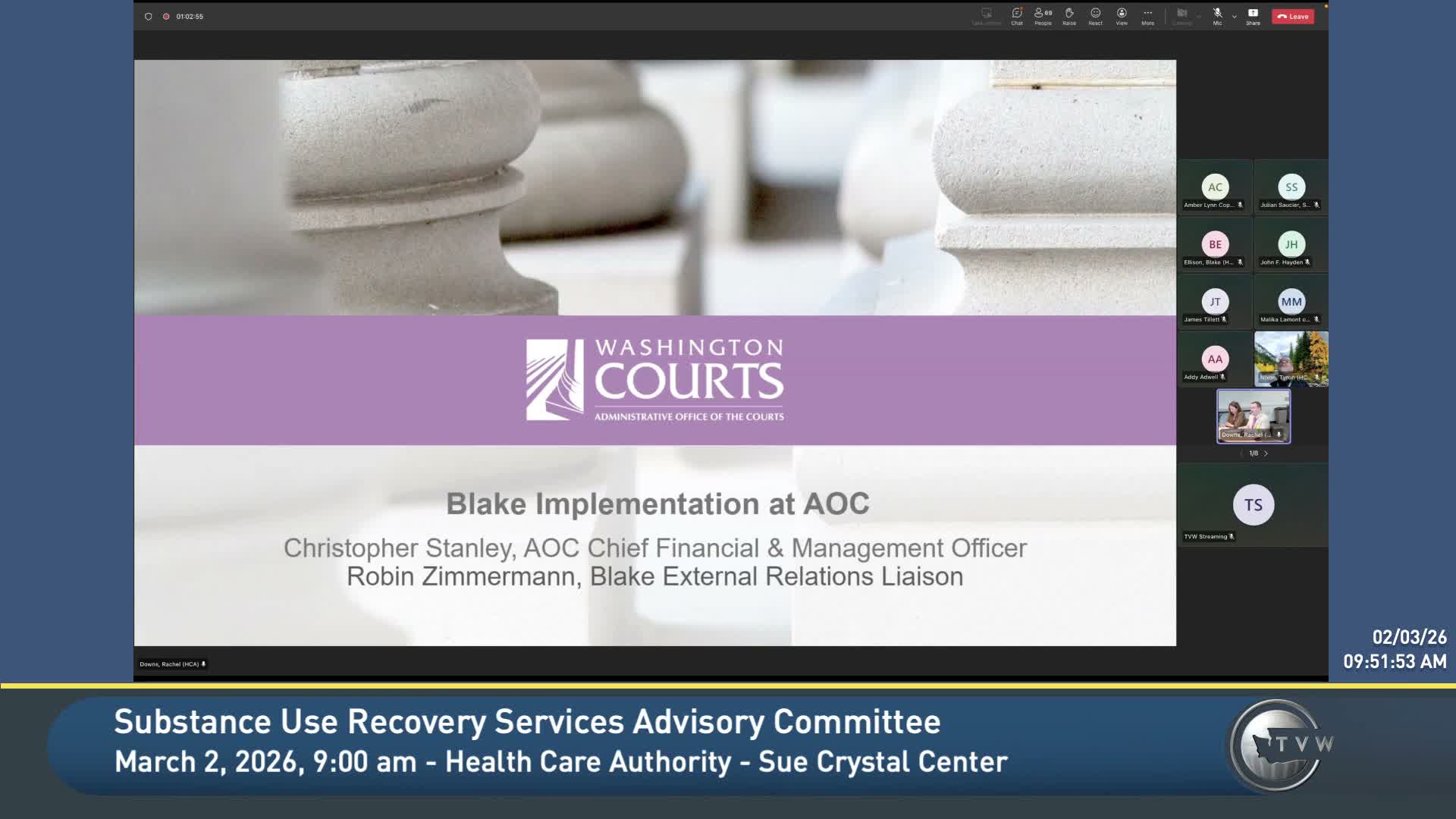
Christopher Stanley, chief financial and management officer at the Administrative Office of the Courts and manager of the Blake Refund Bureau, briefed the Substance Use Recovery Services Advisory Committee on the bureau’s work to vacate old drug-possession convictions and return legal financial obligations to affected people.
Stanley summarized the legal background: a 2021 Washington State Supreme Court decision invalidated the drug-possession statute as written, requiring courts to vacate qualifying convictions dating as far back as the statute’s passage. "In 2021, the Washington State Supreme Court found that the law criminalizing drug possession was unconstitutional," he said, and the decision can touch convictions going back decades.
Stanley described the scale of the effort: he cited roughly 600,000 cases that require processing across many jurisdictions and said AOC has identified about 100,000 cases on the bureau’s current list. To date, he said, the bureau has returned about $10 million in refunds to more than 6,000 cases; the refunds per case vary widely, and $31 million remains available to claim. Stanley said the bureau will begin more proactive outreach, such as cold calling or emailing potentially affected individuals, while acknowledging the bureau lacks the sort of outreach budget available to the Department of Revenue’s "claim your cash" campaigns.
Robin Zimmerman, Blake external relations liaison, described outreach tactics: community visits, partnership with legal aid (Office of Public Defense and civil legal-aid groups), PSAs, custom collateral (postcards, posters and social-media toolkits), and local "relief days" where multiple partners support outreach and intake. She said she is the AOC staff lead for outreach and offered to supply printed materials and tailored communications to local providers and reentry groups.
Committee members asked why more jurisdictions do not perform blanket vacaturs as King County did. Stanley said practice varies by court: ex parte or blanket vacaturs are possible in some places but not universal; AOC has a blank-vacate unit that prepares paperwork to speed local processing when jurisdictions are ready to proceed.
Stanley also noted funding pressures. He said an earlier appropriation was roughly $118 million, but the account has been spent down and some funds were reallocated amid broader budget pressures; he said the bureau expects to request additional general-fund support in the next biennial budget if needed, and that obligations to pay refunds will be honored in compliance with the court order.
The court staff asked committee members and providers to help disseminate information to potentially affected people and to contact AOC for outreach materials and collaboration.
Stanley summarized the legal background: a 2021 Washington State Supreme Court decision invalidated the drug-possession statute as written, requiring courts to vacate qualifying convictions dating as far back as the statute’s passage. "In 2021, the Washington State Supreme Court found that the law criminalizing drug possession was unconstitutional," he said, and the decision can touch convictions going back decades.
Stanley described the scale of the effort: he cited roughly 600,000 cases that require processing across many jurisdictions and said AOC has identified about 100,000 cases on the bureau’s current list. To date, he said, the bureau has returned about $10 million in refunds to more than 6,000 cases; the refunds per case vary widely, and $31 million remains available to claim. Stanley said the bureau will begin more proactive outreach, such as cold calling or emailing potentially affected individuals, while acknowledging the bureau lacks the sort of outreach budget available to the Department of Revenue’s "claim your cash" campaigns.
Robin Zimmerman, Blake external relations liaison, described outreach tactics: community visits, partnership with legal aid (Office of Public Defense and civil legal-aid groups), PSAs, custom collateral (postcards, posters and social-media toolkits), and local "relief days" where multiple partners support outreach and intake. She said she is the AOC staff lead for outreach and offered to supply printed materials and tailored communications to local providers and reentry groups.
Committee members asked why more jurisdictions do not perform blanket vacaturs as King County did. Stanley said practice varies by court: ex parte or blanket vacaturs are possible in some places but not universal; AOC has a blank-vacate unit that prepares paperwork to speed local processing when jurisdictions are ready to proceed.
Stanley also noted funding pressures. He said an earlier appropriation was roughly $118 million, but the account has been spent down and some funds were reallocated amid broader budget pressures; he said the bureau expects to request additional general-fund support in the next biennial budget if needed, and that obligations to pay refunds will be honored in compliance with the court order.
The court staff asked committee members and providers to help disseminate information to potentially affected people and to contact AOC for outreach materials and collaboration.
Don't Miss a Word: See the Full Meeting!
Go beyond summaries. Unlock every video, transcript, and key insight with a Founder Membership.
✓
Get instant access to full meeting videos
✓
Search and clip any phrase from complete transcripts
✓
Receive AI-powered summaries & custom alerts
✓
Enjoy lifetime, unrestricted access to government data
30-day money-back guarantee
