Washington Supreme Court weighs whether shelter-care orders require 30‑day court review
May 23, 2024 | Supreme Court, Judicial , Washington
This article was created by AI summarizing key points discussed. AI makes mistakes, so for full details and context, please refer to the video of the full meeting. Please report any errors so we can fix them. Report an error »
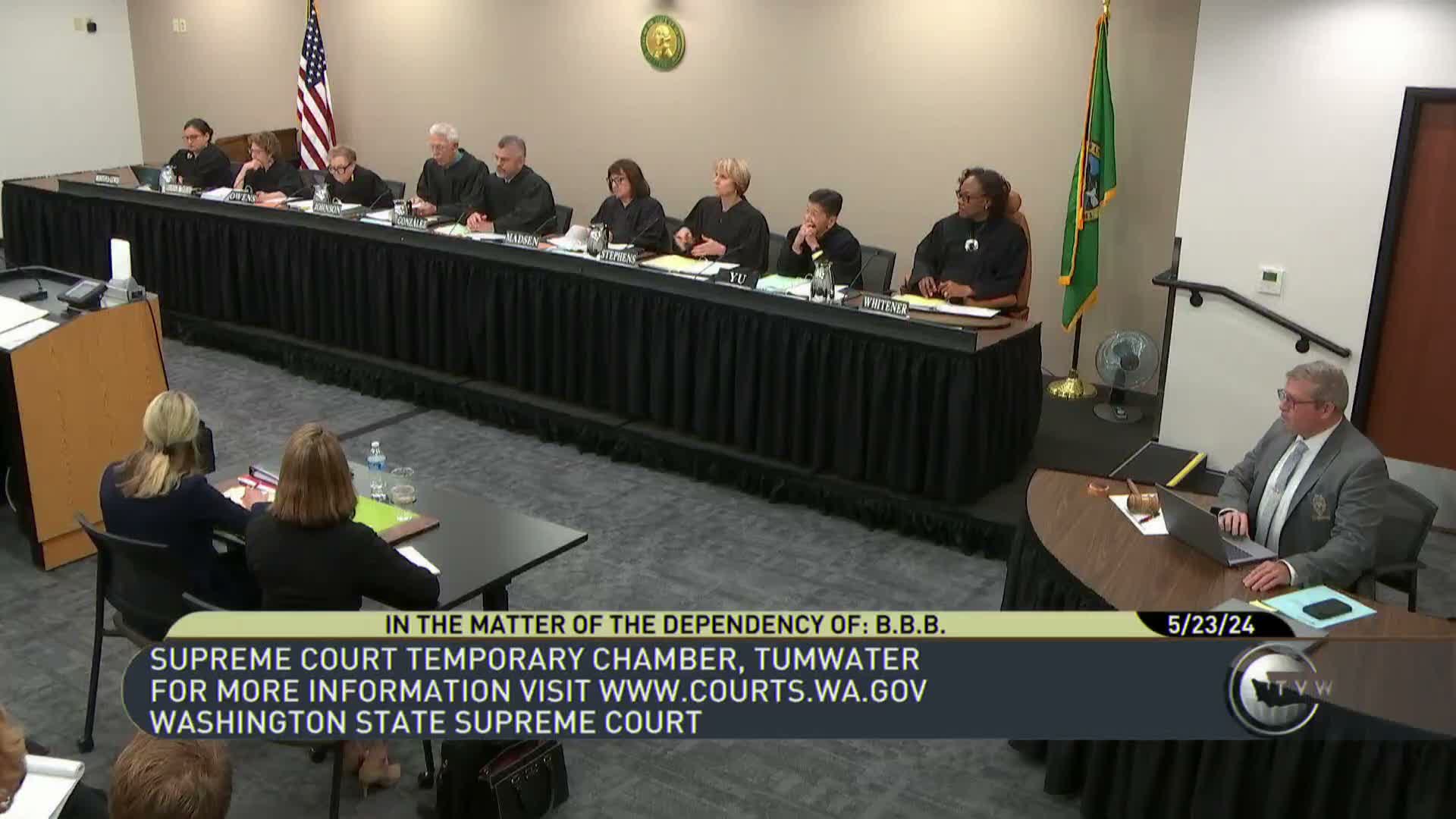
The Washington Supreme Court on May 23 heard arguments over whether the shelter‑care provisions of the juvenile code require a judicial review — and a new order — at least every 30 days when a child remains out of the home.
Beverly Tsai, attorney for the petitioner mother and counsel with the Washington Appellate Project, told the court that the juvenile statute "requires consistent court oversight throughout judicial proceedings to pursue reunification and to justify state intrusion." Tsai said removal during shelter care rests on a lower standard and that "every minute, hour, and day that a child is removed from their family causes long term harm." She urged the court to interpret the statute to require review at least every 30 days.
Tsai outlined the scope of the inquiry she says the statute requires at shelter‑care review: whether the department has tried to prevent removal or to prioritize relatives for placement, whether a parent is willing to accept services, and the visitation plan, among other factors. She argued those inquiries make the decision to continue removal a matter that should be revisited regularly by a judicial officer.
Kelly Paradis, counsel for the Department of Children, Youth, and Families, said the statutory text allows amendment of a shelter‑care order "at any time with notice and hearing" and does not require the court to hold a full hearing every 30 days when there is no contested issue or amendment. Paradis said the statute contemplates a 72‑hour initial order and a 30‑day order, and that subsection 7 contemplates a second 30‑day order without always requiring a fresh hearing; she added that parties can move for a hearing if they seek amendment or contest placement.
Justices pressed both sides on how the 72‑hour initial limit, the 30‑day language, and a separate 60‑day requirement for certain residential‑treatment placements fit together. Counsel acknowledged the practical realities that can delay fact finding, including interpreter needs; Paradis told the court that, "approximately 50 percent of cases proceed to fact finding at 75 days," a statistic she said illustrates the intended time frame is often not met in practice.
The petitioner asked the court to find King County's practice — under which a party must note up a separate hearing beyond the 30‑day mark — inconsistent with the statute and to require recurring 30‑day judicial review. The department asked the court to hold that juvenile courts are not required to hold a hearing every 30 days to authorize continued shelter care, particularly where there is no contested issue or amendment sought.
Neither side asked the court to adopt a specific remedy beyond the statutory interpretation; counsel for the state said courts remain free to exercise additional oversight if they deem it necessary. The case was submitted and the court recessed.
The court will issue a written decision at a later date deciding whether the statute requires recurring in‑court review and new orders at every 30‑day interval while a child remains in shelter care.
Beverly Tsai, attorney for the petitioner mother and counsel with the Washington Appellate Project, told the court that the juvenile statute "requires consistent court oversight throughout judicial proceedings to pursue reunification and to justify state intrusion." Tsai said removal during shelter care rests on a lower standard and that "every minute, hour, and day that a child is removed from their family causes long term harm." She urged the court to interpret the statute to require review at least every 30 days.
Tsai outlined the scope of the inquiry she says the statute requires at shelter‑care review: whether the department has tried to prevent removal or to prioritize relatives for placement, whether a parent is willing to accept services, and the visitation plan, among other factors. She argued those inquiries make the decision to continue removal a matter that should be revisited regularly by a judicial officer.
Kelly Paradis, counsel for the Department of Children, Youth, and Families, said the statutory text allows amendment of a shelter‑care order "at any time with notice and hearing" and does not require the court to hold a full hearing every 30 days when there is no contested issue or amendment. Paradis said the statute contemplates a 72‑hour initial order and a 30‑day order, and that subsection 7 contemplates a second 30‑day order without always requiring a fresh hearing; she added that parties can move for a hearing if they seek amendment or contest placement.
Justices pressed both sides on how the 72‑hour initial limit, the 30‑day language, and a separate 60‑day requirement for certain residential‑treatment placements fit together. Counsel acknowledged the practical realities that can delay fact finding, including interpreter needs; Paradis told the court that, "approximately 50 percent of cases proceed to fact finding at 75 days," a statistic she said illustrates the intended time frame is often not met in practice.
The petitioner asked the court to find King County's practice — under which a party must note up a separate hearing beyond the 30‑day mark — inconsistent with the statute and to require recurring 30‑day judicial review. The department asked the court to hold that juvenile courts are not required to hold a hearing every 30 days to authorize continued shelter care, particularly where there is no contested issue or amendment sought.
Neither side asked the court to adopt a specific remedy beyond the statutory interpretation; counsel for the state said courts remain free to exercise additional oversight if they deem it necessary. The case was submitted and the court recessed.
The court will issue a written decision at a later date deciding whether the statute requires recurring in‑court review and new orders at every 30‑day interval while a child remains in shelter care.
View the Full Meeting & All Its Details
This article offers just a summary. Unlock complete video, transcripts, and insights as a Founder Member.
✓
Watch full, unedited meeting videos
✓
Search every word spoken in unlimited transcripts
✓
AI summaries & real-time alerts (all government levels)
✓
Permanent access to expanding government content
30-day money-back guarantee
