Consultant lays out $4–4.5 million downtown streetscape master plan for Hamlet
February 16, 2025 | Hamlet City, Richmond County, North Carolina
This article was created by AI summarizing key points discussed. AI makes mistakes, so for full details and context, please refer to the video of the full meeting. Please report any errors so we can fix them. Report an error »
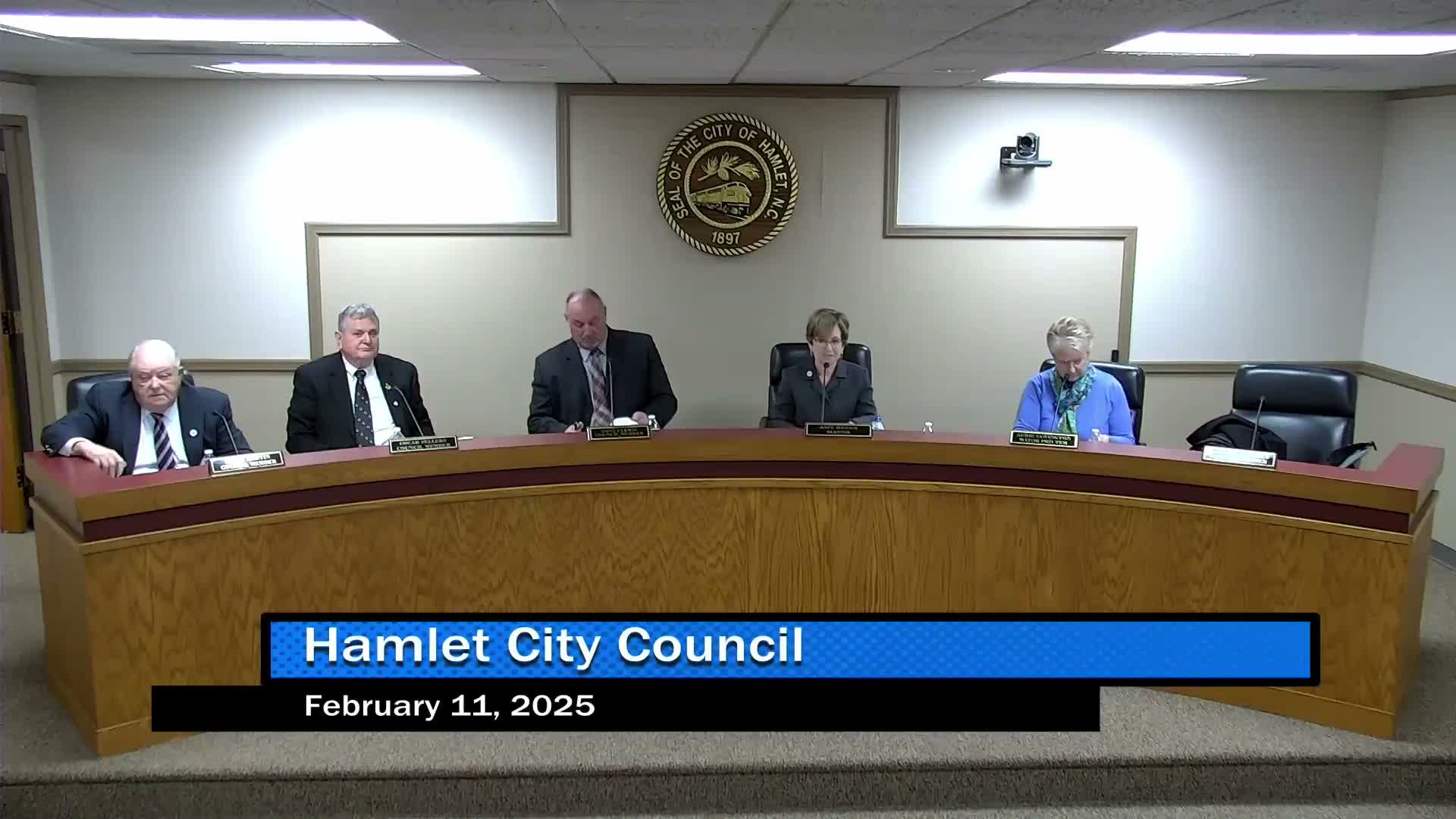
John Blasco, a landscape architect and senior project manager with Withers & Ravenel, presented a master-plan vision for Hamlet’s Main Street corridor and one block of Hamlet Avenue, saying the work aims to make downtown more pedestrian-friendly, safer and ADA‑accessible.
Blasco described a two-tiered approach: in the older, historic southern block the plan raises sidewalk elevations to match storefront entrances and creates a wide walking zone and seating area, while farther north the design allows for angled parking, intersection bump-outs and street trees. “What we have here is a lot of angled parking,” Blasco said. “People didn’t like parallel parking. They wanted angled parking,” and the design balances parking trade-offs against pedestrian space and accessibility. He added, “We’re probably in the 4 to 4 and a half million dollar range for the entirety of the plan.”
The plan is a master plan — Blasco emphasized it’s a vision rather than construction documents — and he urged careful design development to avoid involving the state Department of Transportation except where necessary. He outlined block-by-block phasing as a practical way to reduce immediate cost pressures: “You could focus on a block at a time,” he said.
Blasco also summarized potential funding sources, including USDA community facilities loans/grants, rural business development grants, Federal Highway Administration programs such as Safe Streets and Roads for All, the Active Transportation Infrastructure Investment Program (ATIP), and North Carolina Main Street program funds. He said many grants require a local match and that a grant strategy would likely pair CIP dollars with competitive grants.
Council members asked about trade-offs between angled and parallel parking, tree species that avoid root-lift problems, long‑term maintenance of pavers and benches, and whether the firm had completed similar work in other small downtowns; Blasco cited recent projects in Four Oaks and Wendell and noted that some measures (tree soils, specialized pavers) increase upfront cost but reduce long‑term damage.
Next steps: Blasco offered to provide follow-up cost edits he was awaiting from a third‑party estimator and to share the funding-team’s email summary with city staff. Council members did not take an implementation vote at the meeting; staff said the presentation will be used to inform CIP discussions and potential grant applications.
Blasco described a two-tiered approach: in the older, historic southern block the plan raises sidewalk elevations to match storefront entrances and creates a wide walking zone and seating area, while farther north the design allows for angled parking, intersection bump-outs and street trees. “What we have here is a lot of angled parking,” Blasco said. “People didn’t like parallel parking. They wanted angled parking,” and the design balances parking trade-offs against pedestrian space and accessibility. He added, “We’re probably in the 4 to 4 and a half million dollar range for the entirety of the plan.”
The plan is a master plan — Blasco emphasized it’s a vision rather than construction documents — and he urged careful design development to avoid involving the state Department of Transportation except where necessary. He outlined block-by-block phasing as a practical way to reduce immediate cost pressures: “You could focus on a block at a time,” he said.
Blasco also summarized potential funding sources, including USDA community facilities loans/grants, rural business development grants, Federal Highway Administration programs such as Safe Streets and Roads for All, the Active Transportation Infrastructure Investment Program (ATIP), and North Carolina Main Street program funds. He said many grants require a local match and that a grant strategy would likely pair CIP dollars with competitive grants.
Council members asked about trade-offs between angled and parallel parking, tree species that avoid root-lift problems, long‑term maintenance of pavers and benches, and whether the firm had completed similar work in other small downtowns; Blasco cited recent projects in Four Oaks and Wendell and noted that some measures (tree soils, specialized pavers) increase upfront cost but reduce long‑term damage.
Next steps: Blasco offered to provide follow-up cost edits he was awaiting from a third‑party estimator and to share the funding-team’s email summary with city staff. Council members did not take an implementation vote at the meeting; staff said the presentation will be used to inform CIP discussions and potential grant applications.
Don't Miss a Word: See the Full Meeting!
Go beyond summaries. Unlock every video, transcript, and key insight with a Founder Membership.
✓
Get instant access to full meeting videos
✓
Search and clip any phrase from complete transcripts
✓
Receive AI-powered summaries & custom alerts
✓
Enjoy lifetime, unrestricted access to government data
30-day money-back guarantee
