Charter Revision commissioners weigh putting New Canaan Planning & Zoning election to voters
March 02, 2026 | New Canaan, Fairfield, Connecticut
This article was created by AI summarizing key points discussed. AI makes mistakes, so for full details and context, please refer to the video of the full meeting. Please report any errors so we can fix them. Report an error »
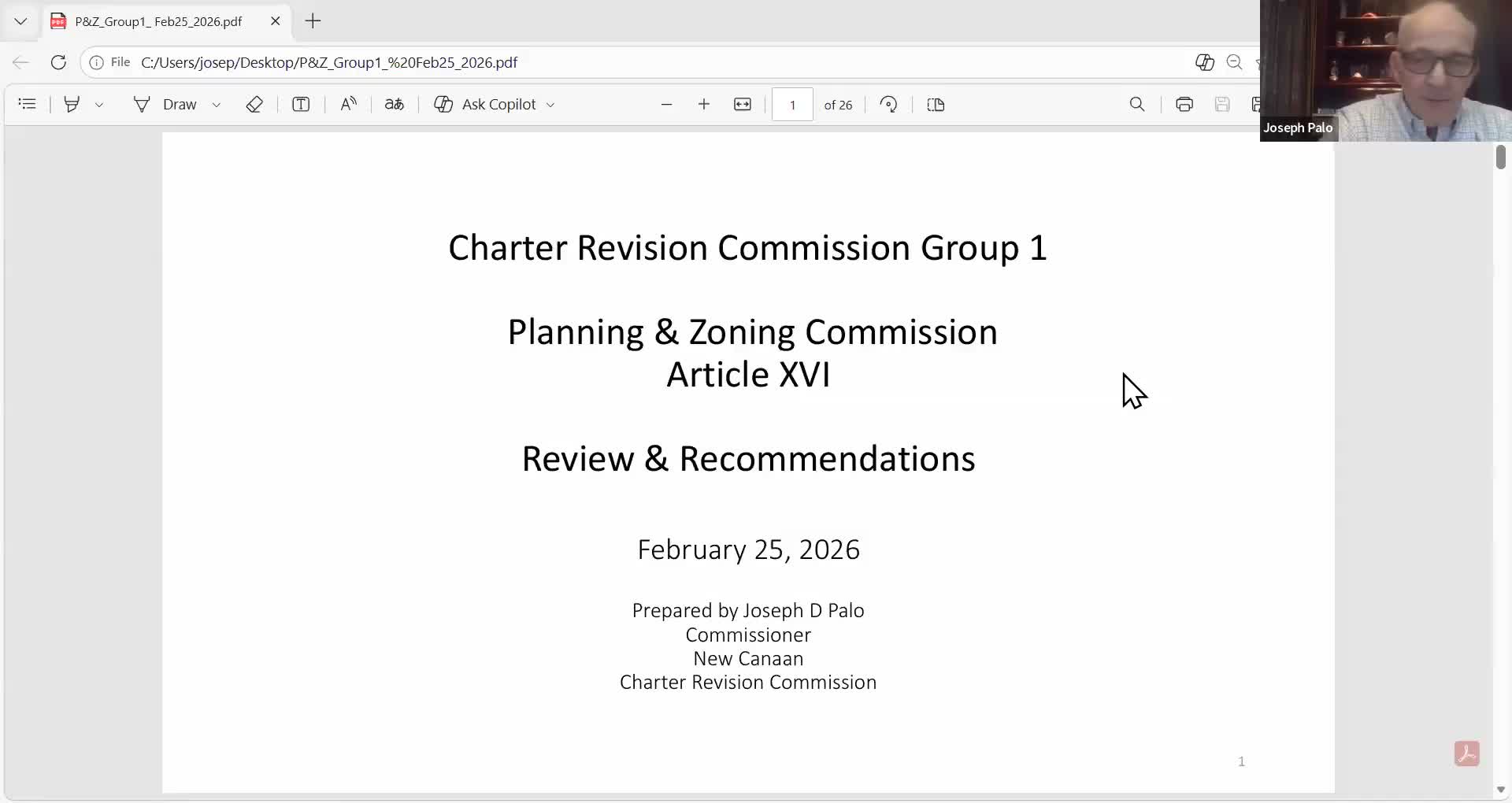
Joseph Paolo, Chair of Group 1 of the Charter Revision Commission, opened a March 2 special meeting and reviewed materials on whether New Canaan’s Planning and Zoning Commission (PNZ) should remain appointed, become elected or move to a mixed model. Paolo said he would recommend in the Commission’s draft May 4 report that the town council put the question to voters.
Paolo summarized outreach conducted since November — “30 to 40 interviews,” written public comments and an online survey — and described the central question: “should PNZ remain appointed or be elected? And who should make that decision?” He said he used PNZ’s January 16 letter as a working model for the appointed-case arguments and laid out countervailing data and examples for the elected option.
Citing PNZ’s letter, Paolo said the appointed model allows the town to “intentionally curate” a commission with professional expertise and argued PNZ believes appointment reduces political pressure and improves legal defensibility of land-use decisions. Paolo also presented an inventory (submitted to the record by Jennifer Holmes) that found PNZ currently meets about 50% of a six-skill-set aspiration that PNZ had identified, and compared New Canaan to nearby benchmark towns to argue an elected body could similarly meet skill targets.
Commissioner Steve Case raised a separate concern: some residents, particularly those in certain careers, might be precluded from running for elective office because of employment or regulatory constraints. Case said he would review whether career restrictions could reduce the pool of eligible candidates — an argument in favor of appointment that Paolo said merited further study.
Paolo gave an example to illustrate scope and stakes: he cited page 59 of the town’s Plan of Conservation and Development (POCD), saying the document opens the door to green-energy standards beyond solar — including wind — and noted that typical wind towers can average about 340 feet and may require FAA lighting if taller than 200 feet. Paolo said that if PNZ or regulators adopted mandatory standards, appointed commissioners would make those decisions without direct voter control, and that was one reason to consider letting voters decide the PNZ selection method.
On early outreach results, Paolo said initial survey responses showed PNZ as the top area for change (38% of early respondents). He encouraged wider public engagement through an upcoming postcard and the online survey; Case also urged residents to participate.
On options, Paolo said the case for keeping PNZ appointed was “mostly anecdotal” and in some respects contradicted by the data he presented, while the case for an elected PNZ was “strongly supported by the data.” He said he would recommend the Commission advise the town council to submit the question to voters. Case and Paolo also discussed a hybrid or mixed board (part elected, part appointed); both said they were open to exploring that structure if legal and procedural issues could be solved.
The meeting ended with a motion to close, which was moved and seconded; Steve Case voiced “Aye,” and Paolo declared the meeting closed.
Why it matters: The Commission’s recommendation to ask voters would shift the decision on how planning and zoning commissioners are selected from appointed bodies to either the town council or the electorate, changing how land-use decisions are vetted and who is accountable for zoning standards. The Commission’s May 4 draft report will be the next procedural step.
Sources: Proceedings of the Charter Revision Commission, Group 1 special meeting, March 2, 2026; speakers: Joseph Paolo (Chair) and Commissioner Steve Case.
Paolo summarized outreach conducted since November — “30 to 40 interviews,” written public comments and an online survey — and described the central question: “should PNZ remain appointed or be elected? And who should make that decision?” He said he used PNZ’s January 16 letter as a working model for the appointed-case arguments and laid out countervailing data and examples for the elected option.
Citing PNZ’s letter, Paolo said the appointed model allows the town to “intentionally curate” a commission with professional expertise and argued PNZ believes appointment reduces political pressure and improves legal defensibility of land-use decisions. Paolo also presented an inventory (submitted to the record by Jennifer Holmes) that found PNZ currently meets about 50% of a six-skill-set aspiration that PNZ had identified, and compared New Canaan to nearby benchmark towns to argue an elected body could similarly meet skill targets.
Commissioner Steve Case raised a separate concern: some residents, particularly those in certain careers, might be precluded from running for elective office because of employment or regulatory constraints. Case said he would review whether career restrictions could reduce the pool of eligible candidates — an argument in favor of appointment that Paolo said merited further study.
Paolo gave an example to illustrate scope and stakes: he cited page 59 of the town’s Plan of Conservation and Development (POCD), saying the document opens the door to green-energy standards beyond solar — including wind — and noted that typical wind towers can average about 340 feet and may require FAA lighting if taller than 200 feet. Paolo said that if PNZ or regulators adopted mandatory standards, appointed commissioners would make those decisions without direct voter control, and that was one reason to consider letting voters decide the PNZ selection method.
On early outreach results, Paolo said initial survey responses showed PNZ as the top area for change (38% of early respondents). He encouraged wider public engagement through an upcoming postcard and the online survey; Case also urged residents to participate.
On options, Paolo said the case for keeping PNZ appointed was “mostly anecdotal” and in some respects contradicted by the data he presented, while the case for an elected PNZ was “strongly supported by the data.” He said he would recommend the Commission advise the town council to submit the question to voters. Case and Paolo also discussed a hybrid or mixed board (part elected, part appointed); both said they were open to exploring that structure if legal and procedural issues could be solved.
The meeting ended with a motion to close, which was moved and seconded; Steve Case voiced “Aye,” and Paolo declared the meeting closed.
Why it matters: The Commission’s recommendation to ask voters would shift the decision on how planning and zoning commissioners are selected from appointed bodies to either the town council or the electorate, changing how land-use decisions are vetted and who is accountable for zoning standards. The Commission’s May 4 draft report will be the next procedural step.
Sources: Proceedings of the Charter Revision Commission, Group 1 special meeting, March 2, 2026; speakers: Joseph Paolo (Chair) and Commissioner Steve Case.
View the Full Meeting & All Its Details
This article offers just a summary. Unlock complete video, transcripts, and insights as a Founder Member.
✓
Watch full, unedited meeting videos
✓
Search every word spoken in unlimited transcripts
✓
AI summaries & real-time alerts (all government levels)
✓
Permanent access to expanding government content
30-day money-back guarantee
