Washington Supreme Court hears dispute over whether Ecology's denial letter imposed an unadopted nutrient rule
May 30, 2024 | Supreme Court, Judicial , Washington
This article was created by AI summarizing key points discussed. AI makes mistakes, so for full details and context, please refer to the video of the full meeting. Please report any errors so we can fix them. Report an error »
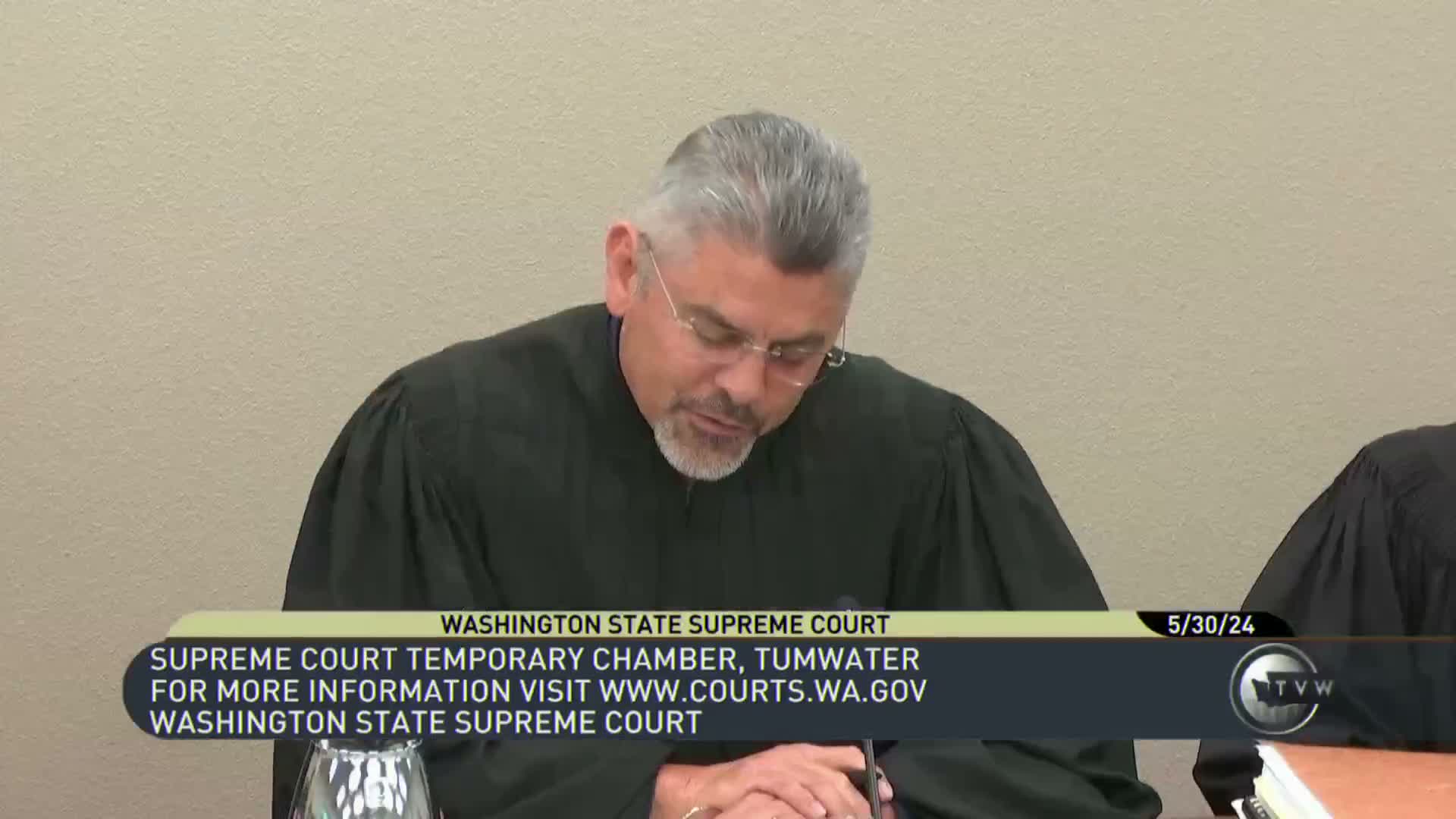
The Washington Supreme Court heard argument May 30 over whether a January 2019 letter from the Department of Ecology — which committed that Ecology “would set nutrient loading levels for Puget Sound municipalities to prevent the pollution problem from getting worse” — constituted a rule that required formal rulemaking under the state Administrative Procedure Act.
In opening, Ron Levine, senior counsel for the Department of Ecology, told the court the Court of Appeals erred on three points and urged reversal. Levine said the agency’s statement in the denial letter was explanatory and left room for agency discretion, noting that “the statement did not say what nutrients would be regulated” and that different permits afterward regulated different nutrients. He argued that an agency action is a rule only when it is binding on the regulated community and restricts agency discretion, and he asked the justices to resolve a conflict between divisions of the Court of Appeals about that test.
Why it matters: Respondent permittees say the January letter functioned as a de facto rule and was implemented in subsequent permits, affecting planning and capital investment. Counsel for the respondents asked the court to affirm lower courts’ findings that the annual nutrient loading limits in the January 11, 2019 letter “constitute a rule that have not gone through rulemaking.” They warned the court that the adoption of such a rule outside the APA “has enormous impacts that ripple through the operation of those facilities and also the municipal functions that rely on the essential services that wastewater treatment plants provide.”
A central legal question before the justices was how to apply the multi-part test from Northwest Pulp and Paper and related precedents to decide whether an agency statement is a rule. One justice framed the issue this way: if both sides accept the same two-part framework, but different appellate panels applied it differently, does the Supreme Court need to clarify the proper analysis? Levine urged the court to reaffirm the requirement that agency action be binding on the regulated community to qualify as a rule.
Economic and procedural consequences were pressed by the bench. One justice cited an estimate that the new permitting restrictions might cost $750,000,000 in capital investment over the permit term and asked where such projected costs fit into the legal analysis. Levine responded that the ultimate cost of addressing nutrient pollution is unknown and that the denial letter itself “isn’t requiring anyone to invest anything” because it committed only that, as permits are reissued, Ecology would set loading levels at current levels.
Both sides discussed the relationship between the general Puget Sound nutrient permit (which was on appeal to the Pollution Control Hearings Board) and individual NPDES permit reissues. Levine said the general permit uses “action levels” for total inorganic nitrogen that vary by discharge and trigger follow-up steps if exceeded, rather than imposing a single hard numeric effluent limit on all facilities. He emphasized that draft permits undergo public notice and comment and are appealable, meaning the permit process itself involves public participation and review.
Respondent counsel argued the record shows Ecology implemented the letter’s commitment across multiple permits and that permit writers perceived the directive as nondiscretionary. Counsel framed the harm as immediate: municipal permittees plan and fund utilities on a long-term basis, and a centrally announced annual loading cap effectively “freezes” allowable discharges and can constrain development and housing projects in growing Puget Sound communities.
Levine reiterated in rebuttal that Ecology’s denial letter did not create new legal obligations but described how Ecology would exercise existing state and federal water pollution authority. He said individual permits still require calculations and permit writers retain discretion over what nutrients and numeric values apply; those permit determinations proceed through notice-and-comment and appeal channels, and those administrative processes are the appropriate venues to test technical and factual implementations.
What happens next: The arguments were submitted and the court recessed. The transcript does not record a decision; the justices will confer and issue a written opinion resolving whether the letter was a rule that required APA rulemaking and, if so, what remedy should follow.
In opening, Ron Levine, senior counsel for the Department of Ecology, told the court the Court of Appeals erred on three points and urged reversal. Levine said the agency’s statement in the denial letter was explanatory and left room for agency discretion, noting that “the statement did not say what nutrients would be regulated” and that different permits afterward regulated different nutrients. He argued that an agency action is a rule only when it is binding on the regulated community and restricts agency discretion, and he asked the justices to resolve a conflict between divisions of the Court of Appeals about that test.
Why it matters: Respondent permittees say the January letter functioned as a de facto rule and was implemented in subsequent permits, affecting planning and capital investment. Counsel for the respondents asked the court to affirm lower courts’ findings that the annual nutrient loading limits in the January 11, 2019 letter “constitute a rule that have not gone through rulemaking.” They warned the court that the adoption of such a rule outside the APA “has enormous impacts that ripple through the operation of those facilities and also the municipal functions that rely on the essential services that wastewater treatment plants provide.”
A central legal question before the justices was how to apply the multi-part test from Northwest Pulp and Paper and related precedents to decide whether an agency statement is a rule. One justice framed the issue this way: if both sides accept the same two-part framework, but different appellate panels applied it differently, does the Supreme Court need to clarify the proper analysis? Levine urged the court to reaffirm the requirement that agency action be binding on the regulated community to qualify as a rule.
Economic and procedural consequences were pressed by the bench. One justice cited an estimate that the new permitting restrictions might cost $750,000,000 in capital investment over the permit term and asked where such projected costs fit into the legal analysis. Levine responded that the ultimate cost of addressing nutrient pollution is unknown and that the denial letter itself “isn’t requiring anyone to invest anything” because it committed only that, as permits are reissued, Ecology would set loading levels at current levels.
Both sides discussed the relationship between the general Puget Sound nutrient permit (which was on appeal to the Pollution Control Hearings Board) and individual NPDES permit reissues. Levine said the general permit uses “action levels” for total inorganic nitrogen that vary by discharge and trigger follow-up steps if exceeded, rather than imposing a single hard numeric effluent limit on all facilities. He emphasized that draft permits undergo public notice and comment and are appealable, meaning the permit process itself involves public participation and review.
Respondent counsel argued the record shows Ecology implemented the letter’s commitment across multiple permits and that permit writers perceived the directive as nondiscretionary. Counsel framed the harm as immediate: municipal permittees plan and fund utilities on a long-term basis, and a centrally announced annual loading cap effectively “freezes” allowable discharges and can constrain development and housing projects in growing Puget Sound communities.
Levine reiterated in rebuttal that Ecology’s denial letter did not create new legal obligations but described how Ecology would exercise existing state and federal water pollution authority. He said individual permits still require calculations and permit writers retain discretion over what nutrients and numeric values apply; those permit determinations proceed through notice-and-comment and appeal channels, and those administrative processes are the appropriate venues to test technical and factual implementations.
What happens next: The arguments were submitted and the court recessed. The transcript does not record a decision; the justices will confer and issue a written opinion resolving whether the letter was a rule that required APA rulemaking and, if so, what remedy should follow.
View the Full Meeting & All Its Details
This article offers just a summary. Unlock complete video, transcripts, and insights as a Founder Member.
✓
Watch full, unedited meeting videos
✓
Search every word spoken in unlimited transcripts
✓
AI summaries & real-time alerts (all government levels)
✓
Permanent access to expanding government content
30-day money-back guarantee
