Washington Supreme Court hears arguments in Old Mill Village eviction dispute
May 29, 2024 | Supreme Court, Judicial , Washington
This article was created by AI summarizing key points discussed. AI makes mistakes, so for full details and context, please refer to the video of the full meeting. Please report any errors so we can fix them. Report an error »
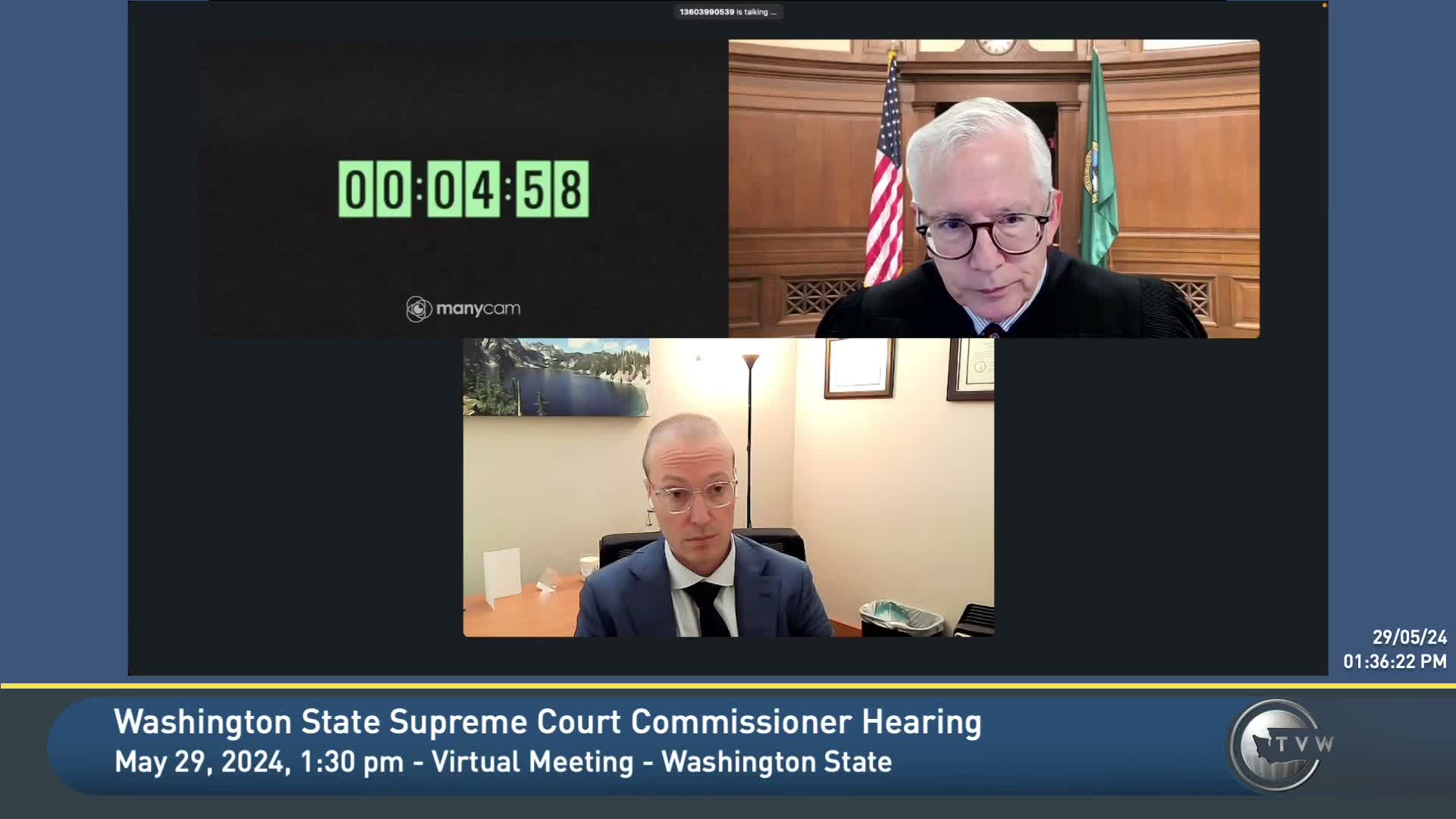
The Washington Supreme Court heard oral argument on a petition for discretionary review in the eviction case MF Old Mill Village LLC v. Susan Tosh on Tuesday, with Commissioner Michael Johnston presiding.
Petitioner Susan Tosh, identified herself as a PhD hydrologist and told the court the eviction, framed as an unlawful detainer, is part of “a long documented history of discrimination and retaliation” against her. Tosh said she had submitted more than 40 pages of evidence and asked the court to order respondents to return her home and belongings, award restitution and sanctions, and correct the record: “I am asking this court to order respondents to immediately return to me my home or provide a like residence with similar or better amenities,” she told the court.
Tosh also alleged a range of misconduct by respondents that she said affected habitability and public health, including pollution and withholding of personal and medical property. Those claims were presented as allegations and were not litigated to a factual finding in the hearing.
Respondent counsel Connor Sapp, who said he represents MF Old Mill Village and Peak Management, told the court the writ of restitution at issue was lawfully executed more than seven months ago and that the matter currently before the court is only whether it should accept discretionary review of a Court of Appeals decision. “The writ has been executed for over seven months,” Sapp said, arguing petitioner had not posted the supersedeas bond required to stay a writ of restitution and that the Court of Appeals therefore properly denied emergency relief.
Sapp cited the standards for discretionary review and pointed to appellate procedure governing when the Supreme Court should accept a discretionary petition. He also asked the court to consider attorney fees and sanctions under appellate rules; Commissioner Johnston said those provisions apply to different filings and indicated he was disinclined to award fees on the record before him.
Commissioner Johnston clarified procedural points, including that only parties or counsel may speak during oral argument, explained the time allocation for each side, and told the parties he would issue a ruling on the motion expeditiously. “I will get to work on a ruling,” he said, and asked the parties to expect further notice soon.
The court took the petition for discretionary review under advisement and did not issue a decision at the hearing. The Court of Appeals proceeding on the underlying matter remains pending, and Tosh’s counsel has an extension to file an opening brief in that forum.
Petitioner Susan Tosh, identified herself as a PhD hydrologist and told the court the eviction, framed as an unlawful detainer, is part of “a long documented history of discrimination and retaliation” against her. Tosh said she had submitted more than 40 pages of evidence and asked the court to order respondents to return her home and belongings, award restitution and sanctions, and correct the record: “I am asking this court to order respondents to immediately return to me my home or provide a like residence with similar or better amenities,” she told the court.
Tosh also alleged a range of misconduct by respondents that she said affected habitability and public health, including pollution and withholding of personal and medical property. Those claims were presented as allegations and were not litigated to a factual finding in the hearing.
Respondent counsel Connor Sapp, who said he represents MF Old Mill Village and Peak Management, told the court the writ of restitution at issue was lawfully executed more than seven months ago and that the matter currently before the court is only whether it should accept discretionary review of a Court of Appeals decision. “The writ has been executed for over seven months,” Sapp said, arguing petitioner had not posted the supersedeas bond required to stay a writ of restitution and that the Court of Appeals therefore properly denied emergency relief.
Sapp cited the standards for discretionary review and pointed to appellate procedure governing when the Supreme Court should accept a discretionary petition. He also asked the court to consider attorney fees and sanctions under appellate rules; Commissioner Johnston said those provisions apply to different filings and indicated he was disinclined to award fees on the record before him.
Commissioner Johnston clarified procedural points, including that only parties or counsel may speak during oral argument, explained the time allocation for each side, and told the parties he would issue a ruling on the motion expeditiously. “I will get to work on a ruling,” he said, and asked the parties to expect further notice soon.
The court took the petition for discretionary review under advisement and did not issue a decision at the hearing. The Court of Appeals proceeding on the underlying matter remains pending, and Tosh’s counsel has an extension to file an opening brief in that forum.
View the Full Meeting & All Its Details
This article offers just a summary. Unlock complete video, transcripts, and insights as a Founder Member.
✓
Watch full, unedited meeting videos
✓
Search every word spoken in unlimited transcripts
✓
AI summaries & real-time alerts (all government levels)
✓
Permanent access to expanding government content
30-day money-back guarantee
