Petitioner urges resentencing, saying brain-development research undermines 1989 aggravators
May 28, 2024 | Supreme Court, Judicial , Washington
This article was created by AI summarizing key points discussed. AI makes mistakes, so for full details and context, please refer to the video of the full meeting. Please report any errors so we can fix them. Report an error »
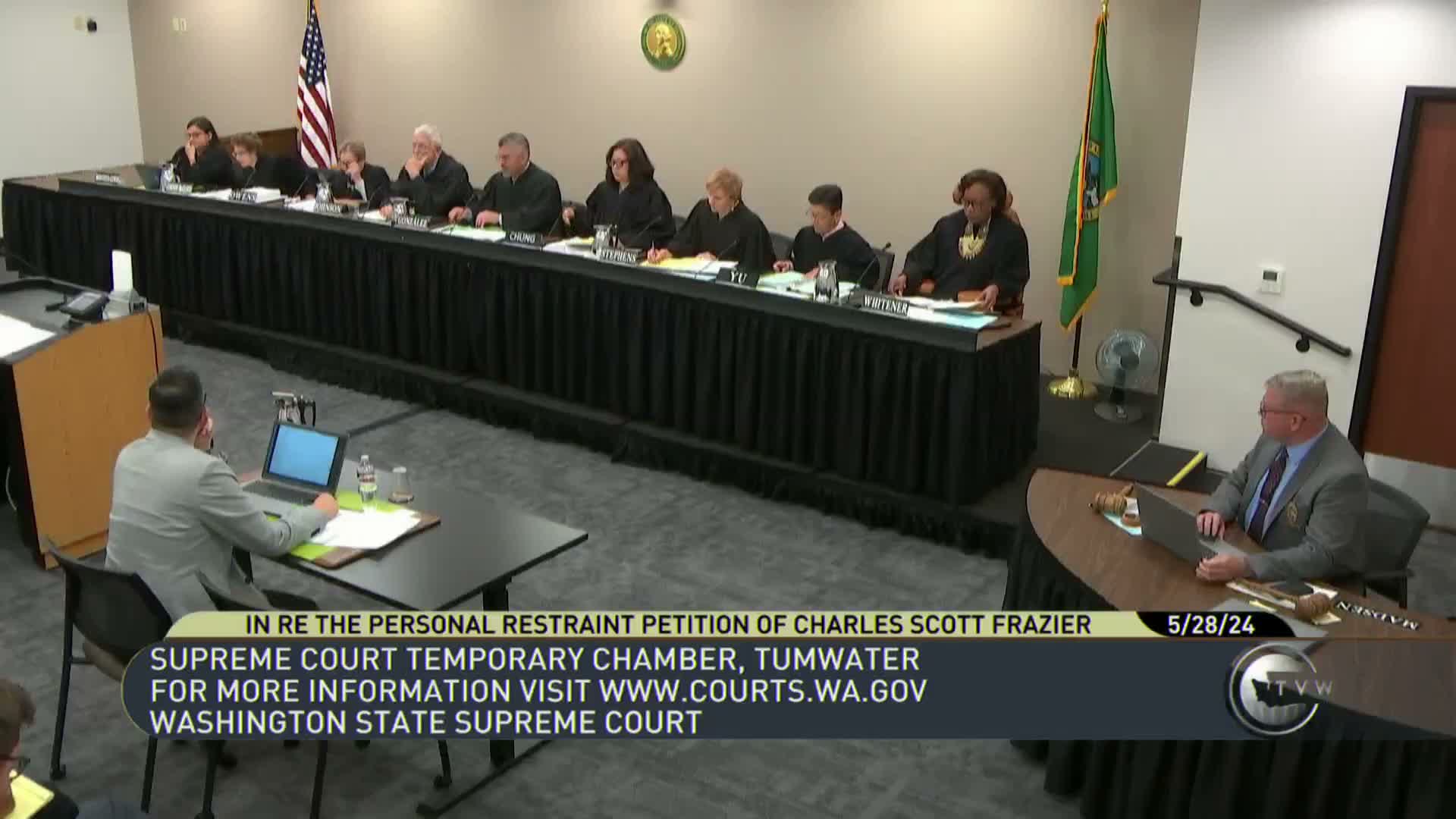
Nancy Collins, counsel for petitioner Charles Frasier, told the Washington Supreme Court on May 28, 2024, that brain-imaging studies unavailable in 1989 now show adolescents’ executive functioning remains under development and that this scientific change undercuts the trial court’s finding that Frasier’s age was an aggravating factor supporting an exceptional sentence. "This brain imaging test didn't exist in 1989," Collins said during argument in Tumwater.
Collins asked the court to treat the modern science as "newly discovered evidence" that can apply to sentencing and to rule that Frasier is entitled to a new sentencing hearing. She noted the petitioner filed a personal restraint petition in 2018 and argued the diligence clock should be measured from when the scientific understanding reached general acceptance, citing Odell and related authority as temporal markers the court should consider.
The state, represented by Randall Sutton, disputed the framing. Sutton urged the court to view the matter as a legal and policy evolution rather than newly discovered factual evidence specific to Frasier’s case. "The sentence in this case was supported by the abuse of trust and the unusual cruelty of the crime," Sutton said, arguing those factual findings independently justified the exceptional sentence.
Justices pressed both sides on two threshold questions: whether the newly discovered evidence statutory prong (RCW 10.73.100) applies to sentencing as well as guilt-phase facts, and when the reasonable-diligence clock begins for a collateral challenge based on evolving scientific understanding. Collins argued the statute does not restrict the newly discovered evidence prong to guilt-phase claims and pointed to a line of state cases (Lord, Brown, Jefferies, Kennedy) that have permitted newly discovered evidence claims affecting sentencing. Counsel acknowledged some companion opinions (Davis) contain language suggesting limits but said Davis did not categorically bar sentencing claims.
On timing, the court and counsel debated whether the relevant date is the publication of early studies (Collins said studies appear as early as 2004) or when the scientific community more broadly accepted the findings (Collins suggested the Odell decision as an earliest practical marker for an incarcerated petitioner who lacked access to legal resources). Collins emphasized petitioner Frasier’s circumstances — long incarceration, limited resources, and documented intellectual and educational limitations — when arguing for a later diligence start date; she noted Frasier filed a PRP in 2018 that cited Odell-related authority.
Justices also probed whether the trial court’s written findings (some of which the Court of Appeals later reversed as aggravators) left a record that could show the brain science would have produced a different outcome. Several justices asked whether the remaining aggravators (the court of appeals left deliberate cruelty and abuse of position of trust) independently support the exceptional sentence and whether assumptions about youth might have infected other factual findings. The state argued the record reflects a particularly horrific crime — the son set his father on fire in the father's home — and that the judge’s reaction to those facts explains the exceptional sentence.
The court exchanged questions about the evidentiary nature of the defense’s submission: whether the change is properly characterized as newly discovered, case-specific evidence (for example, expert testimony or psychological and JRA records that predate sentencing) or as an evolution in constitutional or statutory sentencing law (the latter being a legal-change claim). Collins pointed to psychological testing and juvenile records assembled for the PRP that she said document Frasier’s condition contemporaneous to the offense; the state responded that much of the factual detail was already in the presentence report and that the defense has the burden to prove newly discovered evidence after a decades-old record.
Both sides were given full time for argument and rebuttal; after brief rebuttal from Collins, the court submitted the case and adjourned without announcing a decision.
The court’s questions focused on legal thresholds the justices must resolve: whether RCW 10.73.100’s newly discovered evidence exception can reopen sentencing, what temporal marker satisfies reasonable diligence for incarcerated petitioners, and whether the existing record plus modern brain science would make it reasonably probable the sentencing judge would have imposed a lesser sentence. The case is submitted.
Collins asked the court to treat the modern science as "newly discovered evidence" that can apply to sentencing and to rule that Frasier is entitled to a new sentencing hearing. She noted the petitioner filed a personal restraint petition in 2018 and argued the diligence clock should be measured from when the scientific understanding reached general acceptance, citing Odell and related authority as temporal markers the court should consider.
The state, represented by Randall Sutton, disputed the framing. Sutton urged the court to view the matter as a legal and policy evolution rather than newly discovered factual evidence specific to Frasier’s case. "The sentence in this case was supported by the abuse of trust and the unusual cruelty of the crime," Sutton said, arguing those factual findings independently justified the exceptional sentence.
Justices pressed both sides on two threshold questions: whether the newly discovered evidence statutory prong (RCW 10.73.100) applies to sentencing as well as guilt-phase facts, and when the reasonable-diligence clock begins for a collateral challenge based on evolving scientific understanding. Collins argued the statute does not restrict the newly discovered evidence prong to guilt-phase claims and pointed to a line of state cases (Lord, Brown, Jefferies, Kennedy) that have permitted newly discovered evidence claims affecting sentencing. Counsel acknowledged some companion opinions (Davis) contain language suggesting limits but said Davis did not categorically bar sentencing claims.
On timing, the court and counsel debated whether the relevant date is the publication of early studies (Collins said studies appear as early as 2004) or when the scientific community more broadly accepted the findings (Collins suggested the Odell decision as an earliest practical marker for an incarcerated petitioner who lacked access to legal resources). Collins emphasized petitioner Frasier’s circumstances — long incarceration, limited resources, and documented intellectual and educational limitations — when arguing for a later diligence start date; she noted Frasier filed a PRP in 2018 that cited Odell-related authority.
Justices also probed whether the trial court’s written findings (some of which the Court of Appeals later reversed as aggravators) left a record that could show the brain science would have produced a different outcome. Several justices asked whether the remaining aggravators (the court of appeals left deliberate cruelty and abuse of position of trust) independently support the exceptional sentence and whether assumptions about youth might have infected other factual findings. The state argued the record reflects a particularly horrific crime — the son set his father on fire in the father's home — and that the judge’s reaction to those facts explains the exceptional sentence.
The court exchanged questions about the evidentiary nature of the defense’s submission: whether the change is properly characterized as newly discovered, case-specific evidence (for example, expert testimony or psychological and JRA records that predate sentencing) or as an evolution in constitutional or statutory sentencing law (the latter being a legal-change claim). Collins pointed to psychological testing and juvenile records assembled for the PRP that she said document Frasier’s condition contemporaneous to the offense; the state responded that much of the factual detail was already in the presentence report and that the defense has the burden to prove newly discovered evidence after a decades-old record.
Both sides were given full time for argument and rebuttal; after brief rebuttal from Collins, the court submitted the case and adjourned without announcing a decision.
The court’s questions focused on legal thresholds the justices must resolve: whether RCW 10.73.100’s newly discovered evidence exception can reopen sentencing, what temporal marker satisfies reasonable diligence for incarcerated petitioners, and whether the existing record plus modern brain science would make it reasonably probable the sentencing judge would have imposed a lesser sentence. The case is submitted.
Don't Miss a Word: See the Full Meeting!
Go beyond summaries. Unlock every video, transcript, and key insight with a Founder Membership.
✓
Get instant access to full meeting videos
✓
Search and clip any phrase from complete transcripts
✓
Receive AI-powered summaries & custom alerts
✓
Enjoy lifetime, unrestricted access to government data
30-day money-back guarantee
