Washington Supreme Court hears argument on long-term spousal maintenance in Wilcox matter
May 16, 2024 | Supreme Court, Judicial , Washington
This article was created by AI summarizing key points discussed. AI makes mistakes, so for full details and context, please refer to the video of the full meeting. Please report any errors so we can fix them. Report an error »
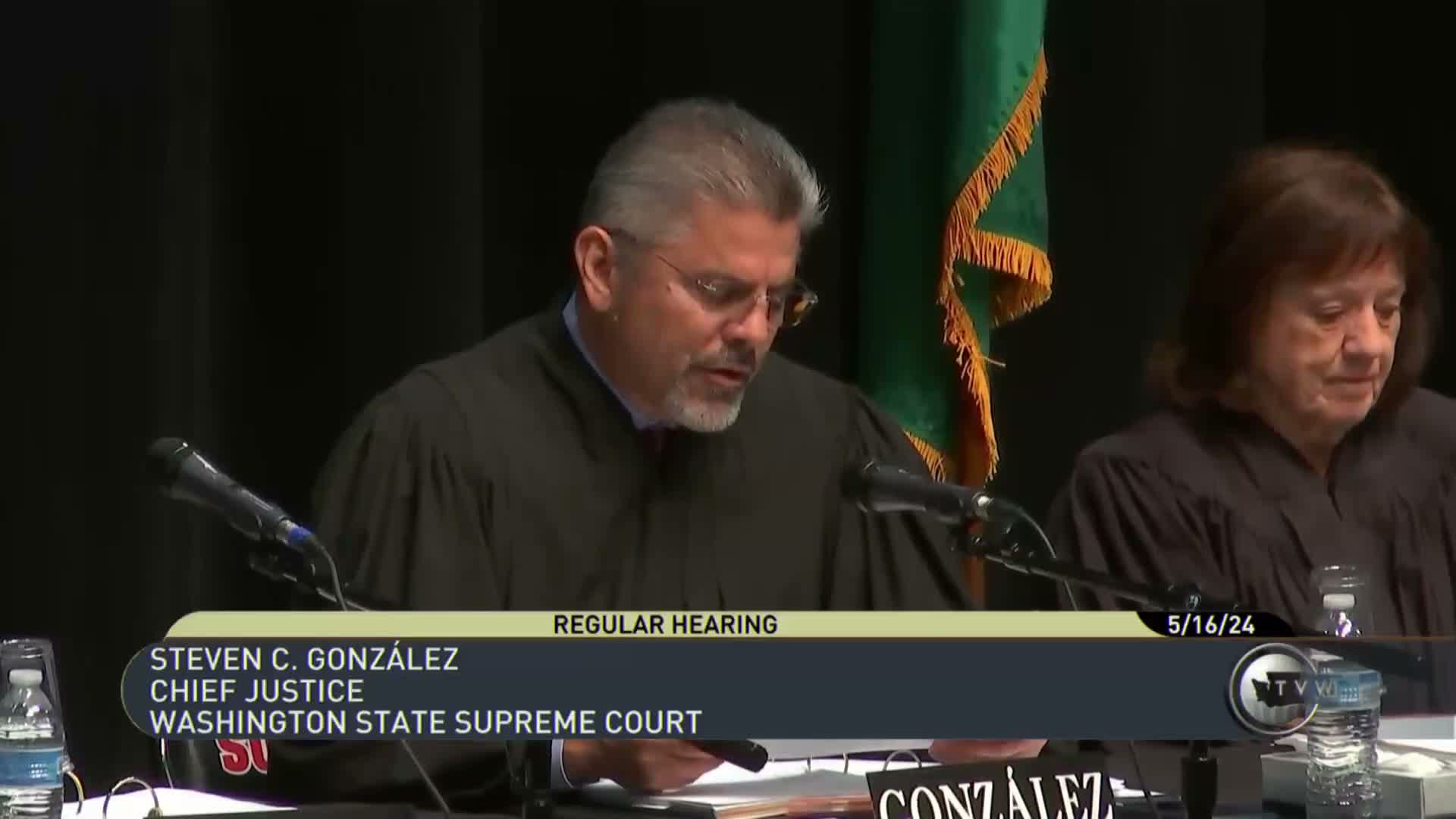
The Washington Supreme Court heard argument on May 16, 2024, over a spousal maintenance award in a dissolution case that counsel for the petitioner said functionally equalized the parties’ future incomes.
Petitioner’s attorney Aaron Orheim told the court the trial court’s remand order resulted in an award that ‘‘equalize[d] the future incomes of spouses after a 20 year marriage for the rest of their working lives,’’ which he described as a results‑oriented decision untethered to statutory factors. Orheim said the record showed the wife had already received the family home, retirement accounts and other assets and that she had received more than $100,000 in temporary maintenance and about $77,000 in attorney fees.
Responding, Raymond Alexander for the respondent said two central questions guided the dispute: whether maintenance can be awarded without a specific finding of need and how to reconcile conflicting case law. Alexander cited the court’s Washburn decision and the statutory framework enacted in 1973 (codified under RCW 26.09), arguing that need is one nonexclusive factor a court must consider, not necessarily a prerequisite.
Justices asked multiple questions about how the 1973 statute should be applied, whether ability to pay must be weighed, and how courts should build risk or temporal limits into maintenance awards when a spouse’s income stems from a business that may fluctuate. Counsel for the respondent pointed to precedent granting multi‑year awards in other cases (counsel referenced Valente and Kaplan) and said trial courts remain subject to modification if circumstances change.
The record, as summarized by counsel during argument, included an 11‑year maintenance award on remand, earlier temporary payments over several years, and counsel’s characterization of the remand award as totaling about $550,000 over 11 years. Counsel disputed whether maintenance here functioned as an attempt to divide the value of the business, saying the trial court considered the enumerated statutory factors and sought to equalize post‑decree economic positions where earning capacity diverged sharply.
The court’s questions focused repeatedly on the proper legal standard for reviewing maintenance awards, how to treat passive assets and future earning capacity, and the permissible duration of awards in long‑term marriages. Counsel for the petitioner asked the court to reverse; counsel for the respondent asked the court to affirm and to clarify whether Washburn remains controlling.
The court concluded oral argument and reserved its decision. No formal ruling was announced at the session.
Petitioner’s attorney Aaron Orheim told the court the trial court’s remand order resulted in an award that ‘‘equalize[d] the future incomes of spouses after a 20 year marriage for the rest of their working lives,’’ which he described as a results‑oriented decision untethered to statutory factors. Orheim said the record showed the wife had already received the family home, retirement accounts and other assets and that she had received more than $100,000 in temporary maintenance and about $77,000 in attorney fees.
Responding, Raymond Alexander for the respondent said two central questions guided the dispute: whether maintenance can be awarded without a specific finding of need and how to reconcile conflicting case law. Alexander cited the court’s Washburn decision and the statutory framework enacted in 1973 (codified under RCW 26.09), arguing that need is one nonexclusive factor a court must consider, not necessarily a prerequisite.
Justices asked multiple questions about how the 1973 statute should be applied, whether ability to pay must be weighed, and how courts should build risk or temporal limits into maintenance awards when a spouse’s income stems from a business that may fluctuate. Counsel for the respondent pointed to precedent granting multi‑year awards in other cases (counsel referenced Valente and Kaplan) and said trial courts remain subject to modification if circumstances change.
The record, as summarized by counsel during argument, included an 11‑year maintenance award on remand, earlier temporary payments over several years, and counsel’s characterization of the remand award as totaling about $550,000 over 11 years. Counsel disputed whether maintenance here functioned as an attempt to divide the value of the business, saying the trial court considered the enumerated statutory factors and sought to equalize post‑decree economic positions where earning capacity diverged sharply.
The court’s questions focused repeatedly on the proper legal standard for reviewing maintenance awards, how to treat passive assets and future earning capacity, and the permissible duration of awards in long‑term marriages. Counsel for the petitioner asked the court to reverse; counsel for the respondent asked the court to affirm and to clarify whether Washburn remains controlling.
The court concluded oral argument and reserved its decision. No formal ruling was announced at the session.
Don't Miss a Word: See the Full Meeting!
Go beyond summaries. Unlock every video, transcript, and key insight with a Founder Membership.
✓
Get instant access to full meeting videos
✓
Search and clip any phrase from complete transcripts
✓
Receive AI-powered summaries & custom alerts
✓
Enjoy lifetime, unrestricted access to government data
30-day money-back guarantee
