Board staff give 'crash course' on OSBA model policies and updates, discuss head-lice and mandatory-reporting changes
March 02, 2026 | Ontario SD 8C, School Districts, Oregon
This article was created by AI summarizing key points discussed. AI makes mistakes, so for full details and context, please refer to the video of the full meeting. Please report any errors so we can fix them. Report an error »
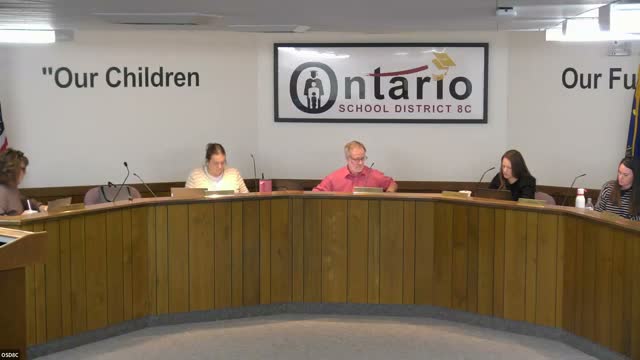
District staff provided a step-by-step explanation of the board policy process and how OSBA model policies are used as the basis for local updates.
“OSBA keeps track… they translate those into policy, and then we subscribe,” the superintendent said while walking the board through how model policies arrive and how the district reviews them. He described the three-step process: administrative review, first reading to the board, then a second reading and adoption. Staff explained administrative regulations (ARs) are the operational implementation of policy and may not always require board approval, though the district frequently brings ARs to the board for transparency.
Staff showed examples. For injury and illness reporting, the packet included OSBA markups; for board member standards the district updated language after statute made board members mandatory reporters. The superintendent noted the district chooses between model versions and applies only the changes it can staff and implement locally.
The board also discussed student-health policy. On head lice, staff said the district does not routinely exclude students for typical cases and will work with families when infestations are chronic: “You should not exclude them from school… if they have live nits and not 1, but a head full of live nits, then we are going to call the parent, work the parent to help get that cleaned up and get them back in school,” the superintendent said.
Board members asked about where to find ORS citations and policy codes; staff pointed to the packet and the board webpage where policy codes and ORS references are listed. Staff said after second reading the local policy is cleaned up and posted and OSBA’s platform is updated with the district-specific text.
What happens next: staff will continue to present recommended policy updates in future work sessions and place adoption items on business agendas when formal action is required.
“OSBA keeps track… they translate those into policy, and then we subscribe,” the superintendent said while walking the board through how model policies arrive and how the district reviews them. He described the three-step process: administrative review, first reading to the board, then a second reading and adoption. Staff explained administrative regulations (ARs) are the operational implementation of policy and may not always require board approval, though the district frequently brings ARs to the board for transparency.
Staff showed examples. For injury and illness reporting, the packet included OSBA markups; for board member standards the district updated language after statute made board members mandatory reporters. The superintendent noted the district chooses between model versions and applies only the changes it can staff and implement locally.
The board also discussed student-health policy. On head lice, staff said the district does not routinely exclude students for typical cases and will work with families when infestations are chronic: “You should not exclude them from school… if they have live nits and not 1, but a head full of live nits, then we are going to call the parent, work the parent to help get that cleaned up and get them back in school,” the superintendent said.
Board members asked about where to find ORS citations and policy codes; staff pointed to the packet and the board webpage where policy codes and ORS references are listed. Staff said after second reading the local policy is cleaned up and posted and OSBA’s platform is updated with the district-specific text.
What happens next: staff will continue to present recommended policy updates in future work sessions and place adoption items on business agendas when formal action is required.
Don't Miss a Word: See the Full Meeting!
Go beyond summaries. Unlock every video, transcript, and key insight with a Founder Membership.
✓
Get instant access to full meeting videos
✓
Search and clip any phrase from complete transcripts
✓
Receive AI-powered summaries & custom alerts
✓
Enjoy lifetime, unrestricted access to government data
30-day money-back guarantee
