Assembly select committee hears youth and advocates call to divest probation and invest in community programs
February 27, 2026 | California State Assembly, House, Legislative, California
This article was created by AI summarizing key points discussed. AI makes mistakes, so for full details and context, please refer to the video of the full meeting. Please report any errors so we can fix them. Report an error »
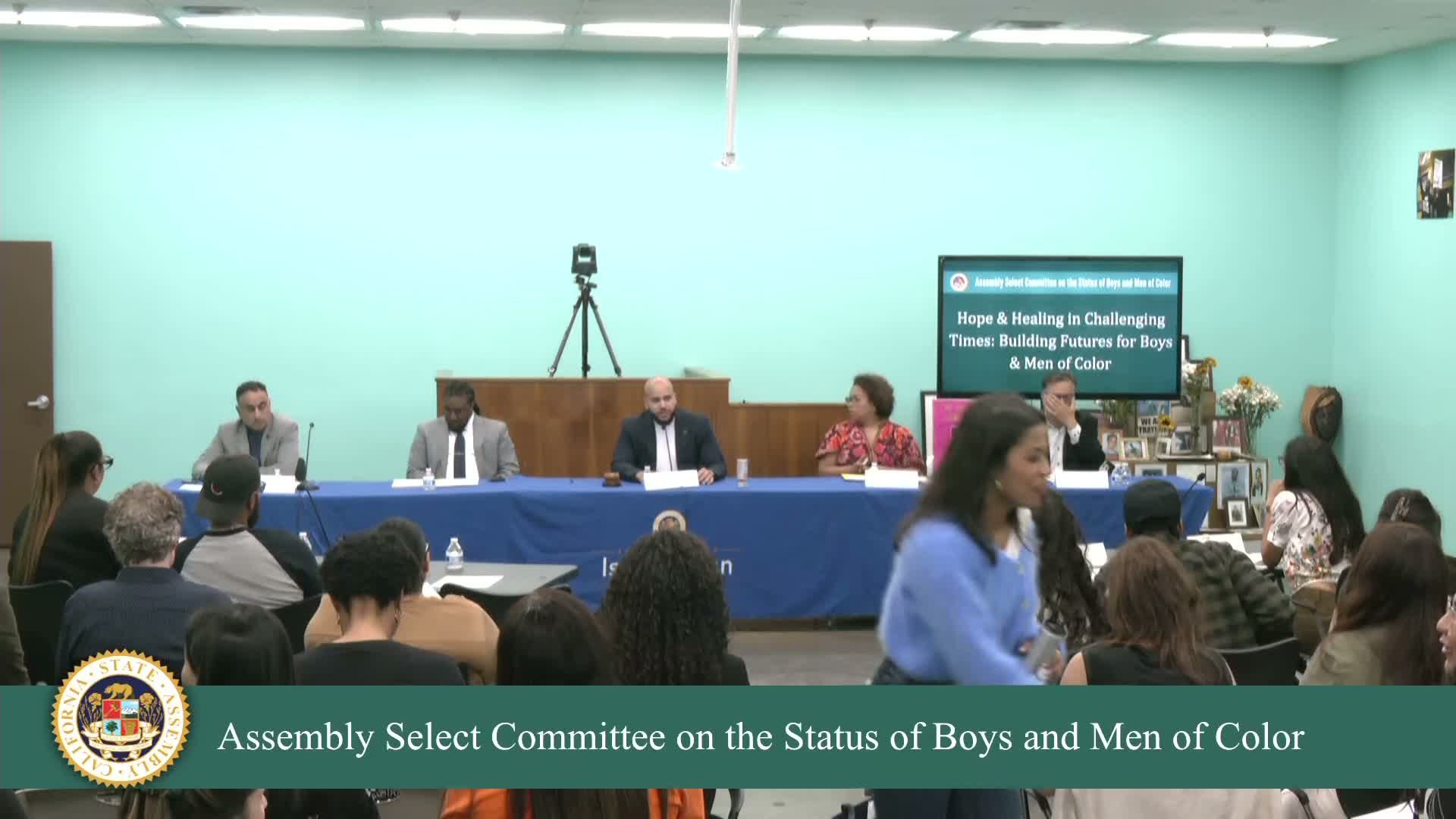
Assemblymember Isaac Bridal convened the first hearing of the Assembly Select Committee on the Status of Boys and Men of Color at a Youth Justice Coalition site, saying the committee would center "hope and healing" and that members had spent the morning meeting with young people at Los Padrinos Juvenile Hall.
Advocates and youth across three panels pressed state lawmakers to redirect resources from probation and policing to community-led services, job pathways and long-term mental-health supports. "We keep us safe, not police, not probation," said Justin Andrew Marks, co-executive director of the Youth Justice Coalition, at the start of the witness panels. Marks added that in his view the financial trade-offs are stark: "It costs over $800,000 to keep 1 youth locked up in a cell for a year." That figure was presented to illustrate advocates' argument that community investment would deliver better outcomes per dollar.
Panelists from nonprofit and advocacy organizations described local programs they said produce better results than incarceration. Joseph Williams, executive director of Students Deserve, highlighted work in Los Angeles Unified School District that sought to end criminalizing discipline and to reallocate funds: "LAUSD is 90% students of color," he said, and the district in recent years redirected $25,000,000 away from its school police department toward a Black Student Achievement Plan that funds restorative justice teachers, counselors and community partnerships. Deanna Pittman of the Young Women's Freedom Center described the "Liberation Fund" and placement alternatives for girls and gender-expansive youth.
Speakers also documented racial disproportionality and raised calls for accountability. Melinda Kakani of the California Youth Justice Project told the committee that on a recent day "273 of 282 boys in our juvenile halls were young people of color," a proportion she characterized as nearly 96%. Several speakers urged the committee to consider increased oversight of probation and state-level review where local systems fail youth.
A panel of young people described how mentorship, sponsorship and stable programs changed their lives and why they said probation often falls short. Hector "John John" Gomez of Hoops for Justice described a sponsor who "used her influence" to find an employment path that bypassed record-related barriers; Jazara Holliday recounted family separation and school exclusion that preceded her involvement in youth services; Kaylee Matthews urged that youth be placed in "high-level positions" and not only offered one-off opportunities.
Business and labor representatives said workforce pathways must be part of the solution. Kyle Patterson, speaking about apprenticeship pipelines, urged that public projects and funds prioritize local residents and that career-connected training be expanded into schools and post-release settings. Jeffrey Wallace of LeadersUp presented labor-market estimates (reported in testimony as roughly 130,000 young men of color in Los Angeles County ages 16'30 who are not in school or work) and urged one-stop systems that connect young people to internships, apprenticeships and paid work.
Committee members asked for concrete examples and next steps. The chair and several members said they would follow up on program models and funding distribution problems flagged during testimony, including concerns about county departments slow-walking community allocations from Measure J. Committee discussion also referenced state bills and recent legislation mentioned by witnesses, including AB1376 and two committee bills (recorded in the hearing as AB1646 and AB1647) and Senate Bill 357 for context.
The hearing closed with the chair thanking youth and organizers and noting that at least two pieces of legislation discussed came directly from young people the committee visited earlier in the day. No formal motions or votes were recorded during the session.
What's next: committee members asked to be contacted with program details, and the chair signaled legislative follow-up and invitations for youth to testify in Sacramento on pending bills.
Advocates and youth across three panels pressed state lawmakers to redirect resources from probation and policing to community-led services, job pathways and long-term mental-health supports. "We keep us safe, not police, not probation," said Justin Andrew Marks, co-executive director of the Youth Justice Coalition, at the start of the witness panels. Marks added that in his view the financial trade-offs are stark: "It costs over $800,000 to keep 1 youth locked up in a cell for a year." That figure was presented to illustrate advocates' argument that community investment would deliver better outcomes per dollar.
Panelists from nonprofit and advocacy organizations described local programs they said produce better results than incarceration. Joseph Williams, executive director of Students Deserve, highlighted work in Los Angeles Unified School District that sought to end criminalizing discipline and to reallocate funds: "LAUSD is 90% students of color," he said, and the district in recent years redirected $25,000,000 away from its school police department toward a Black Student Achievement Plan that funds restorative justice teachers, counselors and community partnerships. Deanna Pittman of the Young Women's Freedom Center described the "Liberation Fund" and placement alternatives for girls and gender-expansive youth.
Speakers also documented racial disproportionality and raised calls for accountability. Melinda Kakani of the California Youth Justice Project told the committee that on a recent day "273 of 282 boys in our juvenile halls were young people of color," a proportion she characterized as nearly 96%. Several speakers urged the committee to consider increased oversight of probation and state-level review where local systems fail youth.
A panel of young people described how mentorship, sponsorship and stable programs changed their lives and why they said probation often falls short. Hector "John John" Gomez of Hoops for Justice described a sponsor who "used her influence" to find an employment path that bypassed record-related barriers; Jazara Holliday recounted family separation and school exclusion that preceded her involvement in youth services; Kaylee Matthews urged that youth be placed in "high-level positions" and not only offered one-off opportunities.
Business and labor representatives said workforce pathways must be part of the solution. Kyle Patterson, speaking about apprenticeship pipelines, urged that public projects and funds prioritize local residents and that career-connected training be expanded into schools and post-release settings. Jeffrey Wallace of LeadersUp presented labor-market estimates (reported in testimony as roughly 130,000 young men of color in Los Angeles County ages 16'30 who are not in school or work) and urged one-stop systems that connect young people to internships, apprenticeships and paid work.
Committee members asked for concrete examples and next steps. The chair and several members said they would follow up on program models and funding distribution problems flagged during testimony, including concerns about county departments slow-walking community allocations from Measure J. Committee discussion also referenced state bills and recent legislation mentioned by witnesses, including AB1376 and two committee bills (recorded in the hearing as AB1646 and AB1647) and Senate Bill 357 for context.
The hearing closed with the chair thanking youth and organizers and noting that at least two pieces of legislation discussed came directly from young people the committee visited earlier in the day. No formal motions or votes were recorded during the session.
What's next: committee members asked to be contacted with program details, and the chair signaled legislative follow-up and invitations for youth to testify in Sacramento on pending bills.
View the Full Meeting & All Its Details
This article offers just a summary. Unlock complete video, transcripts, and insights as a Founder Member.
✓
Watch full, unedited meeting videos
✓
Search every word spoken in unlimited transcripts
✓
AI summaries & real-time alerts (all government levels)
✓
Permanent access to expanding government content
30-day money-back guarantee
