Contractor outlines costly and lower-cost options to rehabilitate Prairie Road; commissioners consider life-cycle and haul-road priorities
February 27, 2026 | Brown County, Kansas
This article was created by AI summarizing key points discussed. AI makes mistakes, so for full details and context, please refer to the video of the full meeting. Please report any errors so we can fix them. Report an error »
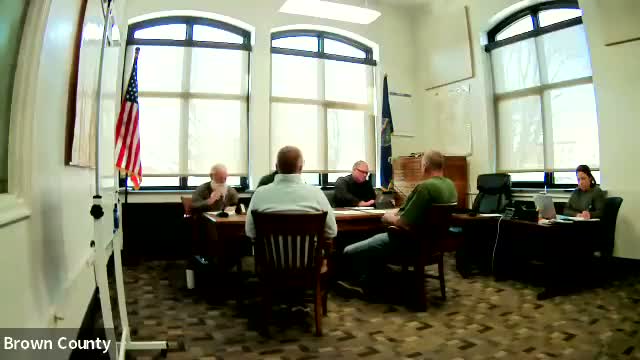
A contractor representative met with Brown County commissioners to present alternatives for rehabilitating Prairie Road and answered commissioners’ technical and cost questions.
The presenter described a structural approach that includes constructing a wedge course to correct crown and irregularities, followed by a three-inch asphalt overlay. He said that option would provide the best long-term performance and estimated a 20-year design life for a full structural treatment. Commissioners and the contractor discussed trade-offs: a full structural overlay improves ride quality and reduces long-term maintenance but carries a substantially higher upfront cost; lower-cost maintenance options such as chip seal, slurry seal or crack filling are cheaper initially but are better described as life-extending maintenance, not structural fixes.
During the exchange, commissioners asked about the project scale (the discussion covered roughly 3–10 miles of routes in the study area), unit-pricing bases (per ton), material sourcing and haul distances, and whether recycled asphalt content could lower binder costs. The presenter explained recycled mix options and noted that local aggregate availability affects price and logistics; commissioners expressed concern about the county’s ability to afford large-scale overlays across many miles and discussed prioritizing haul roads that carry heavy truck traffic.
Cost context discussed in the meeting included an illustrative figure of roughly $900,000 for a three-mile, full structural option presented as an example of a higher-end approach; participants also discussed mid-range unit prices in the local market and options for staging larger projects to gain economies of scale. Commissioners asked the presenter to provide additional project-specific estimates, and several suggested conducting test sections and visiting nearby installations that have used similar treatments before committing to a specific approach.
No procurement vote or contract award was taken during the meeting. Commissioners instructed staff to continue exploring options, consider pilot/test sections, and return with more detailed cost estimates and logistics for targeted segments. The commission also discussed the long-term programmatic question of identifying and prioritizing county haul roads for structural investment versus lower-cost maintenance.
The presentation and ensuing Q&A highlighted the trade-off between immediate budget constraints and longer-term life-cycle savings; commissioners stressed the need for more detailed cost proposals and recommended pilot testing before large capital commitments.
The presenter described a structural approach that includes constructing a wedge course to correct crown and irregularities, followed by a three-inch asphalt overlay. He said that option would provide the best long-term performance and estimated a 20-year design life for a full structural treatment. Commissioners and the contractor discussed trade-offs: a full structural overlay improves ride quality and reduces long-term maintenance but carries a substantially higher upfront cost; lower-cost maintenance options such as chip seal, slurry seal or crack filling are cheaper initially but are better described as life-extending maintenance, not structural fixes.
During the exchange, commissioners asked about the project scale (the discussion covered roughly 3–10 miles of routes in the study area), unit-pricing bases (per ton), material sourcing and haul distances, and whether recycled asphalt content could lower binder costs. The presenter explained recycled mix options and noted that local aggregate availability affects price and logistics; commissioners expressed concern about the county’s ability to afford large-scale overlays across many miles and discussed prioritizing haul roads that carry heavy truck traffic.
Cost context discussed in the meeting included an illustrative figure of roughly $900,000 for a three-mile, full structural option presented as an example of a higher-end approach; participants also discussed mid-range unit prices in the local market and options for staging larger projects to gain economies of scale. Commissioners asked the presenter to provide additional project-specific estimates, and several suggested conducting test sections and visiting nearby installations that have used similar treatments before committing to a specific approach.
No procurement vote or contract award was taken during the meeting. Commissioners instructed staff to continue exploring options, consider pilot/test sections, and return with more detailed cost estimates and logistics for targeted segments. The commission also discussed the long-term programmatic question of identifying and prioritizing county haul roads for structural investment versus lower-cost maintenance.
The presentation and ensuing Q&A highlighted the trade-off between immediate budget constraints and longer-term life-cycle savings; commissioners stressed the need for more detailed cost proposals and recommended pilot testing before large capital commitments.
View the Full Meeting & All Its Details
This article offers just a summary. Unlock complete video, transcripts, and insights as a Founder Member.
✓
Watch full, unedited meeting videos
✓
Search every word spoken in unlimited transcripts
✓
AI summaries & real-time alerts (all government levels)
✓
Permanent access to expanding government content
30-day money-back guarantee
