Calvert County board discusses governance role and community tensions over curriculum and mission wording
January 31, 2026 | Calvert County Public Schools, School Boards, Maryland
This article was created by AI summarizing key points discussed. AI makes mistakes, so for full details and context, please refer to the video of the full meeting. Please report any errors so we can fix them. Report an error »
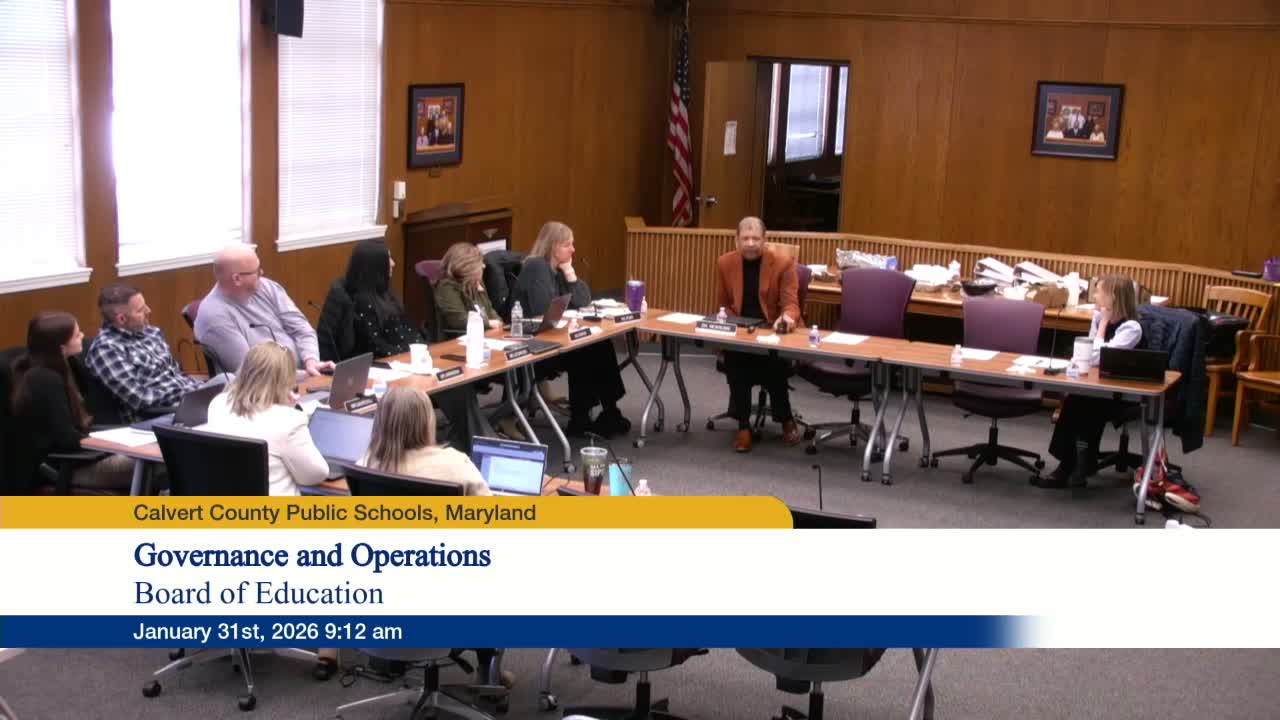
Trustees at the Calvert County Public Schools retreat spent significant time parsing the boundary between governance and operations and how the board should respond when curriculum choices generate public controversy.
Facilitator Molly advised trustees to keep questions at the governance level — policy, vision and budget — and have staff answer operational 'how' questions. "If your educational expert suggests something and you all have questions about it and aren't feeling like it makes the most sense, that discussion is very important," she said, urging transparency about the board's reasons for decisions.
Tensions and past actions: One trustee described eliminating an "anti‑racism" policy because, the trustee said, it "wasn't supported by law," signaling a broader friction between community critics and the board's legal constraints. Molly and other members emphasized that when guidance is not law, the board can advocate at the state level (Annapolis) if it wants a change in statute rather than try to impose matters beyond its legal authority.
Board role and community engagement: Members agreed parents and other community members should be heard but stressed the difference between anecdotal feedback and data. Molly recommended asking staff whether a proposed curriculum meets district policy and the board's strategic vision, and then communicating the reasons for any vote to the public so constituents understand not just the vote but the rationale.
Strategic planning and mission language: Trustees also debated recent edits to the district mission and vision, with some board members describing community upset after the mission wording was adjusted. Members discussed that mission statements should be concise and reflected broad community engagement; they acknowledged missteps where intent and public perception diverged.
What comes next: The facilitator suggested embedding governance questions into regular board meetings and proposed that staff report on a single strategic metric at each meeting so the board can monitor progress without getting bogged down in operational detail. No policy changes were adopted at the retreat; the discussion focused on process and communication.
The retreat then moved to the superintendent evaluation discussion and a later closed session.
Facilitator Molly advised trustees to keep questions at the governance level — policy, vision and budget — and have staff answer operational 'how' questions. "If your educational expert suggests something and you all have questions about it and aren't feeling like it makes the most sense, that discussion is very important," she said, urging transparency about the board's reasons for decisions.
Tensions and past actions: One trustee described eliminating an "anti‑racism" policy because, the trustee said, it "wasn't supported by law," signaling a broader friction between community critics and the board's legal constraints. Molly and other members emphasized that when guidance is not law, the board can advocate at the state level (Annapolis) if it wants a change in statute rather than try to impose matters beyond its legal authority.
Board role and community engagement: Members agreed parents and other community members should be heard but stressed the difference between anecdotal feedback and data. Molly recommended asking staff whether a proposed curriculum meets district policy and the board's strategic vision, and then communicating the reasons for any vote to the public so constituents understand not just the vote but the rationale.
Strategic planning and mission language: Trustees also debated recent edits to the district mission and vision, with some board members describing community upset after the mission wording was adjusted. Members discussed that mission statements should be concise and reflected broad community engagement; they acknowledged missteps where intent and public perception diverged.
What comes next: The facilitator suggested embedding governance questions into regular board meetings and proposed that staff report on a single strategic metric at each meeting so the board can monitor progress without getting bogged down in operational detail. No policy changes were adopted at the retreat; the discussion focused on process and communication.
The retreat then moved to the superintendent evaluation discussion and a later closed session.
View the Full Meeting & All Its Details
This article offers just a summary. Unlock complete video, transcripts, and insights as a Founder Member.
✓
Watch full, unedited meeting videos
✓
Search every word spoken in unlimited transcripts
✓
AI summaries & real-time alerts (all government levels)
✓
Permanent access to expanding government content
30-day money-back guarantee
