Supreme Court Hears Arguments Over Whether County Planning Commissioners Count as "Offices" Under State Law
May 30, 2024 | Supreme Court, Judicial , Washington
This article was created by AI summarizing key points discussed. AI makes mistakes, so for full details and context, please refer to the video of the full meeting. Please report any errors so we can fix them. Report an error »
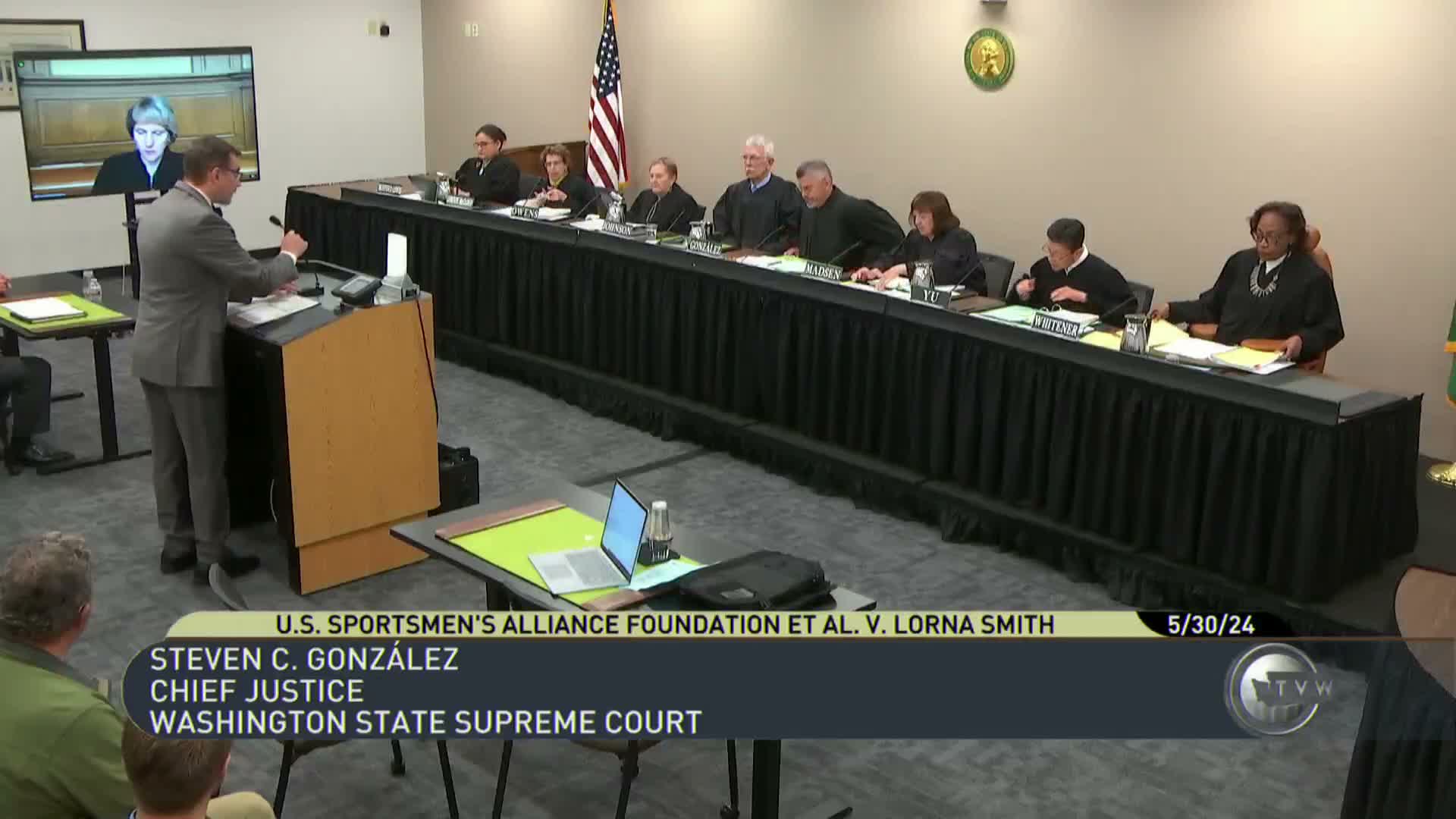
The Washington Supreme Court heard competing arguments on May 30 over whether Washington's "incompatible office" language encompasses appointed roles such as county planning commissioners and how to define an "office" under the statute applied to the Fish and Wildlife Commission.
Joe Pinesco, who said he represented Fish and Wildlife Commissioner Lorna Smith, told the court that "a position constitutes an office for purposes of an incompatible office clause . . . when the position independently exercises sovereign authority." Pinesco urged the justices to adopt a framework (derived from Brown v. Blue) that looks to creation by law, delegation of sovereign power, duties defined by statute, independent performance, and permanence. He argued the Jefferson County planning commissioner is advisory and "does not independently wield any aspect of sovereign authority," because its recommendations have no legal effect until acted on by elected county commissioners.
Counsel pressing a contrary view, Mr. Arndt, representing the Sportsman Alliance Foundation and the named respondents, told the court the analysis should begin with the statute's plain language and pointed to this court's treatment in Jansma and to RCW 1.16.065 for how "officer" has been construed in statutory contexts. "You shouldn't start from a policy answer and then back into statutory construction," he said, urging the justices to read the word "office" in context and to recognize that many appointed bodies perform governmental functions that can amount to delegated sovereign authority.
Justices pressed both sides on practical boundaries for future cases. One justice asked how courts should distinguish advisory bodies created to gather facts from entities that exercise governmental authority; another asked whether the director of the Department (a hired, full-time position) would be covered by the same restriction that applies to commissioners. Pinesco said pay and stipend levels are legally irrelevant to the definition and repeated that "the crux is, what is the office?"
Both sides cited precedent and statutory text repeatedly. Pinesco relied on the Brown v. Blue factors and reasoned that merely influential or recommendatory duties do not transform an advisory body into an office that exercises sovereign authority. Arndt countered that planning commissions adjudicate land-use matters, hold hearings, take testimony, and produce reports that trigger further statutory processes and therefore can carry governmental authority sufficient to qualify as an office for purposes of the incompatibility clause.
No decision was announced at argument. The court took the case under advisement after attorneys completed rebuttal time; the single-day oral argument concluded and the case is pending a written opinion.
Joe Pinesco, who said he represented Fish and Wildlife Commissioner Lorna Smith, told the court that "a position constitutes an office for purposes of an incompatible office clause . . . when the position independently exercises sovereign authority." Pinesco urged the justices to adopt a framework (derived from Brown v. Blue) that looks to creation by law, delegation of sovereign power, duties defined by statute, independent performance, and permanence. He argued the Jefferson County planning commissioner is advisory and "does not independently wield any aspect of sovereign authority," because its recommendations have no legal effect until acted on by elected county commissioners.
Counsel pressing a contrary view, Mr. Arndt, representing the Sportsman Alliance Foundation and the named respondents, told the court the analysis should begin with the statute's plain language and pointed to this court's treatment in Jansma and to RCW 1.16.065 for how "officer" has been construed in statutory contexts. "You shouldn't start from a policy answer and then back into statutory construction," he said, urging the justices to read the word "office" in context and to recognize that many appointed bodies perform governmental functions that can amount to delegated sovereign authority.
Justices pressed both sides on practical boundaries for future cases. One justice asked how courts should distinguish advisory bodies created to gather facts from entities that exercise governmental authority; another asked whether the director of the Department (a hired, full-time position) would be covered by the same restriction that applies to commissioners. Pinesco said pay and stipend levels are legally irrelevant to the definition and repeated that "the crux is, what is the office?"
Both sides cited precedent and statutory text repeatedly. Pinesco relied on the Brown v. Blue factors and reasoned that merely influential or recommendatory duties do not transform an advisory body into an office that exercises sovereign authority. Arndt countered that planning commissions adjudicate land-use matters, hold hearings, take testimony, and produce reports that trigger further statutory processes and therefore can carry governmental authority sufficient to qualify as an office for purposes of the incompatibility clause.
No decision was announced at argument. The court took the case under advisement after attorneys completed rebuttal time; the single-day oral argument concluded and the case is pending a written opinion.
Don't Miss a Word: See the Full Meeting!
Go beyond summaries. Unlock every video, transcript, and key insight with a Founder Membership.
✓
Get instant access to full meeting videos
✓
Search and clip any phrase from complete transcripts
✓
Receive AI-powered summaries & custom alerts
✓
Enjoy lifetime, unrestricted access to government data
30-day money-back guarantee
