Committee advances draft parental-control provisions for library materials, sets limits on book challenges
November 08, 2024 | Upper Adams SD, School Districts, Pennsylvania
This article was created by AI summarizing key points discussed. AI makes mistakes, so for full details and context, please refer to the video of the full meeting. Please report any errors so we can fix them. Report an error »
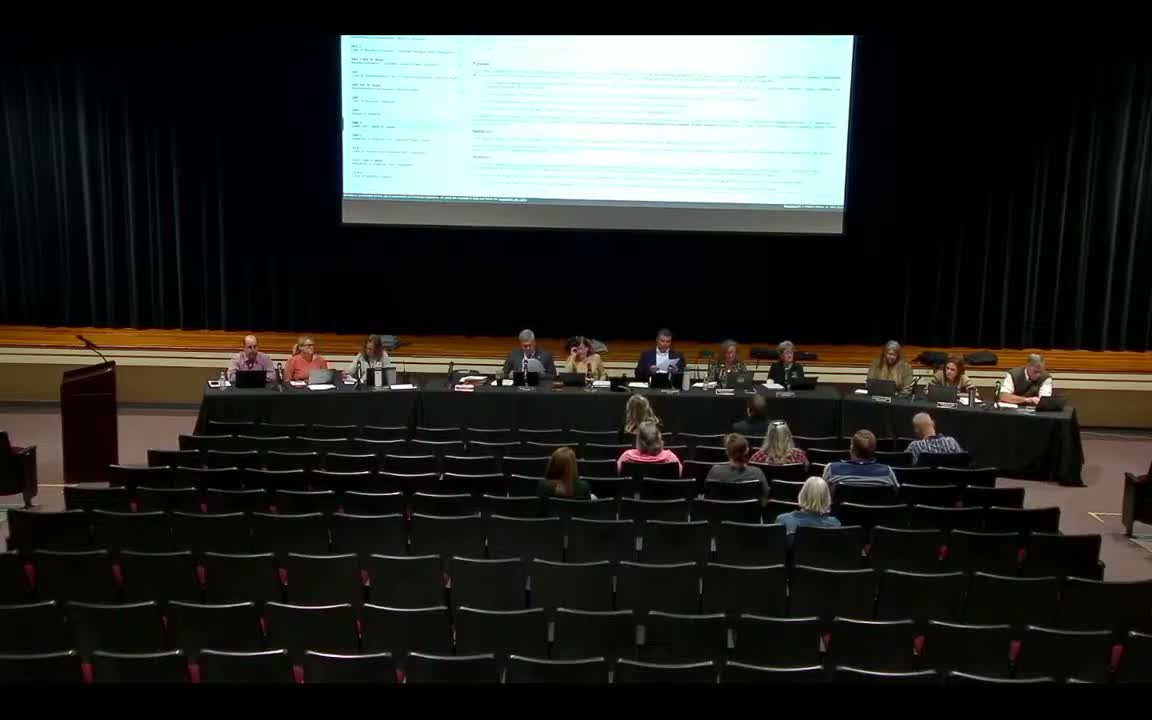
The policy committee spent the bulk of the meeting refining a draft policy on library materials and parental controls that would identify "explicit" content, require parental opt-in for access, and set procedures for challenges and reconsideration.
Committee members reviewed a hybrid draft, a March proposal and an October proposal, and agreed to begin with the confidentiality section and definitions before addressing parental-control language. A committee member proposed sample opt-in wording: "By signing this document, you are giving permission for your child to be provided with books and instructional materials that may include written or visual depictions of explicit conduct and/or excessive profanity. If you decline to sign this document, it will in no way negatively impact your child's ability to participate in any class, school activity, or school function." The chair asked staff for a written copy of the suggested opt-in form.
Members debated the meaning of "explicit and excessive" and a committee member argued to remove "and excessive" because it is too subjective; the committee agreed to eliminate that qualifier so the definition uses "explicit" alone. Administrators explained the draft avoids purchasing materials with explicit content and allows a librarian to request exceptions if a work's overall quality warrants it.
The committee also refined who may challenge materials and how many challenges will be processed. The hybrid draft limited challengers to taxpayers, district residents and parents/guardians; the committee agreed that outside challengers should not consume district resources. Members debated capping the number of challenges processed each year (a suggested cap of three per year) and limiting any individual to one challenge per school year; administrators warned that processing multiple challenges requires staff time and may create substitute costs. The committee settled on language to review three challenges per year with a one-challenge-per-individual-per-school-year limit and to queue late-year requests for the following school year.
Committee members discussed implementation logistics, asked whether cataloged lists of identified materials would be accessible to parents, and assigned staff to work with librarians to determine storage and cataloging procedures for identified titles. The committee agreed that parental-control provisions would take effect in the 2025-26 school year and that the draft should cover existing library holdings as well as future acquisitions.
Next steps: the hybrid Policy 109.1 will be forwarded to the full board for first reading; staff will prepare implementation guidance, sample opt-in forms and clarify how parents will access a catalog of identified materials.
Committee members reviewed a hybrid draft, a March proposal and an October proposal, and agreed to begin with the confidentiality section and definitions before addressing parental-control language. A committee member proposed sample opt-in wording: "By signing this document, you are giving permission for your child to be provided with books and instructional materials that may include written or visual depictions of explicit conduct and/or excessive profanity. If you decline to sign this document, it will in no way negatively impact your child's ability to participate in any class, school activity, or school function." The chair asked staff for a written copy of the suggested opt-in form.
Members debated the meaning of "explicit and excessive" and a committee member argued to remove "and excessive" because it is too subjective; the committee agreed to eliminate that qualifier so the definition uses "explicit" alone. Administrators explained the draft avoids purchasing materials with explicit content and allows a librarian to request exceptions if a work's overall quality warrants it.
The committee also refined who may challenge materials and how many challenges will be processed. The hybrid draft limited challengers to taxpayers, district residents and parents/guardians; the committee agreed that outside challengers should not consume district resources. Members debated capping the number of challenges processed each year (a suggested cap of three per year) and limiting any individual to one challenge per school year; administrators warned that processing multiple challenges requires staff time and may create substitute costs. The committee settled on language to review three challenges per year with a one-challenge-per-individual-per-school-year limit and to queue late-year requests for the following school year.
Committee members discussed implementation logistics, asked whether cataloged lists of identified materials would be accessible to parents, and assigned staff to work with librarians to determine storage and cataloging procedures for identified titles. The committee agreed that parental-control provisions would take effect in the 2025-26 school year and that the draft should cover existing library holdings as well as future acquisitions.
Next steps: the hybrid Policy 109.1 will be forwarded to the full board for first reading; staff will prepare implementation guidance, sample opt-in forms and clarify how parents will access a catalog of identified materials.
Don't Miss a Word: See the Full Meeting!
Go beyond summaries. Unlock every video, transcript, and key insight with a Founder Membership.
✓
Get instant access to full meeting videos
✓
Search and clip any phrase from complete transcripts
✓
Receive AI-powered summaries & custom alerts
✓
Enjoy lifetime, unrestricted access to government data
30-day money-back guarantee
