Anchorage Assembly reviews ordinance to define and limit where data centers can be built
February 28, 2026 | Anchorage Municipality, Alaska
This article was created by AI summarizing key points discussed. AI makes mistakes, so for full details and context, please refer to the video of the full meeting. Please report any errors so we can fix them. Report an error »
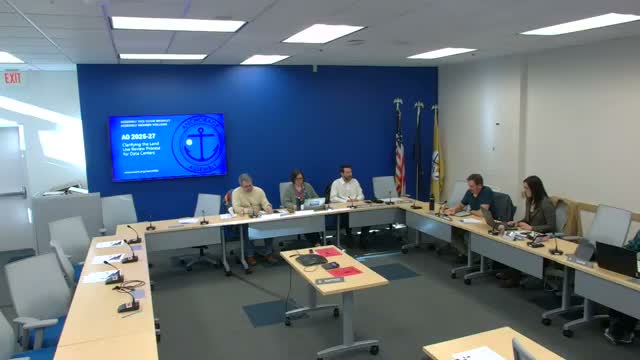
The Anchorage Assembly on Feb. 27 reviewed Ordinance O-2026-27, a work-session presentation that would add a distinct 'data center' land-use category to Title 21 and require conditional-use review for energy-intensive facilities.
Sponsor remarks framed the measure as proactive zoning: "This is co-sponsored by myself and member Bolland," the presenter said, explaining the goal is to "clarify the land use review process for data centers" and to ask planning staff to develop use-specific criteria for energy-intensive uses. The draft ordinance would allow data centers in industrial zones, at the port, the airport and in POI districts, and would not permit them in residential zones.
Why it matters: presenters said data centers can differ widely in size and impacts — from small 'edge' facilities co-located with other infrastructure to hyperscale warehouses — and can be unusually energy- and water-intensive. "One of these buildings basically can use as much electricity as 100,000 households or more," the sponsor said while noting Anchorage itself is roughly that scale, a comparison used to underline the potential grid impact.
What the ordinance would do: the draft would (1) define a data center as a distinct use, (2) treat large and small facilities differently, (3) permit holistic review of phased or multi-parcel projects, (4) amend the use table to restrict data centers to nonresidential zones, and (5) make data centers conditional uses requiring Planning and Zoning-style review rather than treating them as by-right uses.
Suggested conditions and standards discussed included basic design standards and visual screening, a distinct public entrance, landscaping, a noise-mitigation study scaled to facility size, a recommendation of up to a 200-foot setback from residential areas where appropriate, sufficient fire suppression, and a requirement that applicants demonstrate they have consulted utilities about grid capacity. The presenter noted a municipal precedent in the marijuana code that requires applicants to obtain utility confirmation of power supply adequacy and suggested that approach could apply here.
Definitional questions and state ties: the draft defines a threshold in part by electrical draw; the 20-megawatt threshold in the draft, the sponsor said, derives from pending state legislation (HB259). Assembly member Zach Johnson asked whether the 20-megawatt cutoff accurately captures scale or whether server counts might be a more useful metric; the presenter said server counts vary and some facility details can be proprietary, complicating precise thresholds. The sponsor also noted Senate Bill 250 was addressing related utility issues at the state level and recommended tracking the bills.
Revenue and costs: presenters acknowledged potential local benefits, such as property and personal-property tax revenue and a new large utility ratepayer, but also cautioned about trade-offs: limited long-term on-site jobs, larger infrastructure needs, noise, water use and wastewater concerns. Daniel Polland suggested existing local incentives, such as the property-assessed clean energy (PACER) program (chapter 12.75), might be avenues for clean-energy investment tied to development.
Public messaging: Vice Chair Anna Broly directly pushed back on social-media criticism that the Assembly intends to block economic development, saying, "I just wanna put it plainly on the record here that what this is the assembly doing is contemplating our land use code for impacts to residences and other users" and that the process is meant to provide neighbors notice and review opportunities.
Outcome and next steps: the session was a work session with no vote. The ordinance asks planning staff to research use-specific criteria and return with recommendations; the Assembly scheduled its next regular meeting for Tuesday, with no formal action taken at this session.
Sources and limitations: statements and technical estimates (for example, the "100,000 households" electricity comparison and the 20-megawatt threshold) were presented by the sponsor and discussed by assembly members; the Assembly did not adopt findings or independent technical analysis at the session.
Sponsor remarks framed the measure as proactive zoning: "This is co-sponsored by myself and member Bolland," the presenter said, explaining the goal is to "clarify the land use review process for data centers" and to ask planning staff to develop use-specific criteria for energy-intensive uses. The draft ordinance would allow data centers in industrial zones, at the port, the airport and in POI districts, and would not permit them in residential zones.
Why it matters: presenters said data centers can differ widely in size and impacts — from small 'edge' facilities co-located with other infrastructure to hyperscale warehouses — and can be unusually energy- and water-intensive. "One of these buildings basically can use as much electricity as 100,000 households or more," the sponsor said while noting Anchorage itself is roughly that scale, a comparison used to underline the potential grid impact.
What the ordinance would do: the draft would (1) define a data center as a distinct use, (2) treat large and small facilities differently, (3) permit holistic review of phased or multi-parcel projects, (4) amend the use table to restrict data centers to nonresidential zones, and (5) make data centers conditional uses requiring Planning and Zoning-style review rather than treating them as by-right uses.
Suggested conditions and standards discussed included basic design standards and visual screening, a distinct public entrance, landscaping, a noise-mitigation study scaled to facility size, a recommendation of up to a 200-foot setback from residential areas where appropriate, sufficient fire suppression, and a requirement that applicants demonstrate they have consulted utilities about grid capacity. The presenter noted a municipal precedent in the marijuana code that requires applicants to obtain utility confirmation of power supply adequacy and suggested that approach could apply here.
Definitional questions and state ties: the draft defines a threshold in part by electrical draw; the 20-megawatt threshold in the draft, the sponsor said, derives from pending state legislation (HB259). Assembly member Zach Johnson asked whether the 20-megawatt cutoff accurately captures scale or whether server counts might be a more useful metric; the presenter said server counts vary and some facility details can be proprietary, complicating precise thresholds. The sponsor also noted Senate Bill 250 was addressing related utility issues at the state level and recommended tracking the bills.
Revenue and costs: presenters acknowledged potential local benefits, such as property and personal-property tax revenue and a new large utility ratepayer, but also cautioned about trade-offs: limited long-term on-site jobs, larger infrastructure needs, noise, water use and wastewater concerns. Daniel Polland suggested existing local incentives, such as the property-assessed clean energy (PACER) program (chapter 12.75), might be avenues for clean-energy investment tied to development.
Public messaging: Vice Chair Anna Broly directly pushed back on social-media criticism that the Assembly intends to block economic development, saying, "I just wanna put it plainly on the record here that what this is the assembly doing is contemplating our land use code for impacts to residences and other users" and that the process is meant to provide neighbors notice and review opportunities.
Outcome and next steps: the session was a work session with no vote. The ordinance asks planning staff to research use-specific criteria and return with recommendations; the Assembly scheduled its next regular meeting for Tuesday, with no formal action taken at this session.
Sources and limitations: statements and technical estimates (for example, the "100,000 households" electricity comparison and the 20-megawatt threshold) were presented by the sponsor and discussed by assembly members; the Assembly did not adopt findings or independent technical analysis at the session.
View the Full Meeting & All Its Details
This article offers just a summary. Unlock complete video, transcripts, and insights as a Founder Member.
✓
Watch full, unedited meeting videos
✓
Search every word spoken in unlimited transcripts
✓
AI summaries & real-time alerts (all government levels)
✓
Permanent access to expanding government content
30-day money-back guarantee
