Monitoring and reporting requirements detailed for water‑quality order
February 28, 2026 | State Water Resources Control Board, Boards and Commissions, Executive, California
This article was created by AI summarizing key points discussed. AI makes mistakes, so for full details and context, please refer to the video of the full meeting. Please report any errors so we can fix them. Report an error »
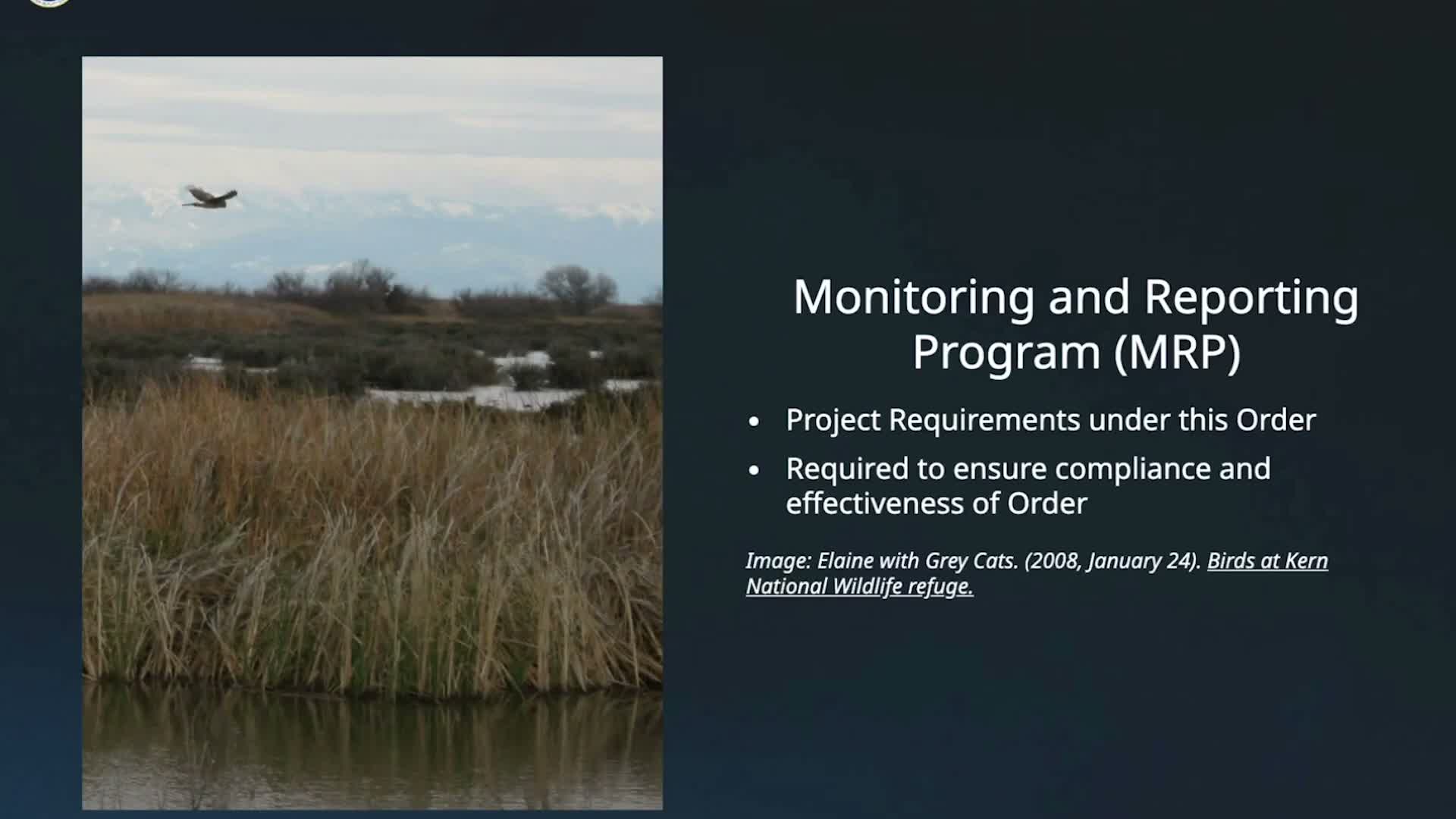
A presenter in a training unit for the order outlined monitoring, reporting and mitigation monitoring requirements that permittees must follow to protect waters of the state.
The presenter said the Monitoring and Reporting Program, referred to as the MRP, “is necessary to measure compliance and effectiveness of the order and to ensure that water quality is not negatively impacted by nonpoint source discharges of waste,” and noted that the program is implemented consistent with Water Code section 13267. The presenter also described the Mitigation Monitoring and Reporting Program (MMRP) in attachment C and said MMRP requirements generally apply to biological resources and must include a summary table listing mitigation measures, implementation status and schedule.
Why it matters: the MRP establishes monitoring, reporting and recordkeeping rules that determine whether projects comply with permit conditions and whether mitigation measures are effective; the executive officer may modify or reissue the MRP for a permittee when land‑use activities could affect waters of the state.
Key reporting deadlines and recordkeeping
The presenter gave several specific timelines permittees must follow. If a discharge or threatened discharge occurs, the permit team must notify the Central Valley Water Board within 24 hours of discovery and submit a written report within 14 days that contains the information required by the order. All monitoring records and reports must be retained for the life of the project and for at least five years after completion.
NPOs and pesticide notifications
For category B projects, permittees must submit a Notice of Planned Operations (NPO) at least 15 days before starting activities (or, for post‑emergency recovery projects, no later than 30 days after ground disturbance begins). An NPO remains in effect for one year from signature; if activities continue, the permittee must submit an updated NPO at least 15 days before the prior NPO expires. NPOs must include federal agency information, project details, CSDS information and a project map.
For projects that include broadcast or aerial pesticide application, the presenter said permittees must submit a pesticide application notification at least 15 days prior to application and must provide written notice of changes at least 48 hours before application. Notifications must include project location information, materials, application equipment and an assigned certification statement. The presenter listed locations where pesticide application is prohibited under the order, including watercourse and lake protection zones (WLPZs) and areas burned within the prior three years on slopes greater than 30% unless at least 50% ground cover is present.
Monitoring types, focus areas and methods
The training described two monitoring types: implementation monitoring (conducted at completion of project activities before the winter period) and effectiveness monitoring (conducted after the winter season). The winter period was identified as commencing on November 15 each year; implementation monitoring verifies that best management practices (BMPs) are functioning as designed prior to winter, while effectiveness monitoring evaluates whether those measures prevented nonpoint source discharges.
The presenter listed focus areas for category B monitoring that the PERMA team must evaluate when applicable: roads, trail systems, landings, staging areas, campgrounds and surrounding drainages, permanent and temporary water crossings, water‑drafting locations and watercourse or lake protection zones, areas with unstable soils, and identified controllable sediment source (CSDS) locations. The presenter recommended photopoint monitoring for documenting site conditions: “A picture is worth 1,000 words. Photopoint monitoring can be used to accurately represent site conditions and development throughout the course of a project.”
Watershed work plans, cycles and reports
If a targeted watershed is identified, permittees must prepare field assessment work plans for selected HUC‑12 watersheds and submit them to the board for executive officer review on a seven‑year cycle. The first work plan is due approximately six months from the date of order adoption. Watershed treatment plans must be implemented within 10 years of board approval; interim progress reports are required annually beginning one year after approval and final reports are due either 60 days after completion of the watershed treatment plan or no later than 10 years from approval, whichever comes first. The presenter said permittees may request plan modifications or up to three years of additional time for good cause and that extensions and modifications require executive officer approval.
Submission formats and certification
The presenter reminded permittees that the Central Valley Water Board operates as a paperless office and asked that work plans and reports be submitted in searchable PDF, Word or Excel formats when feasible. Documents under 50 megabytes should be emailed to the appropriate office (Rancho Cordova, Redding or Fresno); larger files should be coordinated with CVRWQCB staff. All reports must include the certification statement and the signature of the authorized representative.
Next steps and resources
The presenter directed permittees to review order attachments (including attachments B and C) on the order website for full MRP and MMRP instructions and template submittals and encouraged permittees to contact Central Valley Water Board staff with questions.
The presenter said the Monitoring and Reporting Program, referred to as the MRP, “is necessary to measure compliance and effectiveness of the order and to ensure that water quality is not negatively impacted by nonpoint source discharges of waste,” and noted that the program is implemented consistent with Water Code section 13267. The presenter also described the Mitigation Monitoring and Reporting Program (MMRP) in attachment C and said MMRP requirements generally apply to biological resources and must include a summary table listing mitigation measures, implementation status and schedule.
Why it matters: the MRP establishes monitoring, reporting and recordkeeping rules that determine whether projects comply with permit conditions and whether mitigation measures are effective; the executive officer may modify or reissue the MRP for a permittee when land‑use activities could affect waters of the state.
Key reporting deadlines and recordkeeping
The presenter gave several specific timelines permittees must follow. If a discharge or threatened discharge occurs, the permit team must notify the Central Valley Water Board within 24 hours of discovery and submit a written report within 14 days that contains the information required by the order. All monitoring records and reports must be retained for the life of the project and for at least five years after completion.
NPOs and pesticide notifications
For category B projects, permittees must submit a Notice of Planned Operations (NPO) at least 15 days before starting activities (or, for post‑emergency recovery projects, no later than 30 days after ground disturbance begins). An NPO remains in effect for one year from signature; if activities continue, the permittee must submit an updated NPO at least 15 days before the prior NPO expires. NPOs must include federal agency information, project details, CSDS information and a project map.
For projects that include broadcast or aerial pesticide application, the presenter said permittees must submit a pesticide application notification at least 15 days prior to application and must provide written notice of changes at least 48 hours before application. Notifications must include project location information, materials, application equipment and an assigned certification statement. The presenter listed locations where pesticide application is prohibited under the order, including watercourse and lake protection zones (WLPZs) and areas burned within the prior three years on slopes greater than 30% unless at least 50% ground cover is present.
Monitoring types, focus areas and methods
The training described two monitoring types: implementation monitoring (conducted at completion of project activities before the winter period) and effectiveness monitoring (conducted after the winter season). The winter period was identified as commencing on November 15 each year; implementation monitoring verifies that best management practices (BMPs) are functioning as designed prior to winter, while effectiveness monitoring evaluates whether those measures prevented nonpoint source discharges.
The presenter listed focus areas for category B monitoring that the PERMA team must evaluate when applicable: roads, trail systems, landings, staging areas, campgrounds and surrounding drainages, permanent and temporary water crossings, water‑drafting locations and watercourse or lake protection zones, areas with unstable soils, and identified controllable sediment source (CSDS) locations. The presenter recommended photopoint monitoring for documenting site conditions: “A picture is worth 1,000 words. Photopoint monitoring can be used to accurately represent site conditions and development throughout the course of a project.”
Watershed work plans, cycles and reports
If a targeted watershed is identified, permittees must prepare field assessment work plans for selected HUC‑12 watersheds and submit them to the board for executive officer review on a seven‑year cycle. The first work plan is due approximately six months from the date of order adoption. Watershed treatment plans must be implemented within 10 years of board approval; interim progress reports are required annually beginning one year after approval and final reports are due either 60 days after completion of the watershed treatment plan or no later than 10 years from approval, whichever comes first. The presenter said permittees may request plan modifications or up to three years of additional time for good cause and that extensions and modifications require executive officer approval.
Submission formats and certification
The presenter reminded permittees that the Central Valley Water Board operates as a paperless office and asked that work plans and reports be submitted in searchable PDF, Word or Excel formats when feasible. Documents under 50 megabytes should be emailed to the appropriate office (Rancho Cordova, Redding or Fresno); larger files should be coordinated with CVRWQCB staff. All reports must include the certification statement and the signature of the authorized representative.
Next steps and resources
The presenter directed permittees to review order attachments (including attachments B and C) on the order website for full MRP and MMRP instructions and template submittals and encouraged permittees to contact Central Valley Water Board staff with questions.
View the Full Meeting & All Its Details
This article offers just a summary. Unlock complete video, transcripts, and insights as a Founder Member.
✓
Watch full, unedited meeting videos
✓
Search every word spoken in unlimited transcripts
✓
AI summaries & real-time alerts (all government levels)
✓
Permanent access to expanding government content
30-day money-back guarantee
