Youth panel at Montgomery County convening urges more school mental-health resources
February 28, 2026 | Montgomery County, Maryland
This article was created by AI summarizing key points discussed. AI makes mistakes, so for full details and context, please refer to the video of the full meeting. Please report any errors so we can fix them. Report an error »
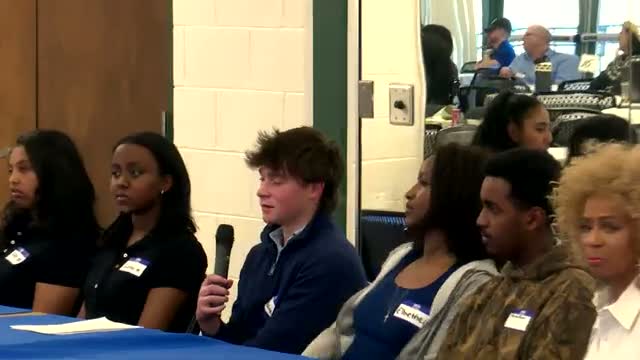
At a mental-health convening at the Gwendolyn Caulfield Recreation Center in Montgomery County, youth panelists told adults they need more school-based mental-health resources and clearer communication with families.
The panelists — identified in the convening transcript as Youth panelist (S5), Youth panelist (S8), Youth panelist (S12), Youth panelist (S15) and others — pressed for early intervention, warned that early exposure to social media fuels daily drama, and offered a five-step approach to supporting peers.
One youth panelist, Youth panelist (S5), described counseling shortages at their school: "Our school has 7 counselors. The senior class alone is 500 kids, and you have to have a meeting," the panelist said, arguing students "can't really meet your counselor when you need it." That example framed repeated requests for more accessible school mental-health staff and programs that include parents.
Youth panelist (S12), who said they work inside middle schools, told the convening that "the introduction of social media at such a young age is what a very big problem is," adding that children as young as 10 or 11 accessing TikTok and Instagram contribute to daily drama and sometimes to physical fights.
Panel facilitator (S4) and Youth panelist (S8) urged programs that bring parents into conversations so adults can understand changing youth experiences: "Parents or adults should get the same resources that we get," Youth panelist (S8) said, suggesting parent–youth joint programming to bridge generational gaps and increase awareness of Montgomery County Public Schools resources.
Several panelists emphasized listening as a first step. Youth panelist (S13) related a workplace exchange that taught them that some people "just need you to hear me" rather than immediate problem-solving. Youth panelist (S15) offered a concise, panel-endorsed set of steps for helping someone who may be struggling: ask direct questions and keep checking in; keep them safe and take thoughts of self-harm seriously; be present and listen without judgment; help them connect to hotlines, counselors or other resources; and remind them that "your struggles are not your weaknesses."
The youth speakers also noted peer-led clubs described as "vibe check" groups intended to make students feel safer and more comfortable and a youth podcast that gives participants a regular forum to discuss issues such as homecoming or Black History Month.
The youth panel concluded after the presentations and the convening returned to other agenda items. The transcript does not record any formal motions or county decisions arising from the panel remarks.
The panelists — identified in the convening transcript as Youth panelist (S5), Youth panelist (S8), Youth panelist (S12), Youth panelist (S15) and others — pressed for early intervention, warned that early exposure to social media fuels daily drama, and offered a five-step approach to supporting peers.
One youth panelist, Youth panelist (S5), described counseling shortages at their school: "Our school has 7 counselors. The senior class alone is 500 kids, and you have to have a meeting," the panelist said, arguing students "can't really meet your counselor when you need it." That example framed repeated requests for more accessible school mental-health staff and programs that include parents.
Youth panelist (S12), who said they work inside middle schools, told the convening that "the introduction of social media at such a young age is what a very big problem is," adding that children as young as 10 or 11 accessing TikTok and Instagram contribute to daily drama and sometimes to physical fights.
Panel facilitator (S4) and Youth panelist (S8) urged programs that bring parents into conversations so adults can understand changing youth experiences: "Parents or adults should get the same resources that we get," Youth panelist (S8) said, suggesting parent–youth joint programming to bridge generational gaps and increase awareness of Montgomery County Public Schools resources.
Several panelists emphasized listening as a first step. Youth panelist (S13) related a workplace exchange that taught them that some people "just need you to hear me" rather than immediate problem-solving. Youth panelist (S15) offered a concise, panel-endorsed set of steps for helping someone who may be struggling: ask direct questions and keep checking in; keep them safe and take thoughts of self-harm seriously; be present and listen without judgment; help them connect to hotlines, counselors or other resources; and remind them that "your struggles are not your weaknesses."
The youth speakers also noted peer-led clubs described as "vibe check" groups intended to make students feel safer and more comfortable and a youth podcast that gives participants a regular forum to discuss issues such as homecoming or Black History Month.
The youth panel concluded after the presentations and the convening returned to other agenda items. The transcript does not record any formal motions or county decisions arising from the panel remarks.
Don't Miss a Word: See the Full Meeting!
Go beyond summaries. Unlock every video, transcript, and key insight with a Founder Membership.
✓
Get instant access to full meeting videos
✓
Search and clip any phrase from complete transcripts
✓
Receive AI-powered summaries & custom alerts
✓
Enjoy lifetime, unrestricted access to government data
30-day money-back guarantee
