Hayward council hears $32.5 million shortfall; staff recommends mix of one‑time fixes, property sales and labor talks
February 28, 2026 | Hayward City, Alameda County, California
This article was created by AI summarizing key points discussed. AI makes mistakes, so for full details and context, please refer to the video of the full meeting. Please report any errors so we can fix them. Report an error »
Hayward’s City Council spent a marathon Feb. 28 budget work session reviewing a staff plan to narrow a projected $32.5 million general‑fund shortfall for fiscal 2026–27 and asking staff to pursue a mix of revenue, one‑time funding and structural options while avoiding rash service eliminations.
The meeting opened with two public commenters urging transparency and caution. Teresa Resendez said the city faces a projected $32.5 million deficit and that even counting Measure C transfers the city would still face a multi‑million dollar shortfall; she asked the council to consider cuts or temporary salary reductions. TJ of Hayward Concerned Citizens told the council it must center local businesses in any plan and avoid unexpected burdens on taxpayers.
“I have full faith in our executive team,” the chair said in opening remarks, while emphasizing the need to preserve core services and to keep the council’s message measured. City Manager Jennifer Roth told council members the session was to introduce numbers and options, not to adopt the budget: “You’re not approving anything tonight,” she said, adding the materials are a working set of recommendations staff wants council feedback on.
Finance staff walked the council through a conservative five‑year baseline that excludes unapproved one‑time transfers and relies on consultants for the big three revenue streams—property tax, sales tax and the utility users tax. Under those assumptions, the forecast produces roughly the $32.5 million gap for FY2026–27. Staff identified the root causes as a combination of one‑time ARPA and grant funding being folded into recurring operations, labor contracts that outpaced market and slower growth in property/sales tax. Staff reported last year ended with about $30 million drawn from reserves.
To narrow the gap, staff proposed a blended approach: use conservative revenue expectations, apply some one‑time resources (for example limited use of Measure C and OPEB trust funds), accelerate prioritized property dispositions and continue aggressive vacancy and overtime management. Tracy Urban, the city’s real‑property manager, described three top candidate properties the city is evaluating for sale or ground lease under the state Surplus Lands Act and said appraisals and market work are under way with the goal of bringing recommendations back by June.
Staff emphasized the distinction between one‑time fixes and structural reductions. Roth and finance officials urged caution about eliminating permanent services because restarting them later can be difficult. Council members repeatedly asked staff to spell out which services are “core” and to provide department‑level metrics and monthly actuals so the council and public can track progress.
The council also reviewed a package of potential revenue ideas. Staff recommended piloting software to enforce the city’s short‑term‑rental ban (estimated software cost about $25,000 a year with potential fine recoveries) and to hold off acting on a first‑responder/EMS billing program until billing responsibility and payer behavior are clearer. The council directed staff to pilot short‑term‑rental enforcement focused on single‑family listings and to return with pilot results and any needed policy changes.
A major portion of the session centered on modernizing the city’s business‑license tax. Staff brought consultant Matt Newman of Blue Sky Consulting to present two scenarios: a “match‑neighbors” modernization that would roughly triple Hayward’s current business‑license revenue (staff estimate roughly +$8.8 million annually under the proposed structure) and a higher “7x” scenario that would raise more but carries greater economic risk. Newman told council, “Hayward’s not collecting as much revenue as virtually any of its neighbors,” and presented rate tables showing progressive brackets with higher rates for larger, less‑mobile businesses.
Council members debated the size of any ballot question, whether small landlords (1–3 units) should remain exempt, and where to draw rate brackets. Roth said staff would not program business‑license revenue into the FY2026–27 budget unless and until voters approve a ballot measure. Council members generally favored directing staff to proceed with public polling: staff and the consultant FM3 will test voter support for the match‑neighbors proposal and (by split sample if council agrees) the higher option, with polling results due in March and another work session set for April to consider next steps.
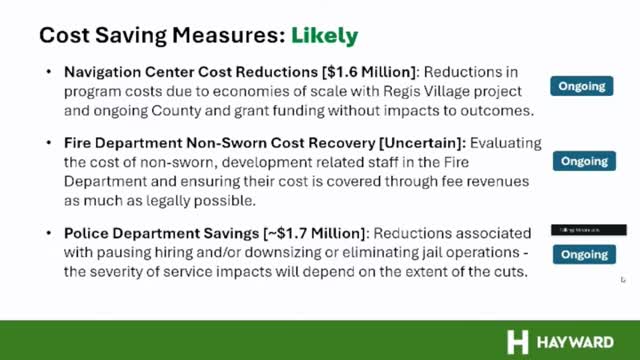
On cost‑savings, staff highlighted options that would avoid across‑the‑board cuts if possible: continuing vacancy management, seeking limited concessions in labor negotiations that are about to begin, modest operational savings in fire and police overtime, and targeted CIP deferrals. Staff said NAV Center contract changes and grant pursuit could reduce general‑fund support for the navigation center by roughly $1.6 million without eliminating the program; staff recommended retaining the NAV Center because of its reported high exit‑to‑permanent‑housing rate.
Council members closed by asking staff to return with more precise departmental breakdowns, to proceed with voter polling and outreach to businesses and labor, and to bring draft budget policy language to the next sessions. Roth said staff will brief employees on the council feedback and begin labor outreach immediately, with formal budget work sessions planned in May and budget adoption targeted for June.
What’s next: staff will run polling and outreach on the business‑license proposals, pilot short‑term‑rental enforcement, pursue property evaluations and continue labor negotiations; the council expects a more detailed recommended budget and draft policy language in late spring.
Attribution note: direct quotations and attributions in this article are drawn from the council work session transcript; speakers are identified to the degree they self‑identified or were introduced on the record.
The meeting opened with two public commenters urging transparency and caution. Teresa Resendez said the city faces a projected $32.5 million deficit and that even counting Measure C transfers the city would still face a multi‑million dollar shortfall; she asked the council to consider cuts or temporary salary reductions. TJ of Hayward Concerned Citizens told the council it must center local businesses in any plan and avoid unexpected burdens on taxpayers.
“I have full faith in our executive team,” the chair said in opening remarks, while emphasizing the need to preserve core services and to keep the council’s message measured. City Manager Jennifer Roth told council members the session was to introduce numbers and options, not to adopt the budget: “You’re not approving anything tonight,” she said, adding the materials are a working set of recommendations staff wants council feedback on.
Finance staff walked the council through a conservative five‑year baseline that excludes unapproved one‑time transfers and relies on consultants for the big three revenue streams—property tax, sales tax and the utility users tax. Under those assumptions, the forecast produces roughly the $32.5 million gap for FY2026–27. Staff identified the root causes as a combination of one‑time ARPA and grant funding being folded into recurring operations, labor contracts that outpaced market and slower growth in property/sales tax. Staff reported last year ended with about $30 million drawn from reserves.
To narrow the gap, staff proposed a blended approach: use conservative revenue expectations, apply some one‑time resources (for example limited use of Measure C and OPEB trust funds), accelerate prioritized property dispositions and continue aggressive vacancy and overtime management. Tracy Urban, the city’s real‑property manager, described three top candidate properties the city is evaluating for sale or ground lease under the state Surplus Lands Act and said appraisals and market work are under way with the goal of bringing recommendations back by June.
Staff emphasized the distinction between one‑time fixes and structural reductions. Roth and finance officials urged caution about eliminating permanent services because restarting them later can be difficult. Council members repeatedly asked staff to spell out which services are “core” and to provide department‑level metrics and monthly actuals so the council and public can track progress.
The council also reviewed a package of potential revenue ideas. Staff recommended piloting software to enforce the city’s short‑term‑rental ban (estimated software cost about $25,000 a year with potential fine recoveries) and to hold off acting on a first‑responder/EMS billing program until billing responsibility and payer behavior are clearer. The council directed staff to pilot short‑term‑rental enforcement focused on single‑family listings and to return with pilot results and any needed policy changes.
A major portion of the session centered on modernizing the city’s business‑license tax. Staff brought consultant Matt Newman of Blue Sky Consulting to present two scenarios: a “match‑neighbors” modernization that would roughly triple Hayward’s current business‑license revenue (staff estimate roughly +$8.8 million annually under the proposed structure) and a higher “7x” scenario that would raise more but carries greater economic risk. Newman told council, “Hayward’s not collecting as much revenue as virtually any of its neighbors,” and presented rate tables showing progressive brackets with higher rates for larger, less‑mobile businesses.
Council members debated the size of any ballot question, whether small landlords (1–3 units) should remain exempt, and where to draw rate brackets. Roth said staff would not program business‑license revenue into the FY2026–27 budget unless and until voters approve a ballot measure. Council members generally favored directing staff to proceed with public polling: staff and the consultant FM3 will test voter support for the match‑neighbors proposal and (by split sample if council agrees) the higher option, with polling results due in March and another work session set for April to consider next steps.
On cost‑savings, staff highlighted options that would avoid across‑the‑board cuts if possible: continuing vacancy management, seeking limited concessions in labor negotiations that are about to begin, modest operational savings in fire and police overtime, and targeted CIP deferrals. Staff said NAV Center contract changes and grant pursuit could reduce general‑fund support for the navigation center by roughly $1.6 million without eliminating the program; staff recommended retaining the NAV Center because of its reported high exit‑to‑permanent‑housing rate.
Council members closed by asking staff to return with more precise departmental breakdowns, to proceed with voter polling and outreach to businesses and labor, and to bring draft budget policy language to the next sessions. Roth said staff will brief employees on the council feedback and begin labor outreach immediately, with formal budget work sessions planned in May and budget adoption targeted for June.
What’s next: staff will run polling and outreach on the business‑license proposals, pilot short‑term‑rental enforcement, pursue property evaluations and continue labor negotiations; the council expects a more detailed recommended budget and draft policy language in late spring.
Attribution note: direct quotations and attributions in this article are drawn from the council work session transcript; speakers are identified to the degree they self‑identified or were introduced on the record.
Don't Miss a Word: See the Full Meeting!
Go beyond summaries. Unlock every video, transcript, and key insight with a Founder Membership.
✓
Get instant access to full meeting videos
✓
Search and clip any phrase from complete transcripts
✓
Receive AI-powered summaries & custom alerts
✓
Enjoy lifetime, unrestricted access to government data
30-day money-back guarantee
