Dr. Szymanski presents 'State of the District' data; flags mastery gaps in algebra and U.S. history
September 27, 2024 | HASTINGS-ON-HUDSON UNION FREE SCHOOL DISTRICT, School Districts, New York
This article was created by AI summarizing key points discussed. AI makes mistakes, so for full details and context, please refer to the video of the full meeting. Please report any errors so we can fix them. Report an error »
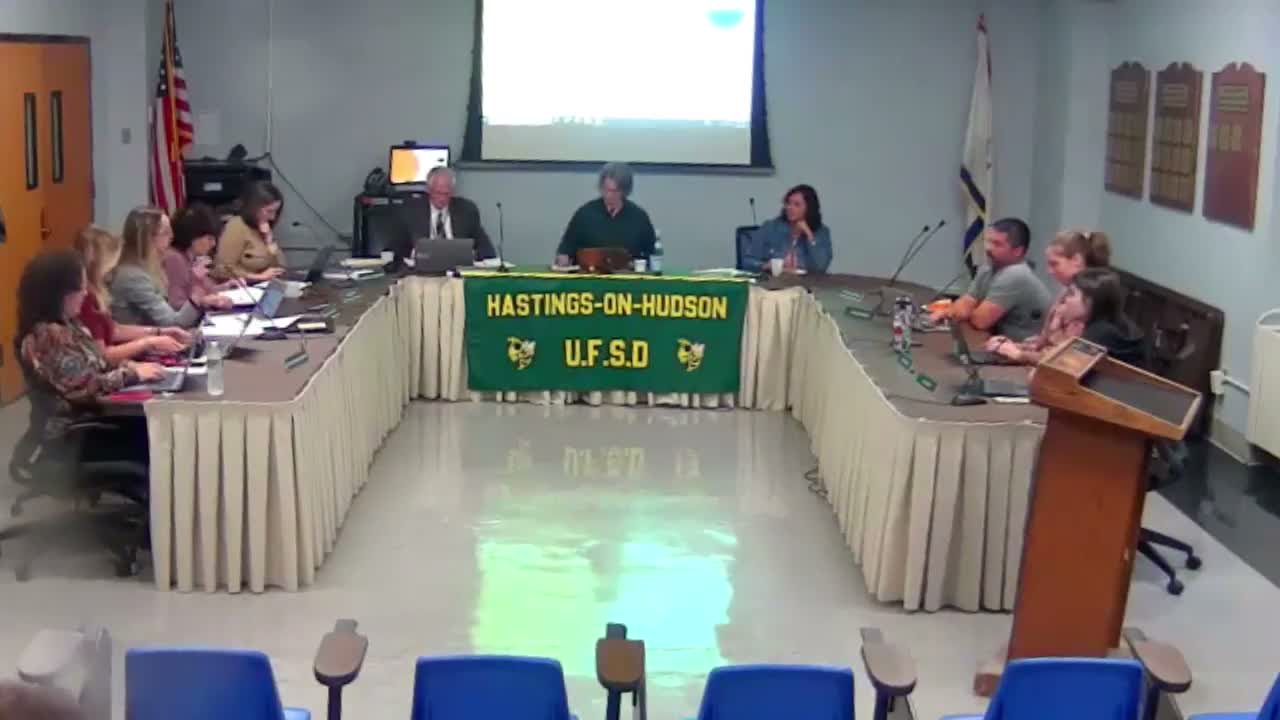
Dr. Szymanski presented Part 1 of the district’s "State of the District," emphasizing that the slides and a larger board-docs packet provide aggregated academic, social-emotional and behavioral data intended to guide follow-up analysis.
The superintendent said the district saw strong proficiency on New York State ELA and math assessments in several grades — noting Hillside’s Grade 4 ELA at 93% meeting or exceeding the proficiency standard and Hillside Grade 4 math at 94% — but cautioned that these figures combine both "meeting" and "exceeding" categories. He told the board the district performs well in the BOCES Southern Westchester region but that a gap remains between proficiency and mastery: "In Algebra and U.S. history, mastery level performance is below 50% when we consider both buildings," he said, noting the state changed some exams and rubrics, which affects comparisons over time.
Szymanski described the district’s STAR diagnostic (K–8) results as showing a large majority at or above benchmark, with higher percentages at the elementary level than the middle school, and urged careful interpretation where cohort sizes and testing modes changed. He also explained the district’s heat-map visual (deciles within the BOCES region) and said the state’s recent shift toward computer-based testing and new regents administrations complicates direct year-to-year comparisons.
On social-emotional learning, Szymanski reviewed Panorama survey results. He reported broad ranges of "favorable" responses (for example, 51%–81% in early grades on some indicators), highlighted supportive relationships as consistently high, and warned that high-school spring response rates were weak: "We had very weak participation in the spring, so I really want to reiterate we need to interpret this extremely cautiously," he said.
Turning to behavioral reporting, Szymanski explained legal privacy limits for individual incidents and described the district’s VADER (violent and disruptive incidents) and DASA (Dignity for All Students Act) reporting. He said the schools recorded five founded VADER incidents in 2023–24, three of which were counted as DASA material incidents, and outlined themes by level (elementary: cursing, physical; FMS: hate speech/threats; high school: confrontation). He said the district will strengthen recordkeeping and alignment across buildings to ensure suspensions and founded incidents are entered consistently in students’ records.
Board members pressed for deeper disaggregation to explain grade-to-grade differences and accelerated-course effects. One board member asked if accelerated eighth-grade Algebra cohorts explain higher mastery; Szymanski said that is one theory among several and committed to follow-up analysis that will examine subgroups and program differences. He said next steps will move from descriptive reporting to analytical interpretation and action planning, and he invited further questions at future meetings.
The presentation was introduced as Part 1; the superintendent said subsequent sessions will show disaggregated analyses and proposed action plans.
The superintendent said the district saw strong proficiency on New York State ELA and math assessments in several grades — noting Hillside’s Grade 4 ELA at 93% meeting or exceeding the proficiency standard and Hillside Grade 4 math at 94% — but cautioned that these figures combine both "meeting" and "exceeding" categories. He told the board the district performs well in the BOCES Southern Westchester region but that a gap remains between proficiency and mastery: "In Algebra and U.S. history, mastery level performance is below 50% when we consider both buildings," he said, noting the state changed some exams and rubrics, which affects comparisons over time.
Szymanski described the district’s STAR diagnostic (K–8) results as showing a large majority at or above benchmark, with higher percentages at the elementary level than the middle school, and urged careful interpretation where cohort sizes and testing modes changed. He also explained the district’s heat-map visual (deciles within the BOCES region) and said the state’s recent shift toward computer-based testing and new regents administrations complicates direct year-to-year comparisons.
On social-emotional learning, Szymanski reviewed Panorama survey results. He reported broad ranges of "favorable" responses (for example, 51%–81% in early grades on some indicators), highlighted supportive relationships as consistently high, and warned that high-school spring response rates were weak: "We had very weak participation in the spring, so I really want to reiterate we need to interpret this extremely cautiously," he said.
Turning to behavioral reporting, Szymanski explained legal privacy limits for individual incidents and described the district’s VADER (violent and disruptive incidents) and DASA (Dignity for All Students Act) reporting. He said the schools recorded five founded VADER incidents in 2023–24, three of which were counted as DASA material incidents, and outlined themes by level (elementary: cursing, physical; FMS: hate speech/threats; high school: confrontation). He said the district will strengthen recordkeeping and alignment across buildings to ensure suspensions and founded incidents are entered consistently in students’ records.
Board members pressed for deeper disaggregation to explain grade-to-grade differences and accelerated-course effects. One board member asked if accelerated eighth-grade Algebra cohorts explain higher mastery; Szymanski said that is one theory among several and committed to follow-up analysis that will examine subgroups and program differences. He said next steps will move from descriptive reporting to analytical interpretation and action planning, and he invited further questions at future meetings.
The presentation was introduced as Part 1; the superintendent said subsequent sessions will show disaggregated analyses and proposed action plans.
Don't Miss a Word: See the Full Meeting!
Go beyond summaries. Unlock every video, transcript, and key insight with a Founder Membership.
✓
Get instant access to full meeting videos
✓
Search and clip any phrase from complete transcripts
✓
Receive AI-powered summaries & custom alerts
✓
Enjoy lifetime, unrestricted access to government data
30-day money-back guarantee
