Washington Supreme Court hears arguments over sufficiency of evidence in State v. Abbas Salah Zahar
October 31, 2024 | Supreme Court, Judicial , Washington
This article was created by AI summarizing key points discussed. AI makes mistakes, so for full details and context, please refer to the video of the full meeting. Please report any errors so we can fix them. Report an error »
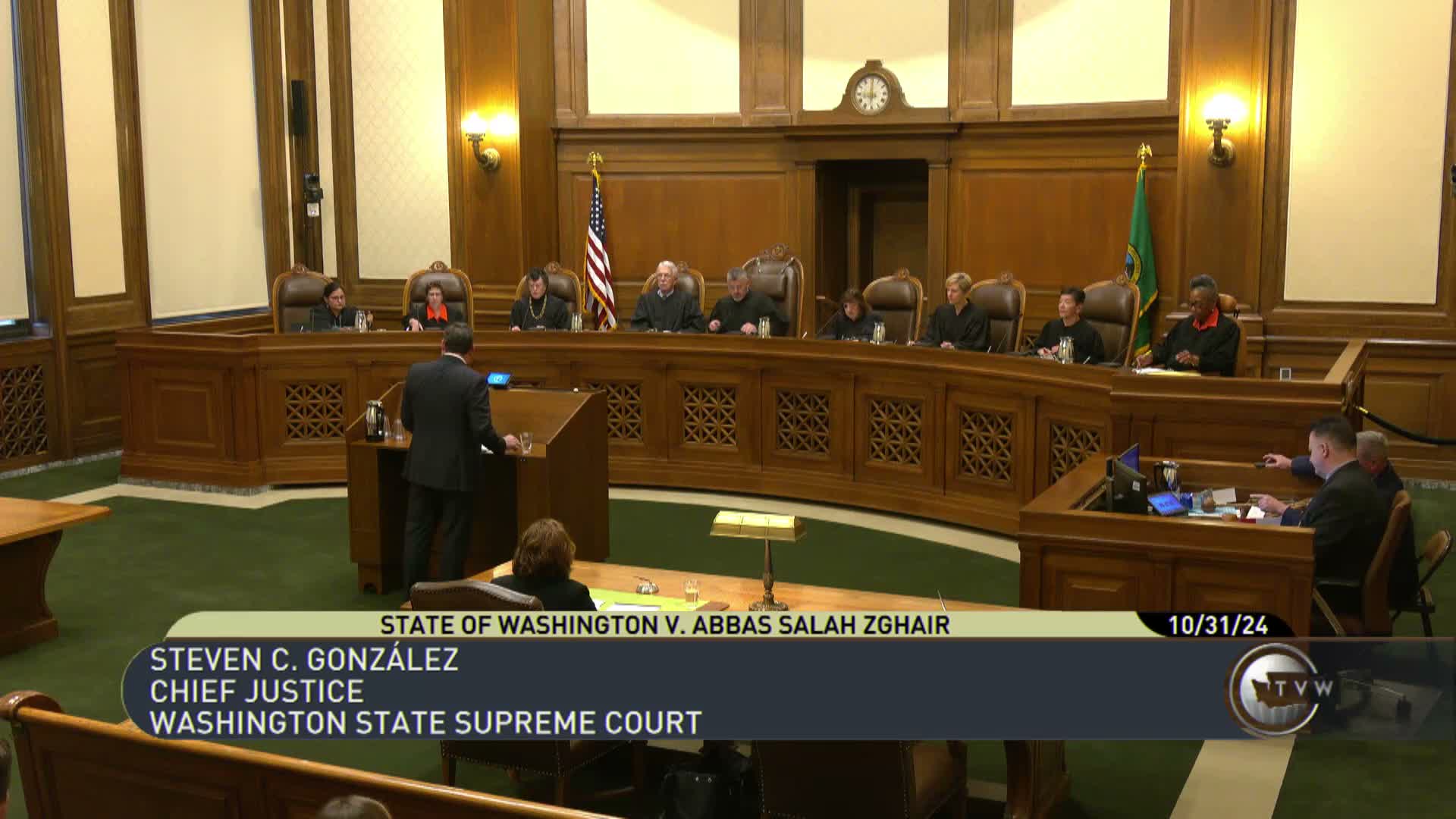
The Washington Supreme Court heard argument on Oct. 31, 2024, over whether the court of appeals improperly reweighed evidence and whether the record contains enough for accomplice liability in State of Washington v. Abbas Salah Zahar. The court noted Justice Owens was recused and Pro Tem Sutton sat for the two cases that morning.
Ian Heath, counsel for the State, urged the justices to reverse the court of appeals, saying the appellate court “usurped the role of the jury in the sufficiency of the evidence review” by discounting state evidence and reweighing competing inferences. Heath told the court the jury was entitled to consider a “basket of evidence” — including the defendant’s presence at the scene, a struggle, disposal of the victim’s phone, a vehicle stashed on a back road, and travel to Canada — and to draw cumulative reasonable inferences pointing to guilty knowledge or participation.
Nancy Collins, counsel for Abbas Salah Zahar, told the court the State must prove that Zahar knowingly aided an intentional shooting, and she argued the record shows only presence and suspicion, not the required knowledge or participation. “Suspicion is not enough to prove his actual knowledge of his participation and his intent,” Collins said, stressing that small trace DNA, equivocal forensic findings, and gaps in the timeline leave key questions unanswered.
Justices pressed both sides on how to treat circumstantial evidence and what additional facts would permit inferring intent. The bench explored whether flight evidence and post‑offense conduct could be discounted and still leave a sufficient record. Heath argued that circumstantial evidence can carry the same weight as direct evidence and that a reviewing court must view all inferences most strongly for the State; Collins countered that established Washington precedent requires more than mere presence plus suspicion to convict on accomplice liability.
The justices also discussed evidentiary specifics raised in briefing and at trial: cell‑tower and GPS tracking showing phones together, surveillance video suggesting a third person in a red shirt, forensic traces in the vehicle, and the absence of direct proof that the defendant handled the firearm. Counsel disagreed about whether those facts, taken together, permit a rational jury to infer the requisite intent for accomplice liability rather than merely proving presence at the scene.
At the close of argument the State reiterated its request that the court reverse the court of appeals; the defense asked the court to affirm. After a few final questions, the court took the case and recessed for 10 minutes. No decision was announced from the bench.
Ian Heath, counsel for the State, urged the justices to reverse the court of appeals, saying the appellate court “usurped the role of the jury in the sufficiency of the evidence review” by discounting state evidence and reweighing competing inferences. Heath told the court the jury was entitled to consider a “basket of evidence” — including the defendant’s presence at the scene, a struggle, disposal of the victim’s phone, a vehicle stashed on a back road, and travel to Canada — and to draw cumulative reasonable inferences pointing to guilty knowledge or participation.
Nancy Collins, counsel for Abbas Salah Zahar, told the court the State must prove that Zahar knowingly aided an intentional shooting, and she argued the record shows only presence and suspicion, not the required knowledge or participation. “Suspicion is not enough to prove his actual knowledge of his participation and his intent,” Collins said, stressing that small trace DNA, equivocal forensic findings, and gaps in the timeline leave key questions unanswered.
Justices pressed both sides on how to treat circumstantial evidence and what additional facts would permit inferring intent. The bench explored whether flight evidence and post‑offense conduct could be discounted and still leave a sufficient record. Heath argued that circumstantial evidence can carry the same weight as direct evidence and that a reviewing court must view all inferences most strongly for the State; Collins countered that established Washington precedent requires more than mere presence plus suspicion to convict on accomplice liability.
The justices also discussed evidentiary specifics raised in briefing and at trial: cell‑tower and GPS tracking showing phones together, surveillance video suggesting a third person in a red shirt, forensic traces in the vehicle, and the absence of direct proof that the defendant handled the firearm. Counsel disagreed about whether those facts, taken together, permit a rational jury to infer the requisite intent for accomplice liability rather than merely proving presence at the scene.
At the close of argument the State reiterated its request that the court reverse the court of appeals; the defense asked the court to affirm. After a few final questions, the court took the case and recessed for 10 minutes. No decision was announced from the bench.
View the Full Meeting & All Its Details
This article offers just a summary. Unlock complete video, transcripts, and insights as a Founder Member.
✓
Watch full, unedited meeting videos
✓
Search every word spoken in unlimited transcripts
✓
AI summaries & real-time alerts (all government levels)
✓
Permanent access to expanding government content
30-day money-back guarantee
