Rome City School District auditor cites documentation gaps, board approves $6 million capital transfer
October 30, 2024 | ROME CITY SCHOOL DISTRICT, School Districts, New York
This article was created by AI summarizing key points discussed. AI makes mistakes, so for full details and context, please refer to the video of the full meeting. Please report any errors so we can fix them. Report an error »
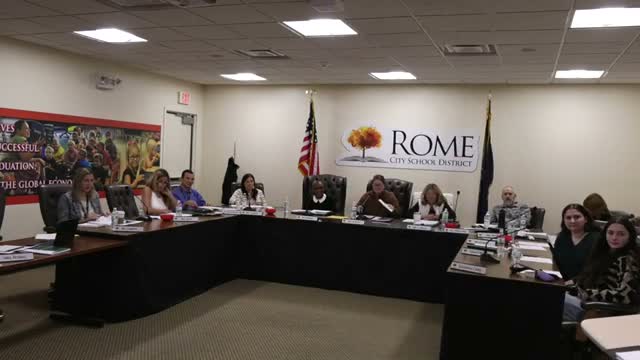
The Rome City School District Board of Education heard an independent auditor outline significant bookkeeping and documentation deficiencies and then approved a series of finance resolutions, including a $6,000,000 transfer to the capital fund and a transfer into the Teacher Retirement Service reserve.
The district's external auditor told the board the June 30, 2024 audit was hampered by tornado-related record issues and staff turnover, and that the audit required an unusually large number of post-closing adjustments. "We had probably, well there's 46 journal entries in total, which is a lot," the auditor said, summarizing reconciliation and trial-balance corrections the audit team posted to clean the books.
Why it matters
The auditor said missing personnel and payroll documents (I-9s, TRS/ERS enrollment forms), delayed single-audit documentation and a backlog of reconciling items increased risk and required corrective journal entries. The auditor advised the board to strengthen approval controls for general journal entries, keep key files backed up off-site, and tighten documentation for federal programs.
Details from the presentation
- Audit context: the auditor described this year as a "stress test" caused by staff changes and a tornado that disrupted record availability. The auditor flagged that many reconciliations and closing procedures needed attention. (External Auditor)
- Journal entries and corrections: 46 journal entries were recorded; about 29 of those corrected trial-balance differences, according to the auditor. The report noted the need for routine reconciliations and approvals.
- Stale-dated checks: the audit identified roughly $158,000 in stale-dated prior-year checks currently listed in accounts payable; the auditor noted they should be routed to the state comptroller's unclaimed funds process if not claimed.
- Federal awards testing: auditors sampled Title I and ESSER programs and reported testing that represented about $9,000,000 of roughly $15,000,000 in federal awards.
- Fund balances and reserves: the audit included districtwide GASB-driven liabilities (OPEB) that create a large long-term liability on the government-wide statements; the auditor emphasized those figures do not change the general fund operating position.
Board actions and votes
At the meeting the board approved several finance resolutions presented by Board Member Sue. On the board's voice vote the board:
- Approved a contract with the County of Oneida to provide preschool special education evaluation and program services from 07/01/2024 to 06/30/2029 (contingent on federal/state funding). (Moved by Sue; seconded; resolution passed.)
- Approved a transfer of $6,000,000 from the general fund to the capital fund to finance the 2022 capital project and directed the superintendent and business administrator to effectuate the transfer. (Moved by Sue; seconded; resolution passed.)
- Approved a resolution to transfer up to $900,000 from unreserved general fund balance to the Teacher Retirement Service (TRS) reserve fund pursuant to General Municipal Law section 6-p, effective 06/30/2024. (Moved by Sue; seconded; resolution passed.)
District response and next steps
The Director of Business and Finance acknowledged management has begun implementing confirmations and new processes since August and described work underway to digitize files and strengthen approvals. The district also noted some documentation was unavailable quickly because records were in transit to a vendor performing scanning and because of the tornado.
Clarifying details
- Journal entries: 46 total; ~29 were correcting items.
- Stale-dated checks: approximately $158,000 total (prior year plus current year additions).
- TRS reserve: board approved transfer up to $900,000; transcript notes $987,000 increase after interest in one calculation context (report pages cited in the audit binders).
- Capital transfer: $6,000,000 to capital fund for the 2022 capital project (approved by the board).
What the board directed
Board members and staff agreed to: pursue stronger electronic document storage and backups; implement additional reconciliation and approval checkpoints for general journal entries; and follow up on single-audit schedules and Title I/ESSER program documentation. The finance committee set future meetings to continue oversight.
The Board voted to adopt the consent and finance resolutions during the meeting; no roll-call tallies were read during these voice votes. The board discussion and audit presentation concluded before the meeting moved to human resources and other business.
The district's external auditor told the board the June 30, 2024 audit was hampered by tornado-related record issues and staff turnover, and that the audit required an unusually large number of post-closing adjustments. "We had probably, well there's 46 journal entries in total, which is a lot," the auditor said, summarizing reconciliation and trial-balance corrections the audit team posted to clean the books.
Why it matters
The auditor said missing personnel and payroll documents (I-9s, TRS/ERS enrollment forms), delayed single-audit documentation and a backlog of reconciling items increased risk and required corrective journal entries. The auditor advised the board to strengthen approval controls for general journal entries, keep key files backed up off-site, and tighten documentation for federal programs.
Details from the presentation
- Audit context: the auditor described this year as a "stress test" caused by staff changes and a tornado that disrupted record availability. The auditor flagged that many reconciliations and closing procedures needed attention. (External Auditor)
- Journal entries and corrections: 46 journal entries were recorded; about 29 of those corrected trial-balance differences, according to the auditor. The report noted the need for routine reconciliations and approvals.
- Stale-dated checks: the audit identified roughly $158,000 in stale-dated prior-year checks currently listed in accounts payable; the auditor noted they should be routed to the state comptroller's unclaimed funds process if not claimed.
- Federal awards testing: auditors sampled Title I and ESSER programs and reported testing that represented about $9,000,000 of roughly $15,000,000 in federal awards.
- Fund balances and reserves: the audit included districtwide GASB-driven liabilities (OPEB) that create a large long-term liability on the government-wide statements; the auditor emphasized those figures do not change the general fund operating position.
Board actions and votes
At the meeting the board approved several finance resolutions presented by Board Member Sue. On the board's voice vote the board:
- Approved a contract with the County of Oneida to provide preschool special education evaluation and program services from 07/01/2024 to 06/30/2029 (contingent on federal/state funding). (Moved by Sue; seconded; resolution passed.)
- Approved a transfer of $6,000,000 from the general fund to the capital fund to finance the 2022 capital project and directed the superintendent and business administrator to effectuate the transfer. (Moved by Sue; seconded; resolution passed.)
- Approved a resolution to transfer up to $900,000 from unreserved general fund balance to the Teacher Retirement Service (TRS) reserve fund pursuant to General Municipal Law section 6-p, effective 06/30/2024. (Moved by Sue; seconded; resolution passed.)
District response and next steps
The Director of Business and Finance acknowledged management has begun implementing confirmations and new processes since August and described work underway to digitize files and strengthen approvals. The district also noted some documentation was unavailable quickly because records were in transit to a vendor performing scanning and because of the tornado.
Clarifying details
- Journal entries: 46 total; ~29 were correcting items.
- Stale-dated checks: approximately $158,000 total (prior year plus current year additions).
- TRS reserve: board approved transfer up to $900,000; transcript notes $987,000 increase after interest in one calculation context (report pages cited in the audit binders).
- Capital transfer: $6,000,000 to capital fund for the 2022 capital project (approved by the board).
What the board directed
Board members and staff agreed to: pursue stronger electronic document storage and backups; implement additional reconciliation and approval checkpoints for general journal entries; and follow up on single-audit schedules and Title I/ESSER program documentation. The finance committee set future meetings to continue oversight.
The Board voted to adopt the consent and finance resolutions during the meeting; no roll-call tallies were read during these voice votes. The board discussion and audit presentation concluded before the meeting moved to human resources and other business.
Don't Miss a Word: See the Full Meeting!
Go beyond summaries. Unlock every video, transcript, and key insight with a Founder Membership.
✓
Get instant access to full meeting videos
✓
Search and clip any phrase from complete transcripts
✓
Receive AI-powered summaries & custom alerts
✓
Enjoy lifetime, unrestricted access to government data
30-day money-back guarantee
