Highland Street connectivity amendment tabled after members seek deeper cost breakdowns
February 27, 2026 | Dauphin County, Pennsylvania
This article was created by AI summarizing key points discussed. AI makes mistakes, so for full details and context, please refer to the video of the full meeting. Please report any errors so we can fix them. Report an error »
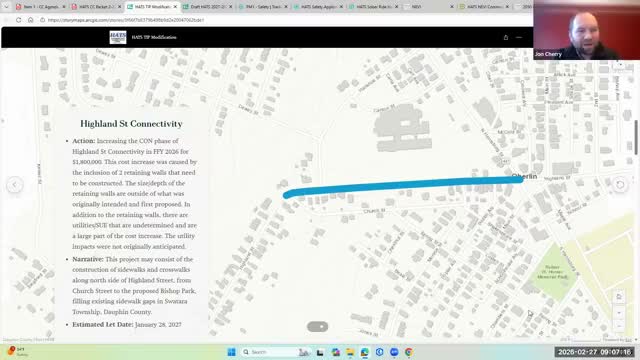
John Cherry, an engineer with Delphine Engineering representing South Swattera Township, presented follow-up information on the Highland Street connectivity project and said the design now includes retaining walls and reconstruction of existing sidewalks to tie into the new Bishop Park multipurpose trail.
"This link effectively plugs the neighborhood again into the Capital Green Belt and the regional trail networks," Cherry said, describing the route from Highland and Church streets to Bishop Park and noting the project’s benefit to students at Quintero Middle School. He said the team prepared a detailed estimate supporting a $1,800,000 project and that the township and the school district would provide local matches (the school district pledged $50,000 for segments in front of the middle school).
Irene, a member of the project design team, told the committee that alternatives such as cutting back slopes were evaluated but often proved infeasible because they would require large right-of-way takings or remove informal parking used by residents. She cited steep unit-cost increases as a major driver: "Pervious concrete went from $60 per square yard to $350 per square yard," she said, adding that related incidental costs (clearing, mobilization, inspection contingencies) expand as subtotals grow.
City of Harrisburg engineer Mohammed asked whether pervious pavement was a regulatory requirement for stormwater or green infrastructure. Project staff said it is not required and that they are discussing switching to conventional concrete to reduce costs, but cautioned that decisions made earlier in the design process and coordination among partners will need to be revisited.
Several committee members said the packet lacked the detailed original-estimate versus current-estimate breakdown they expected after the item was tabled in December. "I would ask that we table it again and ask them to please come back with more," the chair said. A committee member moved to table the amendment; the motion was seconded and a voice vote followed, with members responding "Aye." The motion carried.
Next steps: staff were asked to return with the detailed cost comparison, alternative design options (including the scope and maintenance implications of pervious versus impervious sidewalks), and clearer documentation of which retaining walls are structurally required versus design choices.
"This link effectively plugs the neighborhood again into the Capital Green Belt and the regional trail networks," Cherry said, describing the route from Highland and Church streets to Bishop Park and noting the project’s benefit to students at Quintero Middle School. He said the team prepared a detailed estimate supporting a $1,800,000 project and that the township and the school district would provide local matches (the school district pledged $50,000 for segments in front of the middle school).
Irene, a member of the project design team, told the committee that alternatives such as cutting back slopes were evaluated but often proved infeasible because they would require large right-of-way takings or remove informal parking used by residents. She cited steep unit-cost increases as a major driver: "Pervious concrete went from $60 per square yard to $350 per square yard," she said, adding that related incidental costs (clearing, mobilization, inspection contingencies) expand as subtotals grow.
City of Harrisburg engineer Mohammed asked whether pervious pavement was a regulatory requirement for stormwater or green infrastructure. Project staff said it is not required and that they are discussing switching to conventional concrete to reduce costs, but cautioned that decisions made earlier in the design process and coordination among partners will need to be revisited.
Several committee members said the packet lacked the detailed original-estimate versus current-estimate breakdown they expected after the item was tabled in December. "I would ask that we table it again and ask them to please come back with more," the chair said. A committee member moved to table the amendment; the motion was seconded and a voice vote followed, with members responding "Aye." The motion carried.
Next steps: staff were asked to return with the detailed cost comparison, alternative design options (including the scope and maintenance implications of pervious versus impervious sidewalks), and clearer documentation of which retaining walls are structurally required versus design choices.
View the Full Meeting & All Its Details
This article offers just a summary. Unlock complete video, transcripts, and insights as a Founder Member.
✓
Watch full, unedited meeting videos
✓
Search every word spoken in unlimited transcripts
✓
AI summaries & real-time alerts (all government levels)
✓
Permanent access to expanding government content
30-day money-back guarantee
