Washington House passes supplemental budget after hours of debate over Medicaid, schools and climate funds
February 28, 2026 | Legislative Sessions, Washington
This article was created by AI summarizing key points discussed. AI makes mistakes, so for full details and context, please refer to the video of the full meeting. Please report any errors so we can fix them. Report an error »
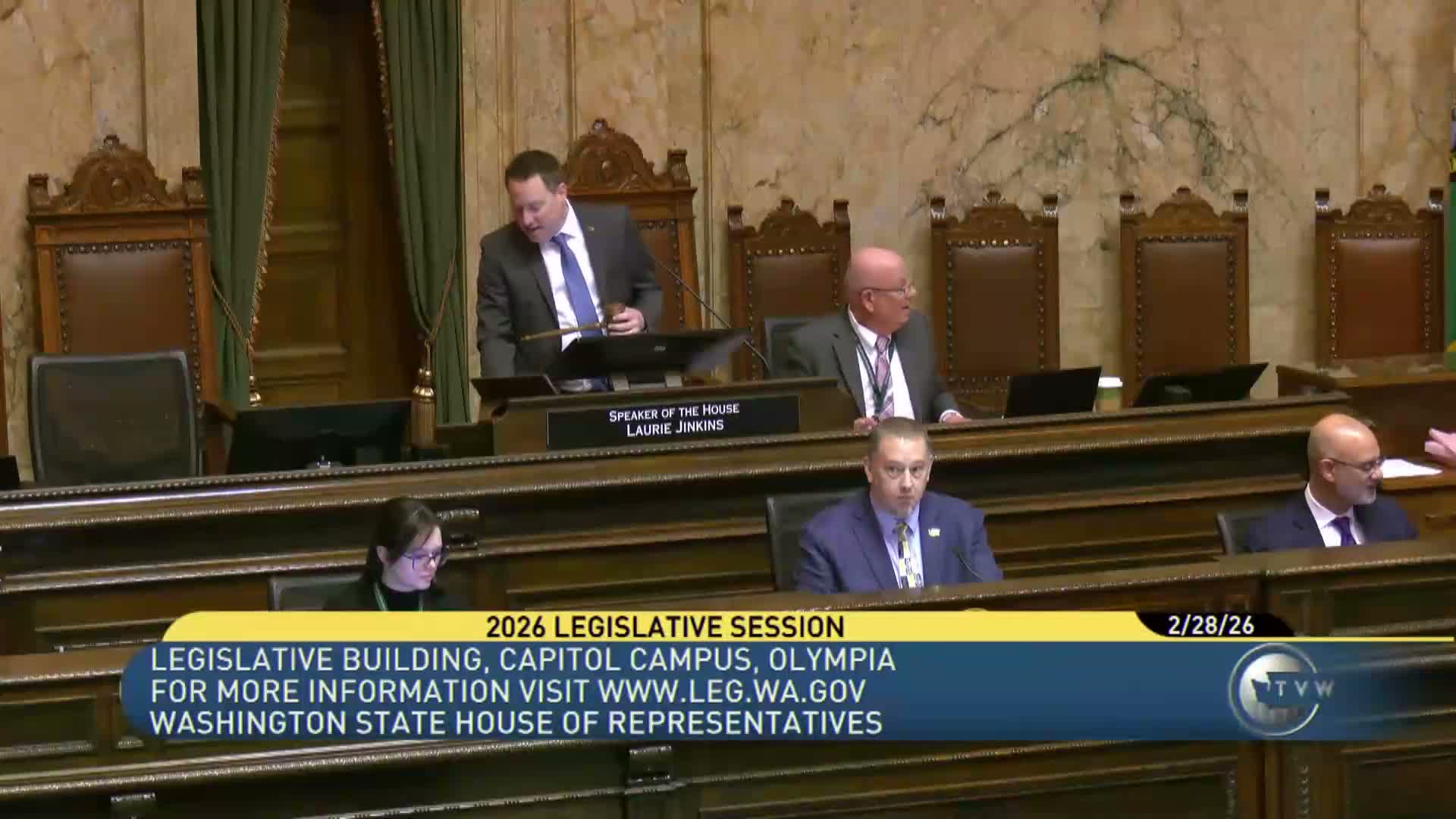
The Washington state House passed a supplemental operating budget late Feb. 28, approving the Appropriations Committee's striking amendment to Substitute Senate Bill 59 98 after extended debate and multiple roll‑call votes. The final tally was 52 yeas, 41 nays and 5 excused.
The measure, presented as a supplemental to the 2025–27 operating budget, included a mix of new appropriations, transfers using climate‑related funds and targeted program changes. Lawmakers spent the day arguing over policy tradeoffs, with hours of floor speeches focused on cuts to Medicaid reimbursements, changes to K‑12 material, supplies and operating costs (MSOC), and whether certain dedicated accounts should be repurposed for property‑tax relief or other priorities.
"Budgets are blueprints to the values in our heart," Representative Ormsby said in floor remarks urging colleagues to support the package. "Maintaining services for those basic needs has been the North Star that we have followed," she said, asking members to weigh the competing pressures the budget attempts to meet.
Opponents repeatedly objected to the scale and some of the methods used in the bill. Representative Couture, who voted against the package, said the budget was "growing government on the backs of our people" and criticized what she called deep Medicaid cuts and reliance on unproven revenue assumptions. "You can't tax your way out of prosperity," she said.
A central set of floor fights concerned health‑care funding. Sponsors said limited state dollars and federal changes required careful tradeoffs; critics said the reduction in state Medicaid funding (added on top of prior cuts) risks further strain on hospitals and rural care. Representative Marshall urged restoring Medicaid funding or accepting modest employee cost‑sharing adjustments to protect services for low‑income residents, while others argued for fiscal restraint.
Education funding was another flashpoint. The supplemental included proposals that would reduce some statewide MSOC support for K‑12 districts and adjust local effort assistance. Multiple amendments were offered to restore MSOC funding, preserve transition‑to‑kindergarten slots and protect bus depreciation schedules. A number of those amendments were debated at length and ultimately not adopted; one omnibus set of changes to education funding was defeated on the floor.
"Teachers are spending more and more out of pocket," said Representative Rood during debate on MSOC funding. "A $100 per‑pupil bump would cover only a portion of rising insurance and utility costs, but it would help districts keep essential services."
Lawmakers also debated whether to reallocate some climate‑related revenues to provide direct relief to drivers. Amendment proponents argued that a targeted rebate would help families facing high gasoline prices; opponents warned that diverting Climate Commitment Act funds would contradict voter intent and undermine long‑term emissions reductions plans. That amendment failed on the floor.
Several policy bills and committee amendments were resolved during the same session. Notable actions earlier in the day included final passage of an amended transportation fiscal bill (Engrossed Substitute Senate Bill 60005) and floor passage of a resources bill (Engrossed Substitute House Bill 27111). The House also considered and amended bills on voter‑registration database penalties and energy policy before taking up the budget.
The House adopted a number of smaller appropriations and provisos — including language directing agencies to produce plans on particular programs — and rejected dozens of member amendments. After the budget vote, the Speaker thanked staff and interns for lengthy work preparing the complex package.
With the House passage complete, the supplemental now moves to the Senate (or, if applicable under chamber procedure, to any required transmittal/conciliation steps) and will undergo the remainder of the legislative process before any changes are enacted. Supporters described the bill as a careful compromise in difficult fiscal times; opponents said it left too many gaps and risky assumptions.
What happens next: The budget will proceed to the next steps in the bicameral process. If the Senate concurs, the bills go to the governor; if not, conferees will negotiate differences. Several lawmakers said they expected ongoing work in committee and possible conference negotiations to adjust the package further.
Vote counts cited in the debate and on the House floor: ESSB 60005 (transportation) final passage 93–0 with 5 excused; Engrossed House Bill 27111 final passage 83–10 with 5 excused; Substitute Senate Bill 59 98 (supplemental operating budget) final passage 52–41 with 5 excused.
The House adjourned to reconvene Monday morning for continuation of remaining business.
The measure, presented as a supplemental to the 2025–27 operating budget, included a mix of new appropriations, transfers using climate‑related funds and targeted program changes. Lawmakers spent the day arguing over policy tradeoffs, with hours of floor speeches focused on cuts to Medicaid reimbursements, changes to K‑12 material, supplies and operating costs (MSOC), and whether certain dedicated accounts should be repurposed for property‑tax relief or other priorities.
"Budgets are blueprints to the values in our heart," Representative Ormsby said in floor remarks urging colleagues to support the package. "Maintaining services for those basic needs has been the North Star that we have followed," she said, asking members to weigh the competing pressures the budget attempts to meet.
Opponents repeatedly objected to the scale and some of the methods used in the bill. Representative Couture, who voted against the package, said the budget was "growing government on the backs of our people" and criticized what she called deep Medicaid cuts and reliance on unproven revenue assumptions. "You can't tax your way out of prosperity," she said.
A central set of floor fights concerned health‑care funding. Sponsors said limited state dollars and federal changes required careful tradeoffs; critics said the reduction in state Medicaid funding (added on top of prior cuts) risks further strain on hospitals and rural care. Representative Marshall urged restoring Medicaid funding or accepting modest employee cost‑sharing adjustments to protect services for low‑income residents, while others argued for fiscal restraint.
Education funding was another flashpoint. The supplemental included proposals that would reduce some statewide MSOC support for K‑12 districts and adjust local effort assistance. Multiple amendments were offered to restore MSOC funding, preserve transition‑to‑kindergarten slots and protect bus depreciation schedules. A number of those amendments were debated at length and ultimately not adopted; one omnibus set of changes to education funding was defeated on the floor.
"Teachers are spending more and more out of pocket," said Representative Rood during debate on MSOC funding. "A $100 per‑pupil bump would cover only a portion of rising insurance and utility costs, but it would help districts keep essential services."
Lawmakers also debated whether to reallocate some climate‑related revenues to provide direct relief to drivers. Amendment proponents argued that a targeted rebate would help families facing high gasoline prices; opponents warned that diverting Climate Commitment Act funds would contradict voter intent and undermine long‑term emissions reductions plans. That amendment failed on the floor.
Several policy bills and committee amendments were resolved during the same session. Notable actions earlier in the day included final passage of an amended transportation fiscal bill (Engrossed Substitute Senate Bill 60005) and floor passage of a resources bill (Engrossed Substitute House Bill 27111). The House also considered and amended bills on voter‑registration database penalties and energy policy before taking up the budget.
The House adopted a number of smaller appropriations and provisos — including language directing agencies to produce plans on particular programs — and rejected dozens of member amendments. After the budget vote, the Speaker thanked staff and interns for lengthy work preparing the complex package.
With the House passage complete, the supplemental now moves to the Senate (or, if applicable under chamber procedure, to any required transmittal/conciliation steps) and will undergo the remainder of the legislative process before any changes are enacted. Supporters described the bill as a careful compromise in difficult fiscal times; opponents said it left too many gaps and risky assumptions.
What happens next: The budget will proceed to the next steps in the bicameral process. If the Senate concurs, the bills go to the governor; if not, conferees will negotiate differences. Several lawmakers said they expected ongoing work in committee and possible conference negotiations to adjust the package further.
Vote counts cited in the debate and on the House floor: ESSB 60005 (transportation) final passage 93–0 with 5 excused; Engrossed House Bill 27111 final passage 83–10 with 5 excused; Substitute Senate Bill 59 98 (supplemental operating budget) final passage 52–41 with 5 excused.
The House adjourned to reconvene Monday morning for continuation of remaining business.
Don't Miss a Word: See the Full Meeting!
Go beyond summaries. Unlock every video, transcript, and key insight with a Founder Membership.
✓
Get instant access to full meeting videos
✓
Search and clip any phrase from complete transcripts
✓
Receive AI-powered summaries & custom alerts
✓
Enjoy lifetime, unrestricted access to government data
30-day money-back guarantee
