Warren Township credits reading reforms for gains, backs SB 34 to widen teacher access
January 25, 2025 | MSD Warren Township, School Boards, Indiana
This article was created by AI summarizing key points discussed. AI makes mistakes, so for full details and context, please refer to the video of the full meeting. Please report any errors so we can fix them. Report an error »
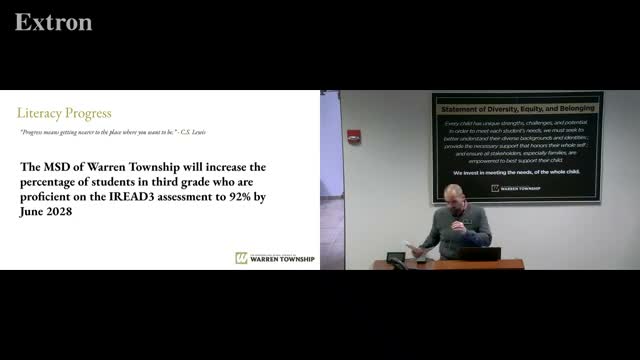
Warren Township officials said the district has seen substantial early‑literacy improvement and urged lawmakers to support Senate Bill 34 to expand teacher access to literacy endorsements.
Ryan Russell, who led the district’s literacy presentation, said the district’s IRE 3 proficiency has increased “by 19% since that pandemic,” and described a district reading plan built on science‑of‑reading principles, external providers and job‑embedded coaching. Russell said the district doubled out‑of‑class reading instruction, expanded summer literacy programs to the full month of June and used ESSER funds to pay for teacher professional development and stipends.
The district asked legislators to back Senate Bill 34 because, the presentation argued, reducing the endorsement hours from 80 to 40 would expand the set of providers able to deliver a complete endorsement pathway and make it easier for teachers to complete certification. Russell said the change “provides an easier access and completion point for staff” and that the district views certification as a starting point that must be paired with ongoing coaching.
Melissa “Missy” Gogel, first vice president of the Warren Education Association and a 33‑year teacher, said she supports lowering the 80‑hour requirement to 40 and removing an additional testing burden. “Eliminating that 80 hours in an endorsement and bringing it down to 40 and then having to take a Praxis, for me, it’s discouraging,” she said, adding the change would reduce costs for teachers pursuing endorsements.
Why it matters: district leaders said faster, less costly pathways to literacy endorsements could accelerate the pool of teachers with targeted preparation in the science of reading at a time when the state is focused on early literacy. They emphasized that certification alone is not enough—ongoing coaching and follow‑up matter for classroom practice.
The forum closed Russell’s presentation by asking legislators to advance Senate Bill 34; a senator in attendance said she and her colleagues appreciated the district's feedback and hoped they could “get Senate Bill 34 across the finish line.”
Next steps: district leaders asked legislators to consider the bill and the resources required to support teachers through both initial certification and ongoing coaching.
Ryan Russell, who led the district’s literacy presentation, said the district’s IRE 3 proficiency has increased “by 19% since that pandemic,” and described a district reading plan built on science‑of‑reading principles, external providers and job‑embedded coaching. Russell said the district doubled out‑of‑class reading instruction, expanded summer literacy programs to the full month of June and used ESSER funds to pay for teacher professional development and stipends.
The district asked legislators to back Senate Bill 34 because, the presentation argued, reducing the endorsement hours from 80 to 40 would expand the set of providers able to deliver a complete endorsement pathway and make it easier for teachers to complete certification. Russell said the change “provides an easier access and completion point for staff” and that the district views certification as a starting point that must be paired with ongoing coaching.
Melissa “Missy” Gogel, first vice president of the Warren Education Association and a 33‑year teacher, said she supports lowering the 80‑hour requirement to 40 and removing an additional testing burden. “Eliminating that 80 hours in an endorsement and bringing it down to 40 and then having to take a Praxis, for me, it’s discouraging,” she said, adding the change would reduce costs for teachers pursuing endorsements.
Why it matters: district leaders said faster, less costly pathways to literacy endorsements could accelerate the pool of teachers with targeted preparation in the science of reading at a time when the state is focused on early literacy. They emphasized that certification alone is not enough—ongoing coaching and follow‑up matter for classroom practice.
The forum closed Russell’s presentation by asking legislators to advance Senate Bill 34; a senator in attendance said she and her colleagues appreciated the district's feedback and hoped they could “get Senate Bill 34 across the finish line.”
Next steps: district leaders asked legislators to consider the bill and the resources required to support teachers through both initial certification and ongoing coaching.
View the Full Meeting & All Its Details
This article offers just a summary. Unlock complete video, transcripts, and insights as a Founder Member.
✓
Watch full, unedited meeting videos
✓
Search every word spoken in unlimited transcripts
✓
AI summaries & real-time alerts (all government levels)
✓
Permanent access to expanding government content
30-day money-back guarantee
