Warren says school safety investments require steady local revenue; warns budget shifts could force trade‑offs
January 25, 2025 | MSD Warren Township, School Boards, Indiana
This article was created by AI summarizing key points discussed. AI makes mistakes, so for full details and context, please refer to the video of the full meeting. Please report any errors so we can fix them. Report an error »
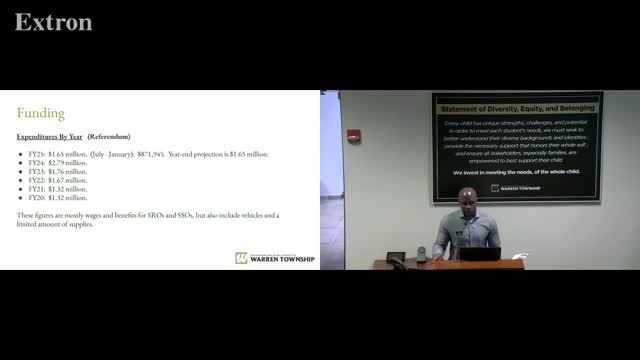
Warren Township officials laid out a district safety framework and the spending trade‑offs that come with it, and asked legislators to consider the fiscal effects of property‑tax and funding proposals.
A district presenter described five safety pillars—physical, emotional/psychological, health, crisis preparedness and community engagement—and said investments now cover wages/benefits for school resource officers, vehicles and equipment. The district reported that safety makes up about 13% of its referendum budget and that, without the referendum, safety spending would be about 5% of the general operations budget.
Officials cited recent uses of Secure School Safety and COPS grants (the district said it received roughly $81,000 from a Secure Safety program this round and used previous awards for fences and radios). The district said it rekeyed its high school and that such capital work is expensive and time‑intensive.
CFO‑level remarks connected safety and broader budget questions: the district projects roughly $160 million in primary funds across all major funds this year, an education fund of about $90 million (with approximately $83.4 million in wages/benefits), and an operations fund near $38 million. The district flagged property‑tax relief bills, levy changes and charter revenue sharing (pilot program already sharing funds in four counties) as potential threats to those revenue streams and cited a $143,000 first‑year impact from one sharing pilot.
Why it matters: safety investments are ongoing costs (people, equipment, vehicles) that compete with transportation, devices and other operational priorities. District leaders said that policy changes that reduce local revenue without replacement will force difficult trade‑offs.
Next steps: district officials urged caution on broad property‑tax changes and asked for conversations about replacement revenue or scaled approaches that preserve local safety investments.
A district presenter described five safety pillars—physical, emotional/psychological, health, crisis preparedness and community engagement—and said investments now cover wages/benefits for school resource officers, vehicles and equipment. The district reported that safety makes up about 13% of its referendum budget and that, without the referendum, safety spending would be about 5% of the general operations budget.
Officials cited recent uses of Secure School Safety and COPS grants (the district said it received roughly $81,000 from a Secure Safety program this round and used previous awards for fences and radios). The district said it rekeyed its high school and that such capital work is expensive and time‑intensive.
CFO‑level remarks connected safety and broader budget questions: the district projects roughly $160 million in primary funds across all major funds this year, an education fund of about $90 million (with approximately $83.4 million in wages/benefits), and an operations fund near $38 million. The district flagged property‑tax relief bills, levy changes and charter revenue sharing (pilot program already sharing funds in four counties) as potential threats to those revenue streams and cited a $143,000 first‑year impact from one sharing pilot.
Why it matters: safety investments are ongoing costs (people, equipment, vehicles) that compete with transportation, devices and other operational priorities. District leaders said that policy changes that reduce local revenue without replacement will force difficult trade‑offs.
Next steps: district officials urged caution on broad property‑tax changes and asked for conversations about replacement revenue or scaled approaches that preserve local safety investments.
Don't Miss a Word: See the Full Meeting!
Go beyond summaries. Unlock every video, transcript, and key insight with a Founder Membership.
✓
Get instant access to full meeting videos
✓
Search and clip any phrase from complete transcripts
✓
Receive AI-powered summaries & custom alerts
✓
Enjoy lifetime, unrestricted access to government data
30-day money-back guarantee
