Commission resumes Community Master Plan deep dive; staff outlines principles, character map and public feedback ahead of Oct. 24 hearing
September 27, 2024 | Grand Rapids City, Kent County, Michigan
This article was created by AI summarizing key points discussed. AI makes mistakes, so for full details and context, please refer to the video of the full meeting. Please report any errors so we can fix them. Report an error »
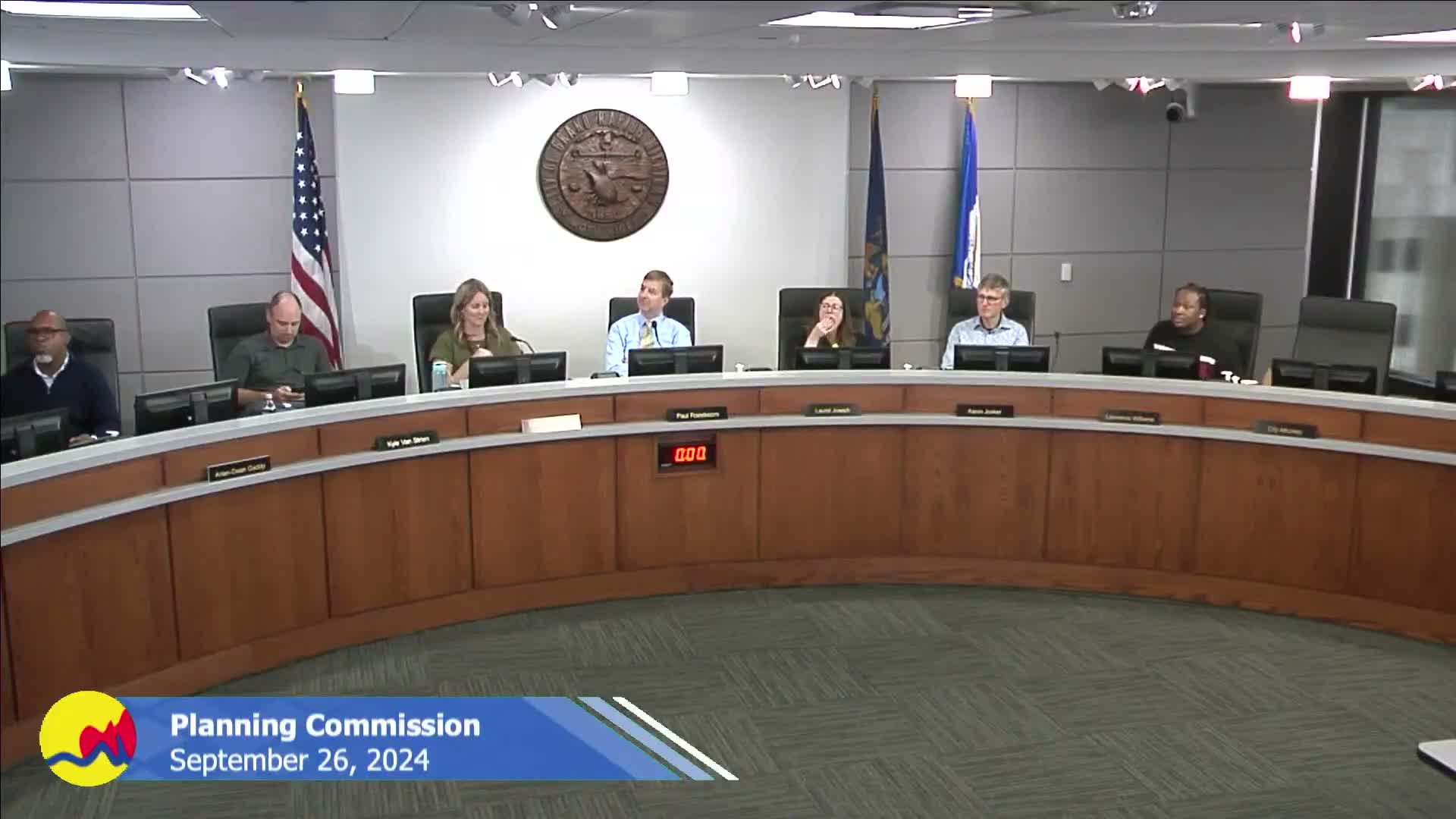
City planning staff and consultants continued a deep-dive review of the Community Master Plan (CMP) on Sept. 26, presenting Chapter 5s guidance on desirable development character, the future character map, and three area-specific plans for Creston, Butterworth and Southtown that are proposed for adoption with the CMP.
Emily Hayes (Planning & Next) summarized 10 development principles — from preserving neighborhood identity to cultivating downtown vibrancy and improving multimodal access — and explained the conceptual development framework that emphasizes nodes (quarter-mile walking radii) and significant corridors where investment should be prioritized. Staff described character types (downtown, neighborhood center, compact and suburban neighborhoods, innovation center, manufacturing/logistics, campus, and parks/open space) and noted the character-map is forward-looking and intended to be used alongside implementation tools such as zoning reforms.
Commissioners probed several technical points: how 'campus' classifications will interact with schools and religious institutions, whether character-type imagery matches textual descriptions (e.g., 'small multifamily' building examples), and how nodes on the conceptual framework align with mapped character types along corridors (for example, Lake Michigan Drive and South Division). Staff agreed to provide side-by-side comparisons between the current master plan map and the proposed future-character map to clarify changes.
Staff also reported 68 comments received through last Friday: common themes included both support and opposition to increased density, calls for more missing-middle housing and accessory/live-work units, requests to adjust setbacks and parking minimums, and requests to make the online map color-blind friendly. Staff committed to continuing outreach, posting presentation slides and returning an update to the commission on Oct. 10 before the public hearing scheduled for Oct. 24; staff said an anticipated adoption is targeted for December.
Commissioners and staff emphasized that the CMPs strategies are intended to inform subsequent ordinance and zoning changes rather than immediate code changes, and that implementation details (e.g., setback adjustments, time-of-planting standards for buffers) will be hashed out during that next phase.
Emily Hayes (Planning & Next) summarized 10 development principles — from preserving neighborhood identity to cultivating downtown vibrancy and improving multimodal access — and explained the conceptual development framework that emphasizes nodes (quarter-mile walking radii) and significant corridors where investment should be prioritized. Staff described character types (downtown, neighborhood center, compact and suburban neighborhoods, innovation center, manufacturing/logistics, campus, and parks/open space) and noted the character-map is forward-looking and intended to be used alongside implementation tools such as zoning reforms.
Commissioners probed several technical points: how 'campus' classifications will interact with schools and religious institutions, whether character-type imagery matches textual descriptions (e.g., 'small multifamily' building examples), and how nodes on the conceptual framework align with mapped character types along corridors (for example, Lake Michigan Drive and South Division). Staff agreed to provide side-by-side comparisons between the current master plan map and the proposed future-character map to clarify changes.
Staff also reported 68 comments received through last Friday: common themes included both support and opposition to increased density, calls for more missing-middle housing and accessory/live-work units, requests to adjust setbacks and parking minimums, and requests to make the online map color-blind friendly. Staff committed to continuing outreach, posting presentation slides and returning an update to the commission on Oct. 10 before the public hearing scheduled for Oct. 24; staff said an anticipated adoption is targeted for December.
Commissioners and staff emphasized that the CMPs strategies are intended to inform subsequent ordinance and zoning changes rather than immediate code changes, and that implementation details (e.g., setback adjustments, time-of-planting standards for buffers) will be hashed out during that next phase.
Don't Miss a Word: See the Full Meeting!
Go beyond summaries. Unlock every video, transcript, and key insight with a Founder Membership.
✓
Get instant access to full meeting videos
✓
Search and clip any phrase from complete transcripts
✓
Receive AI-powered summaries & custom alerts
✓
Enjoy lifetime, unrestricted access to government data
30-day money-back guarantee
