UN Secretary-General Antonio Guterres urges immediate de‑escalation after strikes across the Middle East
February 28, 2026 | United Nations, International
This article was created by AI summarizing key points discussed. AI makes mistakes, so for full details and context, please refer to the video of the full meeting. Please report any errors so we can fix them. Report an error »
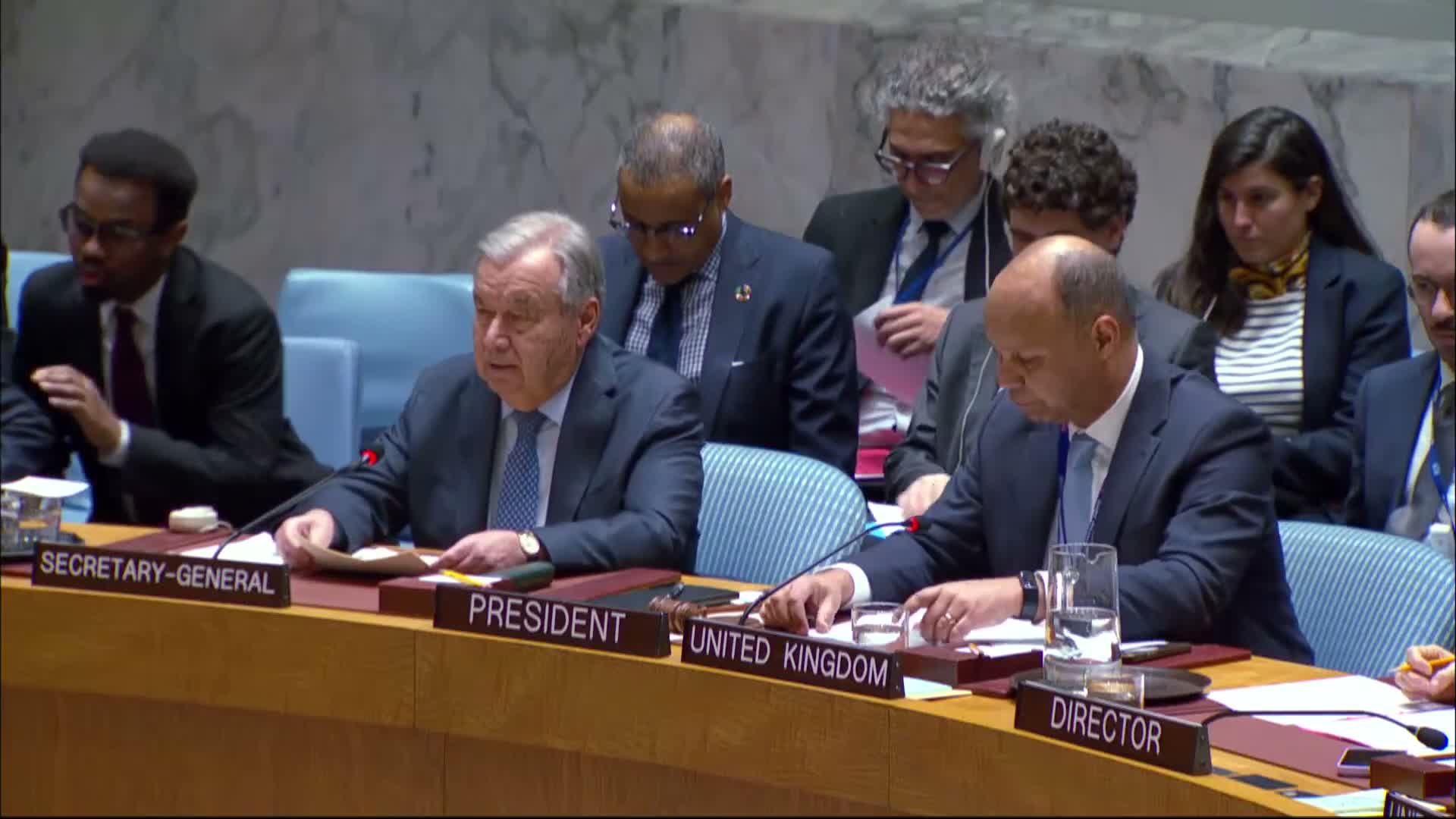
Antonio Guterres, secretary-general of the United Nations, urged an immediate end to hostilities and a return to diplomacy after what he described as a rapid expansion of military action across the Middle East.
Speaking at the meeting, Guterres framed his remarks around “the principles, the facts, and the way out,” invoking the UN Charter’s prohibition on the threat or use of force and stressing that international humanitarian law must be respected. He said the recent strikes risked “igniting a chain of events that no one can control in the most volatile region of the world.”
Guterres explicitly condemned what he said were “massive military strikes by The United States and Israel against Iran” and also condemned subsequent Iranian attacks that he said violated the sovereignty and territorial integrity of Bahrain, Iraq, Jordan, Kuwait, Qatar, Saudi Arabia and the United Arab Emirates. He described the situation as “a grave threat to international peace and security.”
On the facts on the ground, Guterres said the situation remained "very fluid" with many unconfirmed reports. He listed about 20 Iranian cities — including Tehran, Isfahan, Qom and Tabriz — that had reportedly been attacked and said that explosions were reported in Tehran near the Presidential Palace and the supreme leader’s compound. He noted that some reports, which he said he could not confirm, suggested several high-ranking officials had been killed, including a claim made by Israeli sources about Iran’s supreme leader, Ali Khamenei.
Guterres highlighted reports of civilian harm, saying Iran’s airspace had been closed and the country was under a near-total internet blackout. Citing Iranian media, he said an airstrike reportedly killed at least 85 people and injured many more at a girls’ school in Minab (Hormozgan Province), and that a school in Tehran had also reportedly been hit, causing two deaths. He also noted reported injuries in Iran from subsequent strikes and impacts in the occupied West Bank.
Describing broader regional impacts, Guterres said debris and indirect effects were reported in Lebanon and Syria, that most Gulf states intercepted Iranian strikes, and that the UAE reported one civilian death from falling debris from an intercepted missile. He referred to reports of drone and missile attacks in Iraq from both sides and to reports that Iran had closed the Strait of Hormuz to international shipping.
Guterres placed the strikes in a diplomatic context, saying the US and Israeli actions followed indirect talks between the United States and Iran mediated by Oman and that technical talks in Vienna were being prepared for the following week. He said he regretted that the opportunity for diplomacy had been squandered.
He urged all parties to return to the negotiating table, notably on the Iran nuclear program, and noted reported communications between the US president and leaders of Saudi Arabia, Qatar and the UAE as well as conversations by Iran’s foreign minister with Gulf counterparts and Iraq. He called on member states to “strictly uphold their obligations and international law, including the UN Charter,” to protect civilians in accordance with international humanitarian law and to ensure nuclear safety.
The secretary-general closed by urging collective, responsible action to pull the region and the world back from the brink; he gave no timetable for further UN action and did not announce formal decisions or votes at the meeting.
Speaking at the meeting, Guterres framed his remarks around “the principles, the facts, and the way out,” invoking the UN Charter’s prohibition on the threat or use of force and stressing that international humanitarian law must be respected. He said the recent strikes risked “igniting a chain of events that no one can control in the most volatile region of the world.”
Guterres explicitly condemned what he said were “massive military strikes by The United States and Israel against Iran” and also condemned subsequent Iranian attacks that he said violated the sovereignty and territorial integrity of Bahrain, Iraq, Jordan, Kuwait, Qatar, Saudi Arabia and the United Arab Emirates. He described the situation as “a grave threat to international peace and security.”
On the facts on the ground, Guterres said the situation remained "very fluid" with many unconfirmed reports. He listed about 20 Iranian cities — including Tehran, Isfahan, Qom and Tabriz — that had reportedly been attacked and said that explosions were reported in Tehran near the Presidential Palace and the supreme leader’s compound. He noted that some reports, which he said he could not confirm, suggested several high-ranking officials had been killed, including a claim made by Israeli sources about Iran’s supreme leader, Ali Khamenei.
Guterres highlighted reports of civilian harm, saying Iran’s airspace had been closed and the country was under a near-total internet blackout. Citing Iranian media, he said an airstrike reportedly killed at least 85 people and injured many more at a girls’ school in Minab (Hormozgan Province), and that a school in Tehran had also reportedly been hit, causing two deaths. He also noted reported injuries in Iran from subsequent strikes and impacts in the occupied West Bank.
Describing broader regional impacts, Guterres said debris and indirect effects were reported in Lebanon and Syria, that most Gulf states intercepted Iranian strikes, and that the UAE reported one civilian death from falling debris from an intercepted missile. He referred to reports of drone and missile attacks in Iraq from both sides and to reports that Iran had closed the Strait of Hormuz to international shipping.
Guterres placed the strikes in a diplomatic context, saying the US and Israeli actions followed indirect talks between the United States and Iran mediated by Oman and that technical talks in Vienna were being prepared for the following week. He said he regretted that the opportunity for diplomacy had been squandered.
He urged all parties to return to the negotiating table, notably on the Iran nuclear program, and noted reported communications between the US president and leaders of Saudi Arabia, Qatar and the UAE as well as conversations by Iran’s foreign minister with Gulf counterparts and Iraq. He called on member states to “strictly uphold their obligations and international law, including the UN Charter,” to protect civilians in accordance with international humanitarian law and to ensure nuclear safety.
The secretary-general closed by urging collective, responsible action to pull the region and the world back from the brink; he gave no timetable for further UN action and did not announce formal decisions or votes at the meeting.
View the Full Meeting & All Its Details
This article offers just a summary. Unlock complete video, transcripts, and insights as a Founder Member.
✓
Watch full, unedited meeting videos
✓
Search every word spoken in unlimited transcripts
✓
AI summaries & real-time alerts (all government levels)
✓
Permanent access to expanding government content
30-day money-back guarantee
