Utility director recounts staff mobilization and operations during blizzard
February 27, 2026 | North Attleborough Public Schools, School Boards, Massachusetts
This article was created by AI summarizing key points discussed. AI makes mistakes, so for full details and context, please refer to the video of the full meeting. Please report any errors so we can fix them. Report an error »
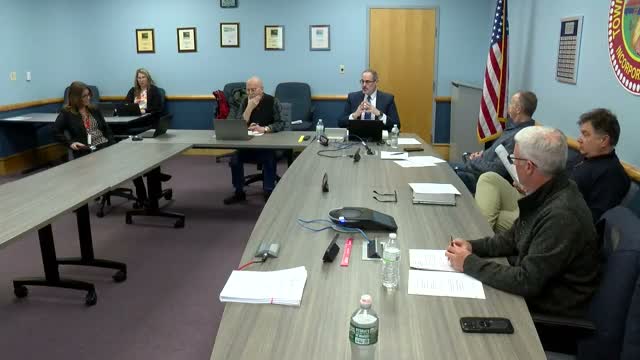
A utility director recounted the utility's response to a major blizzard, saying staff were activated after forecasts jumped from 3–5 inches to as much as 18–24 inches and roughly 33 employees reported Sunday evening to begin overnight operations.
The director said crews bunked onsite — with linemen and managers sleeping on air mattresses in conference rooms and offices — because a travel ban kept staff at work until roads were safe. "Once you're here, you're pretty much stuck here until the roads are passable," the director said.
He described how the utility rotated crews as outage calls arrived, and how the meter department conducted what he called "bird dogging," sending staff to investigate reported problems and identify needed repairs. "We have the meter department going out and doing, called bird dogging. Essentially, they're going out, investigating, seeing what's needed," the director said.
A four-person substation crew plowed and cleared yards around stock and storage so bucket trucks could access equipment, the director said, calling the substation yard a "nonstop operation." He added that line crew members who were not responding to outages helped clear vehicles and equipment with leaf blowers and snow blowers.
The director said the utility published an outage map on its website (a beta product) for public visibility during the event, though he noted there were relatively few outages to display. He said the first outage calls reached staff around 6–7 a.m. the morning after the storm's peak.
He credited several factors for the limited outage impact: the utility's distribution design and crew response, a sharp overnight temperature drop from the low 30s to the mid-20s that kept snow light and fluffy, and recent capital work. "I think one of the things that saved us besides our distribution system and the efforts of our line crew... temperatures also crashed on Monday," the director said.
The director singled out the utility's ongoing capital improvement program — including wire replacements and pole inspections — as improving resilience, contrasting the utility's materials and practices with larger regional providers: "...the general product that we use is a higher class than I would say Eversource... now Rhode Island Energy," he said.
He closed by thanking employees and the board for support. "I just wanna say thank you, and thanks for the support of the board for our continued investment in our system," the director said. No formal vote or action was recorded during this briefing.
The director said crews bunked onsite — with linemen and managers sleeping on air mattresses in conference rooms and offices — because a travel ban kept staff at work until roads were safe. "Once you're here, you're pretty much stuck here until the roads are passable," the director said.
He described how the utility rotated crews as outage calls arrived, and how the meter department conducted what he called "bird dogging," sending staff to investigate reported problems and identify needed repairs. "We have the meter department going out and doing, called bird dogging. Essentially, they're going out, investigating, seeing what's needed," the director said.
A four-person substation crew plowed and cleared yards around stock and storage so bucket trucks could access equipment, the director said, calling the substation yard a "nonstop operation." He added that line crew members who were not responding to outages helped clear vehicles and equipment with leaf blowers and snow blowers.
The director said the utility published an outage map on its website (a beta product) for public visibility during the event, though he noted there were relatively few outages to display. He said the first outage calls reached staff around 6–7 a.m. the morning after the storm's peak.
He credited several factors for the limited outage impact: the utility's distribution design and crew response, a sharp overnight temperature drop from the low 30s to the mid-20s that kept snow light and fluffy, and recent capital work. "I think one of the things that saved us besides our distribution system and the efforts of our line crew... temperatures also crashed on Monday," the director said.
The director singled out the utility's ongoing capital improvement program — including wire replacements and pole inspections — as improving resilience, contrasting the utility's materials and practices with larger regional providers: "...the general product that we use is a higher class than I would say Eversource... now Rhode Island Energy," he said.
He closed by thanking employees and the board for support. "I just wanna say thank you, and thanks for the support of the board for our continued investment in our system," the director said. No formal vote or action was recorded during this briefing.
View the Full Meeting & All Its Details
This article offers just a summary. Unlock complete video, transcripts, and insights as a Founder Member.
✓
Watch full, unedited meeting videos
✓
Search every word spoken in unlimited transcripts
✓
AI summaries & real-time alerts (all government levels)
✓
Permanent access to expanding government content
30-day money-back guarantee
