Council presses mayor's equity office over delayed racial equity plans and budget alignment
February 27, 2026 | New York City Council, New York City, New York County, New York
This article was created by AI summarizing key points discussed. AI makes mistakes, so for full details and context, please refer to the video of the full meeting. Please report any errors so we can fix them. Report an error »
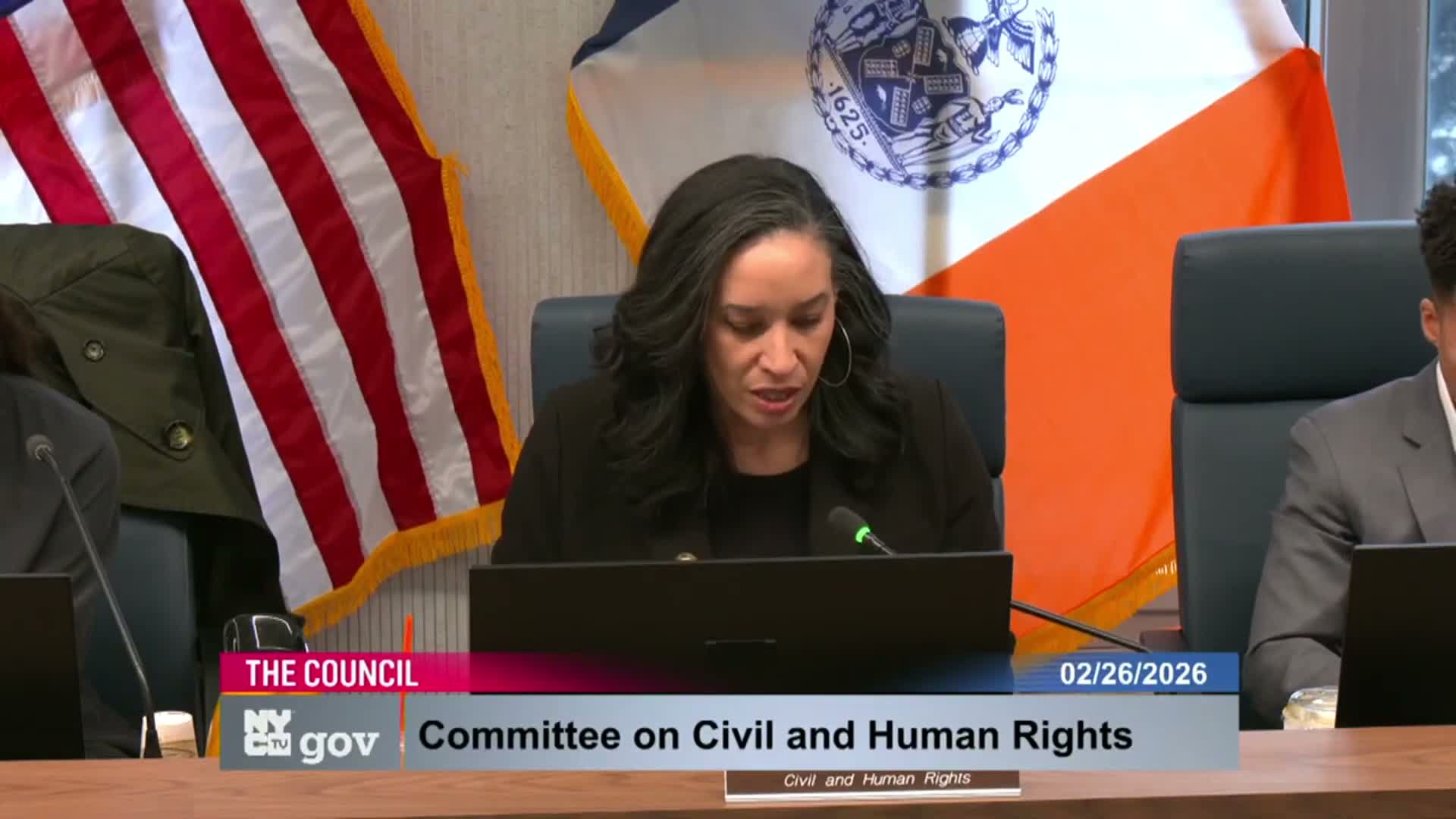
Councilmember Sandy Nurse, chair of the Committee on Civil and Human Rights, opened an oversight hearing by criticizing the city's failure to publish charter-mandated racial equity plans and asking the mayor's Office of Equity and Racial Justice for an update on when those plans would be released and how they would be integrated into the FY27 budget.
"Unfortunately, no racial equity plans or progress reports have ever been issued," Nurse said, calling that omission "one of the biggest failures of the Adams administration." She asked MOERJ how legal review, agency staffing, and budget timing affect the city's ability to produce and use the plans.
Afiyatamensa, who identified themself as New York City's chief equity officer and commissioner of the mayor's Office of Equity and Racial Justice, described MOERJ's planning process and said more than 40 agencies and roughly 200 staff had been involved in drafting agency-level plans. Afiyatamensa told the committee the administration is briefing new agency leaders and "we fully expect that we will have this plan out within the hundred day period," calling the citywide plan a preliminary, living document that will be refined through public input.
Linda Tajani, executive director of the Commission on Racial Equity (CORE), told the council that CORE has already produced community equity priorities based on public engagement and that CORE has complied with its statutory duties to deliver those priorities. Tajani said CORE's oversight work has been hampered because, in their view, the plan has been subjected to an extended legal review that has delayed public release and prevented CORE from applying the statutory framework to current budget decisions. "To our understanding, the plan has been under legal review, extended legal review now for over a year," Tajani said, warning that without a released plan "there is no equity framework that is guiding OMB's review of new needs requests or requests to use underspend."
Logan Clark, assistant director of budget review for the Independent Budget Office, testified that the city's budget publications currently give limited geographic and demographic detail, which constrains equity analysis. Clark said the budget's geographic report covers only 14 agencies and roughly $1.8 billion in geographically reported spending, "about 1.4% of our $127 billion proposed budget," and recommended stronger standards for units of appropriation and broader geographic reporting to improve transparency.
Council members pressed MOERJ on operational questions: whether agencies had budgeted to implement racial equity plans, how many staff were on agency planning teams (responses varied by agency), what public-engagement mechanisms MOERJ and CORE would use, and whether biweekly coordination meetings with CORE would include budget negotiators. MOERJ and CORE said they would continue outreach and that biweekly interactions are planned.
Public witnesses amplified CORE's concerns. Madeline Neely of the Federation of Protestant Welfare Agencies urged release and use of a true cost of living measure (work adapted from the Urban Institute) to make budgetary needs visible to policymakers. CORE and community leaders warned that delays risk further disinvestment in neighborhoods the charter prioritized.
The committee did not take formal votes at the hearing. MOERJ reiterated its commitment to issue a preliminary plan during the mayor's first 100 days and to continue public engagement; CORE said it will continue pursuing oversight and asked the administration to accelerate release to allow budget alignment.
The council scheduled further scrutiny during the budget season and invited IBO, CORE, and MOERJ to provide follow-up materials and testimony at upcoming budget hearings.
"Unfortunately, no racial equity plans or progress reports have ever been issued," Nurse said, calling that omission "one of the biggest failures of the Adams administration." She asked MOERJ how legal review, agency staffing, and budget timing affect the city's ability to produce and use the plans.
Afiyatamensa, who identified themself as New York City's chief equity officer and commissioner of the mayor's Office of Equity and Racial Justice, described MOERJ's planning process and said more than 40 agencies and roughly 200 staff had been involved in drafting agency-level plans. Afiyatamensa told the committee the administration is briefing new agency leaders and "we fully expect that we will have this plan out within the hundred day period," calling the citywide plan a preliminary, living document that will be refined through public input.
Linda Tajani, executive director of the Commission on Racial Equity (CORE), told the council that CORE has already produced community equity priorities based on public engagement and that CORE has complied with its statutory duties to deliver those priorities. Tajani said CORE's oversight work has been hampered because, in their view, the plan has been subjected to an extended legal review that has delayed public release and prevented CORE from applying the statutory framework to current budget decisions. "To our understanding, the plan has been under legal review, extended legal review now for over a year," Tajani said, warning that without a released plan "there is no equity framework that is guiding OMB's review of new needs requests or requests to use underspend."
Logan Clark, assistant director of budget review for the Independent Budget Office, testified that the city's budget publications currently give limited geographic and demographic detail, which constrains equity analysis. Clark said the budget's geographic report covers only 14 agencies and roughly $1.8 billion in geographically reported spending, "about 1.4% of our $127 billion proposed budget," and recommended stronger standards for units of appropriation and broader geographic reporting to improve transparency.
Council members pressed MOERJ on operational questions: whether agencies had budgeted to implement racial equity plans, how many staff were on agency planning teams (responses varied by agency), what public-engagement mechanisms MOERJ and CORE would use, and whether biweekly coordination meetings with CORE would include budget negotiators. MOERJ and CORE said they would continue outreach and that biweekly interactions are planned.
Public witnesses amplified CORE's concerns. Madeline Neely of the Federation of Protestant Welfare Agencies urged release and use of a true cost of living measure (work adapted from the Urban Institute) to make budgetary needs visible to policymakers. CORE and community leaders warned that delays risk further disinvestment in neighborhoods the charter prioritized.
The committee did not take formal votes at the hearing. MOERJ reiterated its commitment to issue a preliminary plan during the mayor's first 100 days and to continue public engagement; CORE said it will continue pursuing oversight and asked the administration to accelerate release to allow budget alignment.
The council scheduled further scrutiny during the budget season and invited IBO, CORE, and MOERJ to provide follow-up materials and testimony at upcoming budget hearings.
View the Full Meeting & All Its Details
This article offers just a summary. Unlock complete video, transcripts, and insights as a Founder Member.
✓
Watch full, unedited meeting videos
✓
Search every word spoken in unlimited transcripts
✓
AI summaries & real-time alerts (all government levels)
✓
Permanent access to expanding government content
30-day money-back guarantee
