Irving weighs DART interlocal agreement: billions at stake, council split over signing and ballot removal
February 27, 2026 | Irving, Dallas County, Texas
This article was created by AI summarizing key points discussed. AI makes mistakes, so for full details and context, please refer to the video of the full meeting. Please report any errors so we can fix them. Report an error »
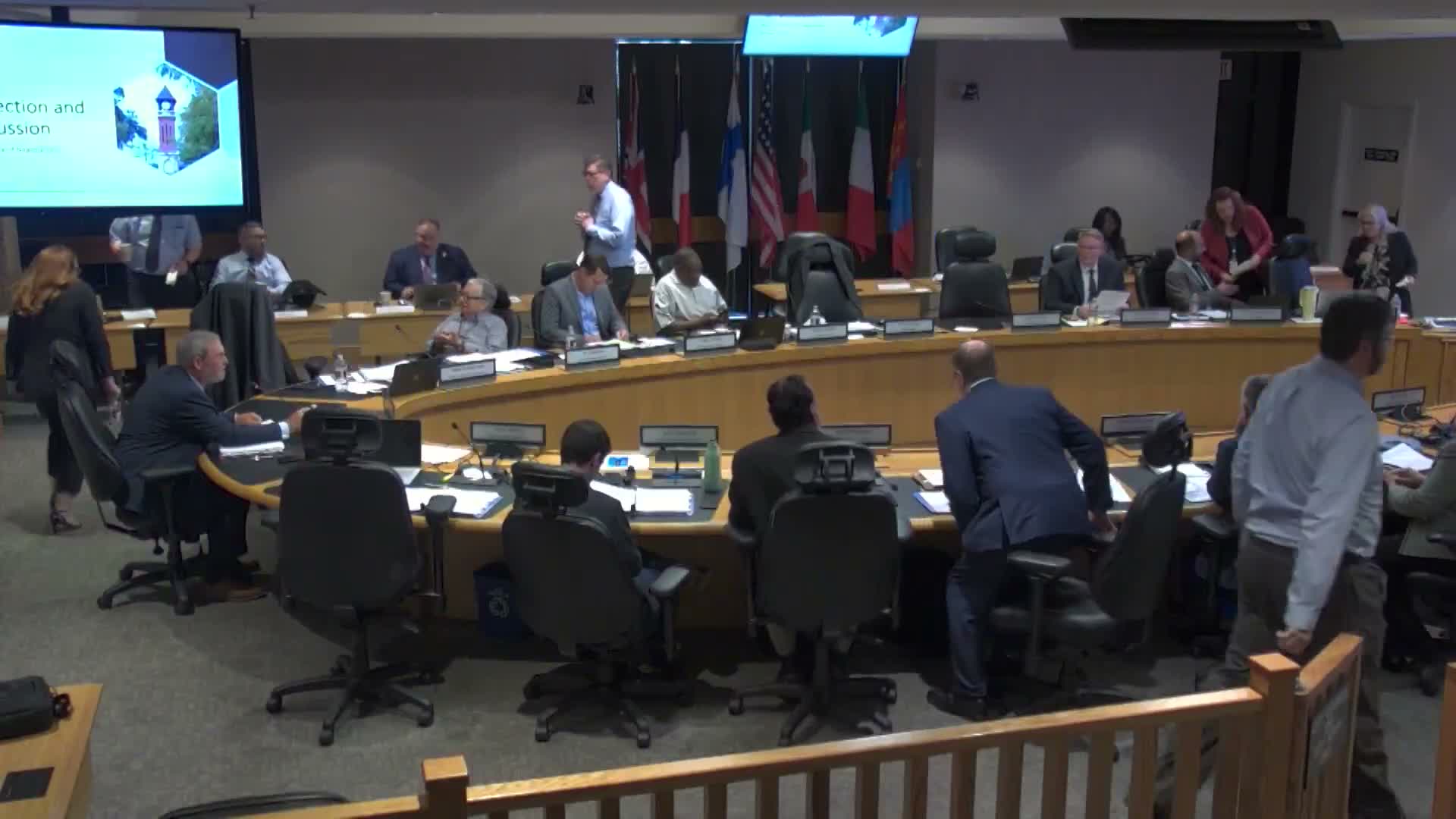
City Manager Chris Hillman and council members spent the Feb. 26 work session debating whether Irving should accept a proposed interlocal agreement (ILA) with Dallas Area Rapid Transit (DART) that would return a share of DART’s general mobility program (GMP) dollars to member cities and pursue negotiated governance changes.
Hillman framed Irving’s interest as a value‑for‑dollar question. “Our value proposition, to be perfectly frank, is butts in seats,” he said, describing the city’s goal of ensuring DART investments produce usable service and ridership. Hillman said DART’s FY26 budget reduced two Irving bus routes (225 and 255), cutting roughly 29% of the city’s local bus service and reducing the number of rail stations with direct bus feeders from eight to three.
The ILA staff described would return 5% of DART’s sales tax receipts to member cities in year one (an amount DART has budgeted), then increase the share by 0.5% annually while the Regional Transportation Council (RTC) matches to reach a combined 10% over six years. Staff estimated Irving’s share at about $5.1 million in the first year, about $6.8 million in year two, and roughly $54–55 million over the six‑year term, noting later years are projections tied to sales‑tax collections.
The governance component under discussion would reorganize board seats and voting weights among member cities. Staff and the mayor said negotiated language reduces a single city’s voting share (Dallas) from a de facto majority toward a cap of roughly 45% while increasing total board seats; proponents said the change improves member city representation. A legislative change is required to finalize the governance structure and Hillman said the council and regional partners would present the multi‑city negotiated record to the Legislature.
Council opinion split. Some council members urged signing the ILA, saying it secures immediate GMP dollars and institutional leverage to press DART on service levels. “We’ve got $51,000,000 on the line,” a council member said in favor of accepting funds to support Irving priorities. Others warned that accepting the ILA requires removing the previously called withdrawal election from the ballot — the statute allows a city to call that election only once every six years — effectively postponing a public vote on continued DART membership for six years unless a voter petition is successful. Skeptical members demanded additional guarantees: production of the underlying AECOM ridership/analysis report, DART audits, and contractual protections on future debt issuance and route reductions.
Council members repeatedly pressed for service commitments and alternatives if DART will not restore bus routes. Hillman said restoring routes is not guaranteed by the ILA; it’s a separate operational question for DART and could require budget or service changes on DART’s side, though the GMP dollars could be used for interim or complementary services. Several council members called for a letter to DART demanding concrete alternatives or re‑instatement plans for affected routes and better communication with city staff and social service providers.
The council also discussed technical legal constraints: the ILA language is uniform for all member cities, so unilateral improvements for Irving would apply to other cities as well; and, staff said, changes to DART governance statutes require legislative action in Austin. Mark Wiggins, the city’s legislative officer, said the multi‑city record of negotiated resolutions helps the delegation present a coordinated bill.
After hours of debate and multiple requests for additional documentation, the council voted to convene an executive session to receive legal advice on the ILA and related matters. Council did not finalize a public vote at the work session; staff said they will continue negotiations and return with details and requested documentation for council review.
Hillman framed Irving’s interest as a value‑for‑dollar question. “Our value proposition, to be perfectly frank, is butts in seats,” he said, describing the city’s goal of ensuring DART investments produce usable service and ridership. Hillman said DART’s FY26 budget reduced two Irving bus routes (225 and 255), cutting roughly 29% of the city’s local bus service and reducing the number of rail stations with direct bus feeders from eight to three.
The ILA staff described would return 5% of DART’s sales tax receipts to member cities in year one (an amount DART has budgeted), then increase the share by 0.5% annually while the Regional Transportation Council (RTC) matches to reach a combined 10% over six years. Staff estimated Irving’s share at about $5.1 million in the first year, about $6.8 million in year two, and roughly $54–55 million over the six‑year term, noting later years are projections tied to sales‑tax collections.
The governance component under discussion would reorganize board seats and voting weights among member cities. Staff and the mayor said negotiated language reduces a single city’s voting share (Dallas) from a de facto majority toward a cap of roughly 45% while increasing total board seats; proponents said the change improves member city representation. A legislative change is required to finalize the governance structure and Hillman said the council and regional partners would present the multi‑city negotiated record to the Legislature.
Council opinion split. Some council members urged signing the ILA, saying it secures immediate GMP dollars and institutional leverage to press DART on service levels. “We’ve got $51,000,000 on the line,” a council member said in favor of accepting funds to support Irving priorities. Others warned that accepting the ILA requires removing the previously called withdrawal election from the ballot — the statute allows a city to call that election only once every six years — effectively postponing a public vote on continued DART membership for six years unless a voter petition is successful. Skeptical members demanded additional guarantees: production of the underlying AECOM ridership/analysis report, DART audits, and contractual protections on future debt issuance and route reductions.
Council members repeatedly pressed for service commitments and alternatives if DART will not restore bus routes. Hillman said restoring routes is not guaranteed by the ILA; it’s a separate operational question for DART and could require budget or service changes on DART’s side, though the GMP dollars could be used for interim or complementary services. Several council members called for a letter to DART demanding concrete alternatives or re‑instatement plans for affected routes and better communication with city staff and social service providers.
The council also discussed technical legal constraints: the ILA language is uniform for all member cities, so unilateral improvements for Irving would apply to other cities as well; and, staff said, changes to DART governance statutes require legislative action in Austin. Mark Wiggins, the city’s legislative officer, said the multi‑city record of negotiated resolutions helps the delegation present a coordinated bill.
After hours of debate and multiple requests for additional documentation, the council voted to convene an executive session to receive legal advice on the ILA and related matters. Council did not finalize a public vote at the work session; staff said they will continue negotiations and return with details and requested documentation for council review.
View the Full Meeting & All Its Details
This article offers just a summary. Unlock complete video, transcripts, and insights as a Founder Member.
✓
Watch full, unedited meeting videos
✓
Search every word spoken in unlimited transcripts
✓
AI summaries & real-time alerts (all government levels)
✓
Permanent access to expanding government content
30-day money-back guarantee
