Planning Commission approves commercial compatibility overlay for parts of Buchanan Street after heated debate
February 27, 2026 | Planning Commission Meetings, Nashville, Davidson County, Tennessee
This article was created by AI summarizing key points discussed. AI makes mistakes, so for full details and context, please refer to the video of the full meeting. Please report any errors so we can fix them. Report an error »
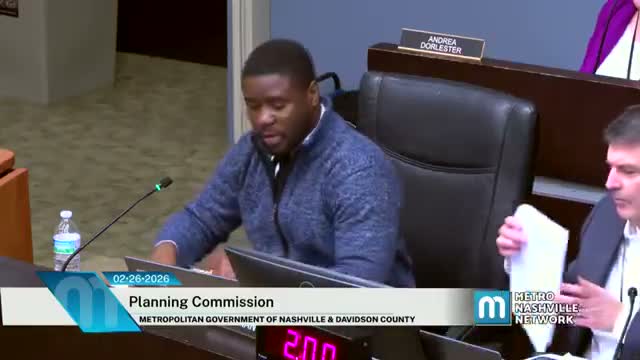
The Metropolitan Planning Commission on Feb. 26 approved a Commercial Compatibility Overlay (CCO) for two stretches of Buchanan Street intended to limit where bars, nightclubs and other high-impact commercial uses may operate and to add time-based limits on amplified outdoor sound.
The measure, advanced by Councilmember Taylor and presented to the commission by planning staff, drew extensive public testimony both for and against. Supporters, including business owner Juan Vega Romero, said the overlay helps “secure the future of the Buchanan Street corridor” and steer growth toward family-friendly retail. Residents and tenants, including Tequila Johnson and Valeria Lopez, told commissioners the overlay would not solve noise and parking complaints because many businesses would remain legally nonconforming and thus effectively grandfathered.
Staff described the overlay as a targeted zoning tool that imposes distance requirements for certain land uses and time-based restrictions on outdoor amplification in areas within 100 feet of residential zoning. The presentation cited peer-city approaches in Memphis, Atlanta, Charlotte and Austin, where hours and separation requirements for nightlife uses are baked into code. Staff recommended approval with a substitute ordinance that adjusted parcel boundaries to exclude residentially zoned portions where the CCO did not apply.
Commissioners debated whether the overlay has adequate enforcement 'teeth' for existing businesses and whether it would unfairly constrain future small, locally owned establishments. Commissioner Leslie said she was skeptical the overlay would fix noise issues and noted that the city’s noise ordinance and its enforcement history remain central problems. Commissioner Henley and several colleagues said the overlay provides a predictable regulatory framework for future businesses even if enforcement of current violations remains a separate challenge. At least one commissioner (Leslie) recorded a 'no' vote on the measure; most commissioners voted in favor. The transcript records voice voting (ayes/nost) but does not provide a numeric roll-call tally for the final motions in the Planning Commission record.
The Planning Commission approved separate motions on the two overlay parcels (items 3 and 4) using substitute ordinances. The commission’s approval is a recommendation; the proposals will now proceed to Metro Council for public hearing and final consideration. Staff and some commissioners urged additional education and outreach for property owners and business operators to clarify how the overlay would apply in practice.
“I’m trying to figure out how we can manage proximity,” Councilmember Taylor told the commission during presentation of the proposal, emphasizing that other cities use distance and time restrictions to reduce nighttime noise impacts. “This is not for any one person or business — this is for the residents who asked us to take this on,” he said.
Opponents warned that the overlay alone will not stop ongoing problems. “This overlay will not address that — those businesses will still be there. They are grandfathered in,” tenant Valeria Lopez said during public comment. Planning staff and multiple commissioners agreed that enforcement and better community engagement would be necessary to realize the overlay’s goals.
Next steps: the ordinance, as recommended by the commission, moves to the Metro Council for public hearing and final action. The commission’s record shows the substitute ordinances passed, but precise vote tallies were not specified in the transcript; the council will receive the commission’s recommendation and the public will have another opportunity to comment at the council hearing.
The measure, advanced by Councilmember Taylor and presented to the commission by planning staff, drew extensive public testimony both for and against. Supporters, including business owner Juan Vega Romero, said the overlay helps “secure the future of the Buchanan Street corridor” and steer growth toward family-friendly retail. Residents and tenants, including Tequila Johnson and Valeria Lopez, told commissioners the overlay would not solve noise and parking complaints because many businesses would remain legally nonconforming and thus effectively grandfathered.
Staff described the overlay as a targeted zoning tool that imposes distance requirements for certain land uses and time-based restrictions on outdoor amplification in areas within 100 feet of residential zoning. The presentation cited peer-city approaches in Memphis, Atlanta, Charlotte and Austin, where hours and separation requirements for nightlife uses are baked into code. Staff recommended approval with a substitute ordinance that adjusted parcel boundaries to exclude residentially zoned portions where the CCO did not apply.
Commissioners debated whether the overlay has adequate enforcement 'teeth' for existing businesses and whether it would unfairly constrain future small, locally owned establishments. Commissioner Leslie said she was skeptical the overlay would fix noise issues and noted that the city’s noise ordinance and its enforcement history remain central problems. Commissioner Henley and several colleagues said the overlay provides a predictable regulatory framework for future businesses even if enforcement of current violations remains a separate challenge. At least one commissioner (Leslie) recorded a 'no' vote on the measure; most commissioners voted in favor. The transcript records voice voting (ayes/nost) but does not provide a numeric roll-call tally for the final motions in the Planning Commission record.
The Planning Commission approved separate motions on the two overlay parcels (items 3 and 4) using substitute ordinances. The commission’s approval is a recommendation; the proposals will now proceed to Metro Council for public hearing and final consideration. Staff and some commissioners urged additional education and outreach for property owners and business operators to clarify how the overlay would apply in practice.
“I’m trying to figure out how we can manage proximity,” Councilmember Taylor told the commission during presentation of the proposal, emphasizing that other cities use distance and time restrictions to reduce nighttime noise impacts. “This is not for any one person or business — this is for the residents who asked us to take this on,” he said.
Opponents warned that the overlay alone will not stop ongoing problems. “This overlay will not address that — those businesses will still be there. They are grandfathered in,” tenant Valeria Lopez said during public comment. Planning staff and multiple commissioners agreed that enforcement and better community engagement would be necessary to realize the overlay’s goals.
Next steps: the ordinance, as recommended by the commission, moves to the Metro Council for public hearing and final action. The commission’s record shows the substitute ordinances passed, but precise vote tallies were not specified in the transcript; the council will receive the commission’s recommendation and the public will have another opportunity to comment at the council hearing.
View the Full Meeting & All Its Details
This article offers just a summary. Unlock complete video, transcripts, and insights as a Founder Member.
✓
Watch full, unedited meeting videos
✓
Search every word spoken in unlimited transcripts
✓
AI summaries & real-time alerts (all government levels)
✓
Permanent access to expanding government content
30-day money-back guarantee
