Ways & Means hears H775: expands treasurer's credit authority, creates Vermont Housing Special Fund and pilot for off-site construction
February 28, 2026 | Ways & Means, HOUSE OF REPRESENTATIVES, Committees, Legislative , Vermont
This article was created by AI summarizing key points discussed. AI makes mistakes, so for full details and context, please refer to the video of the full meeting. Please report any errors so we can fix them. Report an error »
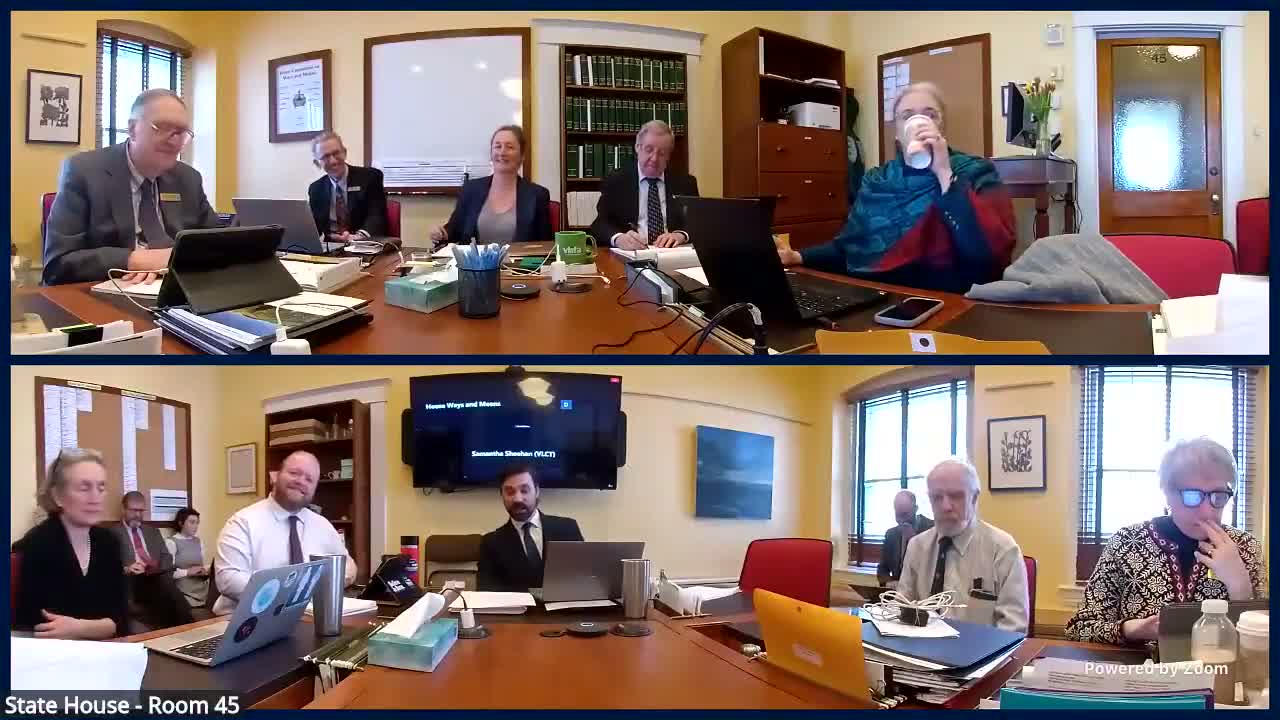
The Ways & Means Committee spent an extended session briefing and question-and-answer on H775, a multi-part bill to create additional financing tools for housing production.
Cameron Wood of the Office of Legislative Council, presenting the strike-all amendment, said the bill would increase the treasurer's statutory credit-facility authority and add an optionally created, up-to-1-percent credit facility limited to bulk purchasing of off-site constructed housing; any amount used for that 1% would be deducted from the broader 12.5% cap so the total authority does not exceed the stated cap.
Wood said interest earned on loans made under the credit facilities would be retained in a newly created Vermont Housing Special Fund rather than flowing to the general fund. "The treasurer shall use funds under this section... to provide capital for housing projects in Vermont," he said, and the fund could be used for loans, grants, loan-loss reserves or even equity interests in projects.
Section 4 would create an Off-Site Construction Accelerator pilot administered by the Agency of Commerce and Community Development in collaboration with Buildings & General Services to test bulk purchasing, regulatory streamlining, peer-proof modular designs and a loan-loss reserve. Municipalities chosen for pilots would be eligible for municipal planning grants and the pilot would produce a report to the legislature by Feb. 15, 2028.
Bernadette of the Joint Fiscal Office summarized fiscal effects: retaining interest for the Vermont Housing Special Fund would forego an estimated $1.2 million in general-fund interest in FY27; expanding the credit facilities could make about $30 million in additional loans available, and a theoretical maximum long-term foregone interest was modeled at roughly $3.0 million in a full-capacity scenario. "That $30,000,000, if it is lent out, would no longer be able to be invested on the short term market and earn the treasurer indicated about 3 and a half percent in interest," Bernadette said.
Deputy Treasurer David Sher said the treasurer's office supports the bill: the existing credit facility has supported roughly 1,700 housing units and additional low-interest loan capacity would leverage more. He told the committee the treasurer can make loans at much lower rates than commercial lenders (roughly 1% to 2.5% depending on term), which can be decisive for projects. "We wanna do the things in this bill," Sher said, noting the office sees value in the tools to expand housing production.
Committee members pressed on risk and underwriting: members asked how much of the state cash balance should be committed, how underwriting of special-assessment districts would be handled, and whether interest-retention funds could be invested in equity. Sher said he believed the proposed increase remained prudent and that equity investment would be a new and optional tool for the housing fund rather than a guaranteed approach.
Legislative counsel and members also explained a new special-assessment revenue-bond tool that would let municipalities issue bonds payable solely from assessments within a limited area (not general obligation debt) to finance public improvements; bonds would require approval by the municipality's legislative body and include marketability safeguards such as a commitment letter from a recognized bank or an investment-grade credit rating.
The committee did not take final action on H775 during this session. Members asked for follow-up testimony from the League of Cities and Towns, the Vermont Bond Bank, the Department of Housing & Community Development, downtown organizations funded by special assessment districts, and JFO on some of the implementation details and marketability concerns.
Cameron Wood of the Office of Legislative Council, presenting the strike-all amendment, said the bill would increase the treasurer's statutory credit-facility authority and add an optionally created, up-to-1-percent credit facility limited to bulk purchasing of off-site constructed housing; any amount used for that 1% would be deducted from the broader 12.5% cap so the total authority does not exceed the stated cap.
Wood said interest earned on loans made under the credit facilities would be retained in a newly created Vermont Housing Special Fund rather than flowing to the general fund. "The treasurer shall use funds under this section... to provide capital for housing projects in Vermont," he said, and the fund could be used for loans, grants, loan-loss reserves or even equity interests in projects.
Section 4 would create an Off-Site Construction Accelerator pilot administered by the Agency of Commerce and Community Development in collaboration with Buildings & General Services to test bulk purchasing, regulatory streamlining, peer-proof modular designs and a loan-loss reserve. Municipalities chosen for pilots would be eligible for municipal planning grants and the pilot would produce a report to the legislature by Feb. 15, 2028.
Bernadette of the Joint Fiscal Office summarized fiscal effects: retaining interest for the Vermont Housing Special Fund would forego an estimated $1.2 million in general-fund interest in FY27; expanding the credit facilities could make about $30 million in additional loans available, and a theoretical maximum long-term foregone interest was modeled at roughly $3.0 million in a full-capacity scenario. "That $30,000,000, if it is lent out, would no longer be able to be invested on the short term market and earn the treasurer indicated about 3 and a half percent in interest," Bernadette said.
Deputy Treasurer David Sher said the treasurer's office supports the bill: the existing credit facility has supported roughly 1,700 housing units and additional low-interest loan capacity would leverage more. He told the committee the treasurer can make loans at much lower rates than commercial lenders (roughly 1% to 2.5% depending on term), which can be decisive for projects. "We wanna do the things in this bill," Sher said, noting the office sees value in the tools to expand housing production.
Committee members pressed on risk and underwriting: members asked how much of the state cash balance should be committed, how underwriting of special-assessment districts would be handled, and whether interest-retention funds could be invested in equity. Sher said he believed the proposed increase remained prudent and that equity investment would be a new and optional tool for the housing fund rather than a guaranteed approach.
Legislative counsel and members also explained a new special-assessment revenue-bond tool that would let municipalities issue bonds payable solely from assessments within a limited area (not general obligation debt) to finance public improvements; bonds would require approval by the municipality's legislative body and include marketability safeguards such as a commitment letter from a recognized bank or an investment-grade credit rating.
The committee did not take final action on H775 during this session. Members asked for follow-up testimony from the League of Cities and Towns, the Vermont Bond Bank, the Department of Housing & Community Development, downtown organizations funded by special assessment districts, and JFO on some of the implementation details and marketability concerns.
View the Full Meeting & All Its Details
This article offers just a summary. Unlock complete video, transcripts, and insights as a Founder Member.
✓
Watch full, unedited meeting videos
✓
Search every word spoken in unlimited transcripts
✓
AI summaries & real-time alerts (all government levels)
✓
Permanent access to expanding government content
30-day money-back guarantee
