Sponsor and maritime industry push Mosquito Fleet Act as island and port leaders urge urgency; orca advocates call for safeguards
February 27, 2026 | Legislative Sessions, Washington
This article was created by AI summarizing key points discussed. AI makes mistakes, so for full details and context, please refer to the video of the full meeting. Please report any errors so we can fix them. Report an error »
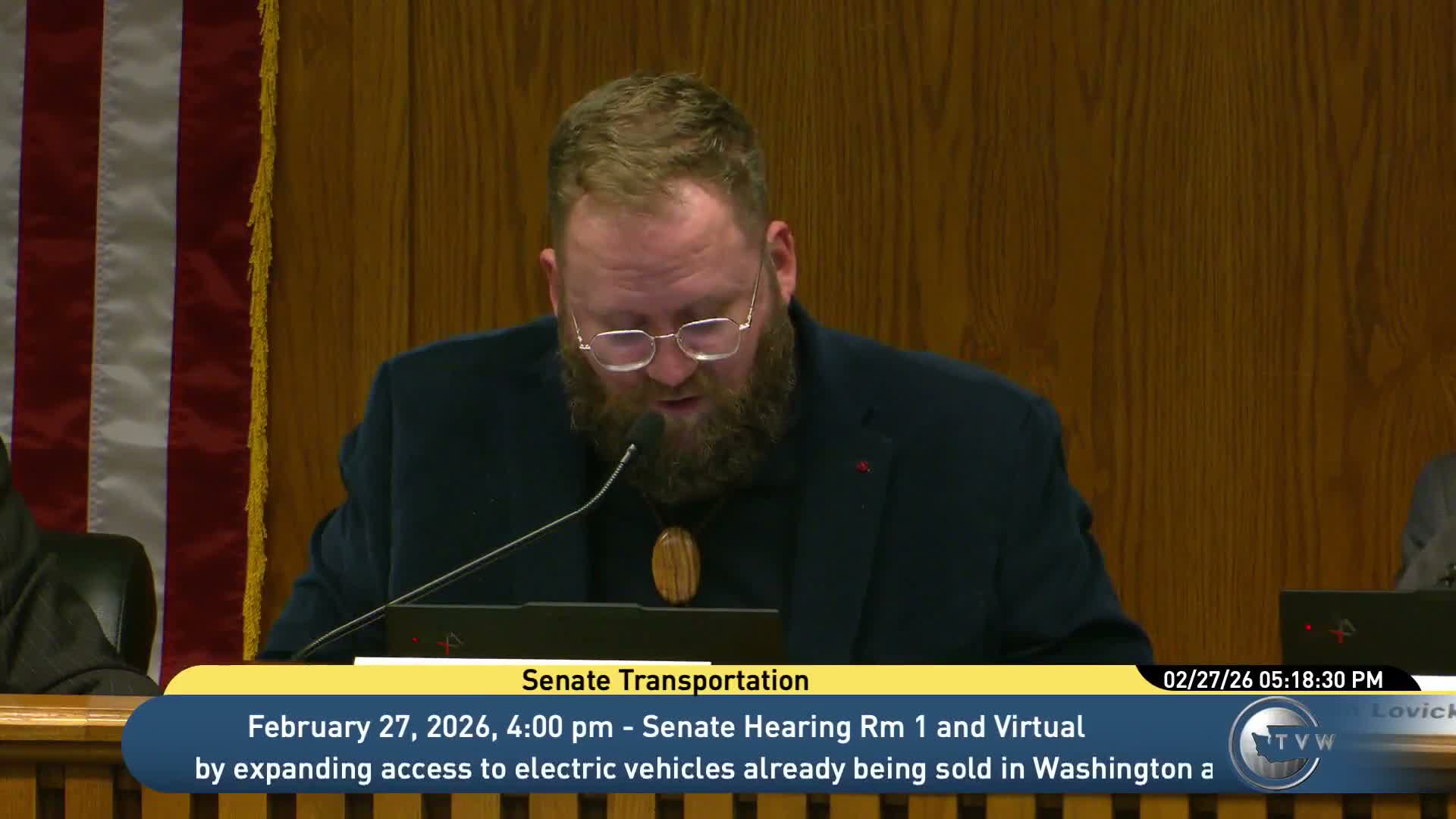
Representative Craig Nance, the bill’s prime sponsor, told the Senate Transportation Committee that the Mosquito Fleet Act would give local governments “another tool” to restore access, create jobs and provide relief to Washington State Ferries while the statewide fleet is rebuilt. “To me, this bill is about parity, and it’s about, solving problems locally,” Nance said, describing service disruptions that have left island communities without reliable transportation.
Clint McCarthy, committee staff, summarized the proposal as a local option allowing ports, transit agencies, county transportation authorities and others to form passenger‑only ferry districts with funding options including up to 0.3 percent sales tax, advertising and parking revenues. McCarthy’s fiscal briefing said the Department of Revenue anticipates near‑term administrative and revenue impacts and provided biennial cost estimates for administering new districts.
Supporters filled the witness list. Industry leaders and shipbuilders told the committee passenger ferries can be built and delivered faster and at lower capital cost than vehicle ferries, and that building vessels in Washington would create family‑wage jobs. Gavin Higgins of Nichols Brothers said local yards have a long record of vessel construction and apprenticeships, and argued that “build here, invest here, and grow here” would multiply local economic benefits. Labor and maritime training organizations also backed the bill as a workforce pipeline.
Transit operators and elected officials from island and coastal communities said passenger‑only ferries had already improved reliability where they operate and could immediately restore essential access for commuters, medical appointments and small businesses. Kitsap Transit representatives described fleets and routes that operate on sales‑tax funding and high farebox recovery and urged flexibility for local operations.
Not all testimony was in favor. Donna Sandstrom, director of the Whale Trail and former member of Governor Inslee’s Orca Recovery Task Force, urged the committee to “slow down” and require permitting, species‑impact review, and mitigation funding before large‑scale expansion. She warned that unmanaged growth of passenger ferry service in the Salish Sea could harm southern resident orcas and asked for conditions and fees to fund Department of Fish and Wildlife enforcement.
Committee members questioned sponsors and witnesses on funding choices, the potential for overlapping local taxes, whether vessels should be required to be built in Washington, and options for low‑ or zero‑emission propulsion. Sponsor Nance said he would welcome amendments to strengthen orca protections and to encourage in‑state construction in future sessions, and emphasized that the bill provides a local option rather than mandating new districts statewide.
The committee held an extended public record with several dozen additional supporters and opponents offering brief remarks by remote testimony. The hearing closed after more than three hours of testimony; no executive action on HB 1923 was recorded in the transcript for this meeting.
What happens next: the bill will remain in committee for further amendment and potential scheduling; sponsors indicated willingness to discuss added environmental safeguards and manufacturing provisions.
Clint McCarthy, committee staff, summarized the proposal as a local option allowing ports, transit agencies, county transportation authorities and others to form passenger‑only ferry districts with funding options including up to 0.3 percent sales tax, advertising and parking revenues. McCarthy’s fiscal briefing said the Department of Revenue anticipates near‑term administrative and revenue impacts and provided biennial cost estimates for administering new districts.
Supporters filled the witness list. Industry leaders and shipbuilders told the committee passenger ferries can be built and delivered faster and at lower capital cost than vehicle ferries, and that building vessels in Washington would create family‑wage jobs. Gavin Higgins of Nichols Brothers said local yards have a long record of vessel construction and apprenticeships, and argued that “build here, invest here, and grow here” would multiply local economic benefits. Labor and maritime training organizations also backed the bill as a workforce pipeline.
Transit operators and elected officials from island and coastal communities said passenger‑only ferries had already improved reliability where they operate and could immediately restore essential access for commuters, medical appointments and small businesses. Kitsap Transit representatives described fleets and routes that operate on sales‑tax funding and high farebox recovery and urged flexibility for local operations.
Not all testimony was in favor. Donna Sandstrom, director of the Whale Trail and former member of Governor Inslee’s Orca Recovery Task Force, urged the committee to “slow down” and require permitting, species‑impact review, and mitigation funding before large‑scale expansion. She warned that unmanaged growth of passenger ferry service in the Salish Sea could harm southern resident orcas and asked for conditions and fees to fund Department of Fish and Wildlife enforcement.
Committee members questioned sponsors and witnesses on funding choices, the potential for overlapping local taxes, whether vessels should be required to be built in Washington, and options for low‑ or zero‑emission propulsion. Sponsor Nance said he would welcome amendments to strengthen orca protections and to encourage in‑state construction in future sessions, and emphasized that the bill provides a local option rather than mandating new districts statewide.
The committee held an extended public record with several dozen additional supporters and opponents offering brief remarks by remote testimony. The hearing closed after more than three hours of testimony; no executive action on HB 1923 was recorded in the transcript for this meeting.
What happens next: the bill will remain in committee for further amendment and potential scheduling; sponsors indicated willingness to discuss added environmental safeguards and manufacturing provisions.
View the Full Meeting & All Its Details
This article offers just a summary. Unlock complete video, transcripts, and insights as a Founder Member.
✓
Watch full, unedited meeting videos
✓
Search every word spoken in unlimited transcripts
✓
AI summaries & real-time alerts (all government levels)
✓
Permanent access to expanding government content
30-day money-back guarantee
