Senate committee hears testimony on 'blue envelope' program to aid neurodiverse drivers
February 27, 2026 | Legislative Sessions, Washington
This article was created by AI summarizing key points discussed. AI makes mistakes, so for full details and context, please refer to the video of the full meeting. Please report any errors so we can fix them. Report an error »
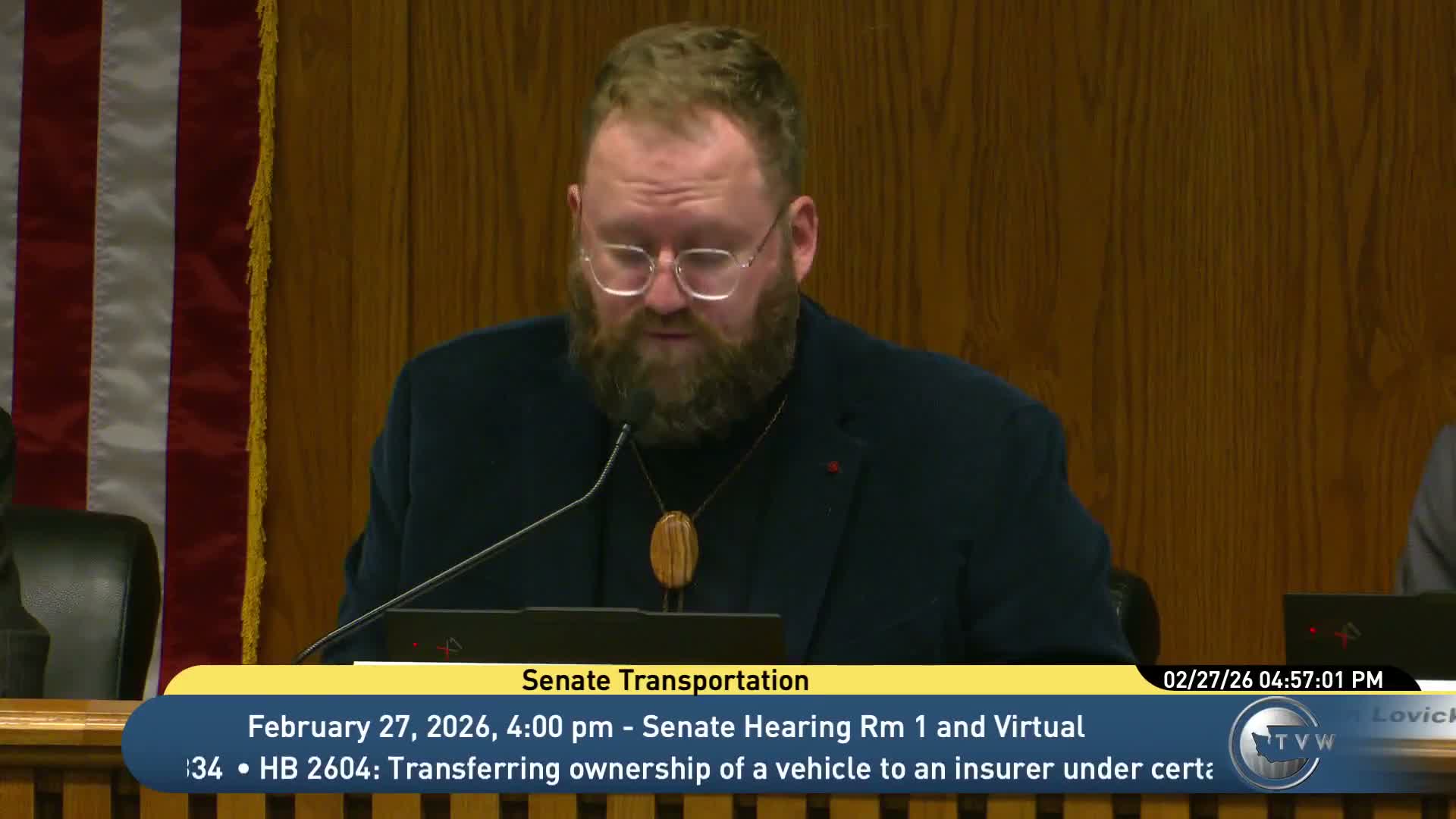
The Senate Transportation Committee heard public testimony on Substitute House Bill 2323, a bill to establish a voluntary Blue Envelope program to help neurodivergent people communicate during traffic stops. Brian Moore, committee staff, said the program would require the Department of Licensing to work with stakeholders to provide a printed envelope with instructions for both the driver and an officer, recommend which documents to include and make envelopes available at driver licensing offices at no cost.
Moore summarized fiscal notes: Department of Licensing estimated a one‑time information technology or provisioning cost (staff referenced $14,000 in one place and the Washington State Patrol fiscal note identified a one‑time training cost of $76,000 in another). Representative Carolyn Eslick, the prime sponsor, said the idea originated with a constituent and noted the program has been adopted by other states: "It started in 2020 in Connecticut," Eslick said, adding that the envelope "signifies to the officer immediately that the person in the car is autistic or has some other, any other communicating disabilities." Eslick told the committee she expected the public safety training cost estimate to be lower than in the fiscal note but deferred to agency analysis.
Senator Fortunato described a family example and asked whether envelopes could be issued to guardians; staff confirmed nothing in the bill prevents a parent or guardian from obtaining an envelope for someone in their care. The committee paused the public hearing after initial sponsor remarks and resumed later without remote testimony from several sign‑ins.
What happens next: Committee members did not take final action on HB 2323 during this session; sponsors and staff said they were available to answer follow‑up questions about implementation and fiscal estimates.
Moore summarized fiscal notes: Department of Licensing estimated a one‑time information technology or provisioning cost (staff referenced $14,000 in one place and the Washington State Patrol fiscal note identified a one‑time training cost of $76,000 in another). Representative Carolyn Eslick, the prime sponsor, said the idea originated with a constituent and noted the program has been adopted by other states: "It started in 2020 in Connecticut," Eslick said, adding that the envelope "signifies to the officer immediately that the person in the car is autistic or has some other, any other communicating disabilities." Eslick told the committee she expected the public safety training cost estimate to be lower than in the fiscal note but deferred to agency analysis.
Senator Fortunato described a family example and asked whether envelopes could be issued to guardians; staff confirmed nothing in the bill prevents a parent or guardian from obtaining an envelope for someone in their care. The committee paused the public hearing after initial sponsor remarks and resumed later without remote testimony from several sign‑ins.
What happens next: Committee members did not take final action on HB 2323 during this session; sponsors and staff said they were available to answer follow‑up questions about implementation and fiscal estimates.
View the Full Meeting & All Its Details
This article offers just a summary. Unlock complete video, transcripts, and insights as a Founder Member.
✓
Watch full, unedited meeting videos
✓
Search every word spoken in unlimited transcripts
✓
AI summaries & real-time alerts (all government levels)
✓
Permanent access to expanding government content
30-day money-back guarantee
