Dartmouth student team tells Senate Transportation MBUF pilots raise privacy and admin cost tradeoffs
February 27, 2026 | Senate Transportation, SENATE, Committees, Legislative , Vermont
This article was created by AI summarizing key points discussed. AI makes mistakes, so for full details and context, please refer to the video of the full meeting. Please report any errors so we can fix them. Report an error »
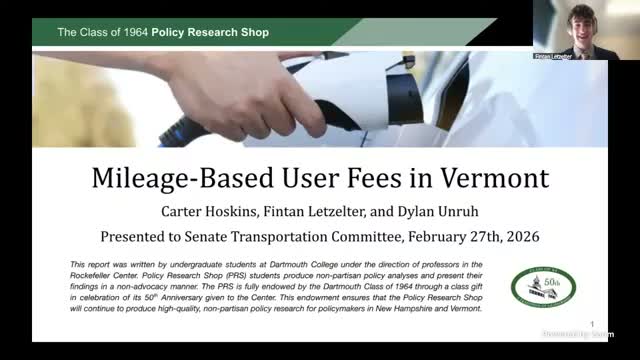
A Dartmouth College student research team presented to the Senate Transportation committee on Feb. 27 about mileage‑based user fees (MBUF) as an alternative to declining gas tax revenues. The students said gas tax purchasing power has declined and that electric vehicle adoption means a growing share of drivers contribute little or nothing via fuel taxes.
The team described three analysis buckets — implementation, equity and revenue — and summarized findings from case studies of Virginia, Utah and Oregon plus in‑depth interviews with six Vermont EV owners. They reported that privacy was the most cited concern among interviewed drivers, characterizing some respondents as describing state mileage tracking as "big brother watching us." The students said administrative burden and cost are highest for telematics and plug‑in OBD2 devices because of device costs and third‑party contract structures; odometer inspections and self‑reporting apps impose lower infrastructure costs and lower perceived privacy risk.
On equity, the team said MBUF can be fairer than a flat EV registration fee because it scales with miles driven; they noted many programs implement fee caps so participants cannot be charged more than a fixed amount in a year. On revenue, the students said pilot programs generally show limited near‑term profitability because enrollment is voluntary and administrative costs are high; Oregon’s closed pilot and Utah’s experience were cited as examples.
Their recommendations to the committee included prioritizing odometer‑based data collection or self‑submission apps (avoiding GPS where possible), minimizing expensive third‑party contracts, and applying a fee cap so low‑mileage drivers are not penalized. In response to senators’ questions, the students said Vermont’s program has been delayed from 2025 to 2027, that program design choices vary by state (odometer, telematics, devices or photos), and that out‑of‑state charging and public chargers remain a policy question beyond the team’s study.
Sen. Wendy Harrison and other committee members asked about data availability, out‑of‑state drivers charging at public highway chargers, the market for third‑party account managers, and whether indexing the gas tax would be an alternative. Professor Kristen Smith and the student team agreed to provide follow‑up information and the presentation materials to the committee.
The committee thanked the team and requested a clean copy of the slides and specific follow‑ups (including details on Utah’s kilowatt‑hour taxation and vendor market dynamics).
The team described three analysis buckets — implementation, equity and revenue — and summarized findings from case studies of Virginia, Utah and Oregon plus in‑depth interviews with six Vermont EV owners. They reported that privacy was the most cited concern among interviewed drivers, characterizing some respondents as describing state mileage tracking as "big brother watching us." The students said administrative burden and cost are highest for telematics and plug‑in OBD2 devices because of device costs and third‑party contract structures; odometer inspections and self‑reporting apps impose lower infrastructure costs and lower perceived privacy risk.
On equity, the team said MBUF can be fairer than a flat EV registration fee because it scales with miles driven; they noted many programs implement fee caps so participants cannot be charged more than a fixed amount in a year. On revenue, the students said pilot programs generally show limited near‑term profitability because enrollment is voluntary and administrative costs are high; Oregon’s closed pilot and Utah’s experience were cited as examples.
Their recommendations to the committee included prioritizing odometer‑based data collection or self‑submission apps (avoiding GPS where possible), minimizing expensive third‑party contracts, and applying a fee cap so low‑mileage drivers are not penalized. In response to senators’ questions, the students said Vermont’s program has been delayed from 2025 to 2027, that program design choices vary by state (odometer, telematics, devices or photos), and that out‑of‑state charging and public chargers remain a policy question beyond the team’s study.
Sen. Wendy Harrison and other committee members asked about data availability, out‑of‑state drivers charging at public highway chargers, the market for third‑party account managers, and whether indexing the gas tax would be an alternative. Professor Kristen Smith and the student team agreed to provide follow‑up information and the presentation materials to the committee.
The committee thanked the team and requested a clean copy of the slides and specific follow‑ups (including details on Utah’s kilowatt‑hour taxation and vendor market dynamics).
Don't Miss a Word: See the Full Meeting!
Go beyond summaries. Unlock every video, transcript, and key insight with a Founder Membership.
✓
Get instant access to full meeting videos
✓
Search and clip any phrase from complete transcripts
✓
Receive AI-powered summaries & custom alerts
✓
Enjoy lifetime, unrestricted access to government data
30-day money-back guarantee
