Board hears plan to double RED program and expand summer enrichment
February 08, 2026 | Utica City School District, School Districts, New York
This article was created by AI summarizing key points discussed. AI makes mistakes, so for full details and context, please refer to the video of the full meeting. Please report any errors so we can fix them. Report an error »
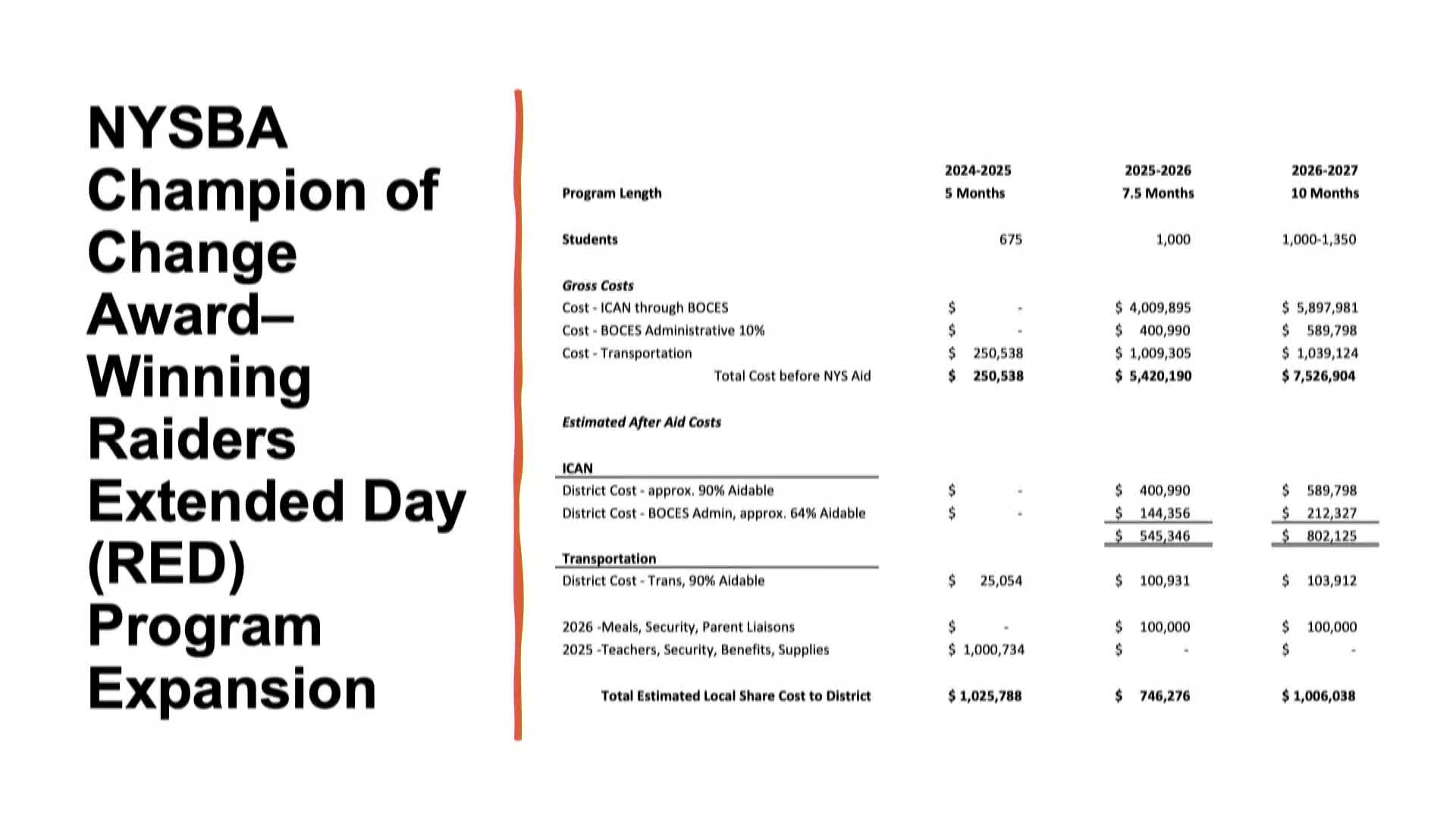
District presenters described a planned expansion of the RED extended-day (summer/enrichment) program and related summer opportunities. Staff said last year’s RED enrollment was about 675 elementary students and the draft 2026–27 plan aims to expand that to approximately 1,350 elementary students and to move the program start into September for a longer offering.
A finance staff member explained the cost dynamics: after the program moved to BOCES the district’s share dropped and the administration proposed expanding the program’s months while maintaining a lower per-month cost compared with the district-run 2024–25 model. "Doctor Spence's request is that within this budget that we move to 10 months, move it, into September instead of starting November," the finance presenter said.
Board members raised equity and operational concerns. Several said participation and program offerings vary widely between buildings and asked whether enrichment activities (for example cooking classes, athletic camps, or community speakers) are budgeted by the district or run under ICANN/contractor arrangements; presenters said design remains district-directed but some activities fit within existing ICANN contracts.
Transportation and supervision were prominent concerns. The board discussed neighborhood hub models versus centralized hubs and whether full-day or half-day schedules would boost participation. One member noted that transportation costs could make full-day models “cost prohibitive,” and staff said pilots and quadrant-based rollouts may be used to contain costs while addressing demand.
The presentation also connected RED expansion to a community-schools approach and discussed re-establishing dental or health clinics in partnership with community agencies; presenters said dental clinics operate in elementary schools but some health clinics stopped after agency partners lost staffing capacity.
Why it matters: The RED expansion directly affects thousands of elementary students, influences summer learning loss mitigation, and raises budgetary and logistical trade-offs for the district.
Next steps: Staff said design and stakeholder feedback will continue, with proposed program models and cost estimates to return to the board for further review.
A finance staff member explained the cost dynamics: after the program moved to BOCES the district’s share dropped and the administration proposed expanding the program’s months while maintaining a lower per-month cost compared with the district-run 2024–25 model. "Doctor Spence's request is that within this budget that we move to 10 months, move it, into September instead of starting November," the finance presenter said.
Board members raised equity and operational concerns. Several said participation and program offerings vary widely between buildings and asked whether enrichment activities (for example cooking classes, athletic camps, or community speakers) are budgeted by the district or run under ICANN/contractor arrangements; presenters said design remains district-directed but some activities fit within existing ICANN contracts.
Transportation and supervision were prominent concerns. The board discussed neighborhood hub models versus centralized hubs and whether full-day or half-day schedules would boost participation. One member noted that transportation costs could make full-day models “cost prohibitive,” and staff said pilots and quadrant-based rollouts may be used to contain costs while addressing demand.
The presentation also connected RED expansion to a community-schools approach and discussed re-establishing dental or health clinics in partnership with community agencies; presenters said dental clinics operate in elementary schools but some health clinics stopped after agency partners lost staffing capacity.
Why it matters: The RED expansion directly affects thousands of elementary students, influences summer learning loss mitigation, and raises budgetary and logistical trade-offs for the district.
Next steps: Staff said design and stakeholder feedback will continue, with proposed program models and cost estimates to return to the board for further review.
Don't Miss a Word: See the Full Meeting!
Go beyond summaries. Unlock every video, transcript, and key insight with a Founder Membership.
✓
Get instant access to full meeting videos
✓
Search and clip any phrase from complete transcripts
✓
Receive AI-powered summaries & custom alerts
✓
Enjoy lifetime, unrestricted access to government data
30-day money-back guarantee
