John Macera explains Ohio testing and alternate-assessment rules for students with disabilities
December 31, 2025 | Pickerington Local, School Districts, Ohio
This article was created by AI summarizing key points discussed. AI makes mistakes, so for full details and context, please refer to the video of the full meeting. Please report any errors so we can fix them. Report an error »
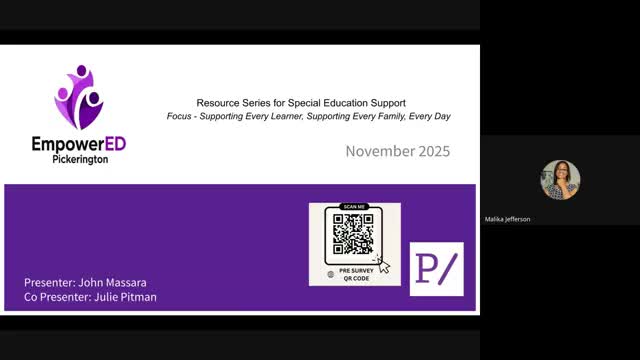
John Macera, a presenter with the district's student services program, told parents at the Empower Ed session that "all students in Ohio, including those with disabilities, are required by law to participate in statewide assessments" and explained how teams decide which assessment a student should take.
Macera opened by framing testing as a tool for equity and accountability, saying participation ensures students with disabilities are "counted, they're included, and given access to the same expectations and opportunities as other students." He said testing helps schools track instruction, identify needs, and maintain legal protections under the Individuals with Disabilities Education Act.
Macera described the two broad participation paths: the regular Ohio State Tests (OSTs) and the Alternate Assessment for students with the most significant cognitive disabilities. He emphasized that the IEP team'not a single parent or staff member'must complete the Ohio Alternate Assessment Participation Decision-Making Tool and justify any placement in the alternate assessment.
On accommodations, Macera listed concrete examples parents should expect to see in an IEP or 504 plan: extended time, small-group or one-on-one testing, frequent breaks, assistive technology, read-aloud options where permitted, scribing, and preferential seating. He warned that accommodations should already be in classroom practice and documented in the IEP before they are used on test day.
Macera noted the alternate assessment is intended for a very small share of students (he said "typically 1% or fewer statewide") and that participation can affect graduation options, so families should review section 12 of the IEP and discuss implications with the IEP team. He also recalled that Ohio once exceeded the federal 1% threshold and that the state adopted a lengthier decision tool after federal guidance and concerns about Title I funding.
The presentation covered English learner screening and proficiency tests as well: the Ohio English Language Proficiency Screener (OELPS) for initial identification and the annual OELPA (and an alternate OELPA for ELs with significant cognitive disabilities) used to measure listening, speaking, reading and writing. Macera said OELPA results help determine when a student can exit EL services, with monitoring continuing afterward.
Macera walked through testing calendars for the 2025'6 school year and practical scheduling rules the district must follow, including examples such as choosing five consecutive school days for a fall grade-3 administration or 15 consecutive days for some high-school testing windows. He said districts receive results on the schedule posted by the state.
To support students, Macera urged parents to attend IEP meetings, ask how accommodations are used during instruction and practice, use state-released practice items and readiness tools, and contact the district testing coordinator or special education director with questions. He closed by pointing attendees to the Ohio accessibility manual and other links posted in the chat and asked parents to complete a post-session survey.
The district-hosted Empower Ed presentation concluded without any formal votes or board actions; Macera thanked participants and the session ended.
Macera opened by framing testing as a tool for equity and accountability, saying participation ensures students with disabilities are "counted, they're included, and given access to the same expectations and opportunities as other students." He said testing helps schools track instruction, identify needs, and maintain legal protections under the Individuals with Disabilities Education Act.
Macera described the two broad participation paths: the regular Ohio State Tests (OSTs) and the Alternate Assessment for students with the most significant cognitive disabilities. He emphasized that the IEP team'not a single parent or staff member'must complete the Ohio Alternate Assessment Participation Decision-Making Tool and justify any placement in the alternate assessment.
On accommodations, Macera listed concrete examples parents should expect to see in an IEP or 504 plan: extended time, small-group or one-on-one testing, frequent breaks, assistive technology, read-aloud options where permitted, scribing, and preferential seating. He warned that accommodations should already be in classroom practice and documented in the IEP before they are used on test day.
Macera noted the alternate assessment is intended for a very small share of students (he said "typically 1% or fewer statewide") and that participation can affect graduation options, so families should review section 12 of the IEP and discuss implications with the IEP team. He also recalled that Ohio once exceeded the federal 1% threshold and that the state adopted a lengthier decision tool after federal guidance and concerns about Title I funding.
The presentation covered English learner screening and proficiency tests as well: the Ohio English Language Proficiency Screener (OELPS) for initial identification and the annual OELPA (and an alternate OELPA for ELs with significant cognitive disabilities) used to measure listening, speaking, reading and writing. Macera said OELPA results help determine when a student can exit EL services, with monitoring continuing afterward.
Macera walked through testing calendars for the 2025'6 school year and practical scheduling rules the district must follow, including examples such as choosing five consecutive school days for a fall grade-3 administration or 15 consecutive days for some high-school testing windows. He said districts receive results on the schedule posted by the state.
To support students, Macera urged parents to attend IEP meetings, ask how accommodations are used during instruction and practice, use state-released practice items and readiness tools, and contact the district testing coordinator or special education director with questions. He closed by pointing attendees to the Ohio accessibility manual and other links posted in the chat and asked parents to complete a post-session survey.
The district-hosted Empower Ed presentation concluded without any formal votes or board actions; Macera thanked participants and the session ended.
View the Full Meeting & All Its Details
This article offers just a summary. Unlock complete video, transcripts, and insights as a Founder Member.
✓
Watch full, unedited meeting videos
✓
Search every word spoken in unlimited transcripts
✓
AI summaries & real-time alerts (all government levels)
✓
Permanent access to expanding government content
30-day money-back guarantee
