Negotiators press to keep traditional health plan as district seeks savings
May 18, 2025 | OAKES 41, School Districts, North Dakota
This article was created by AI summarizing key points discussed. AI makes mistakes, so for full details and context, please refer to the video of the full meeting. Please report any errors so we can fix them. Report an error »
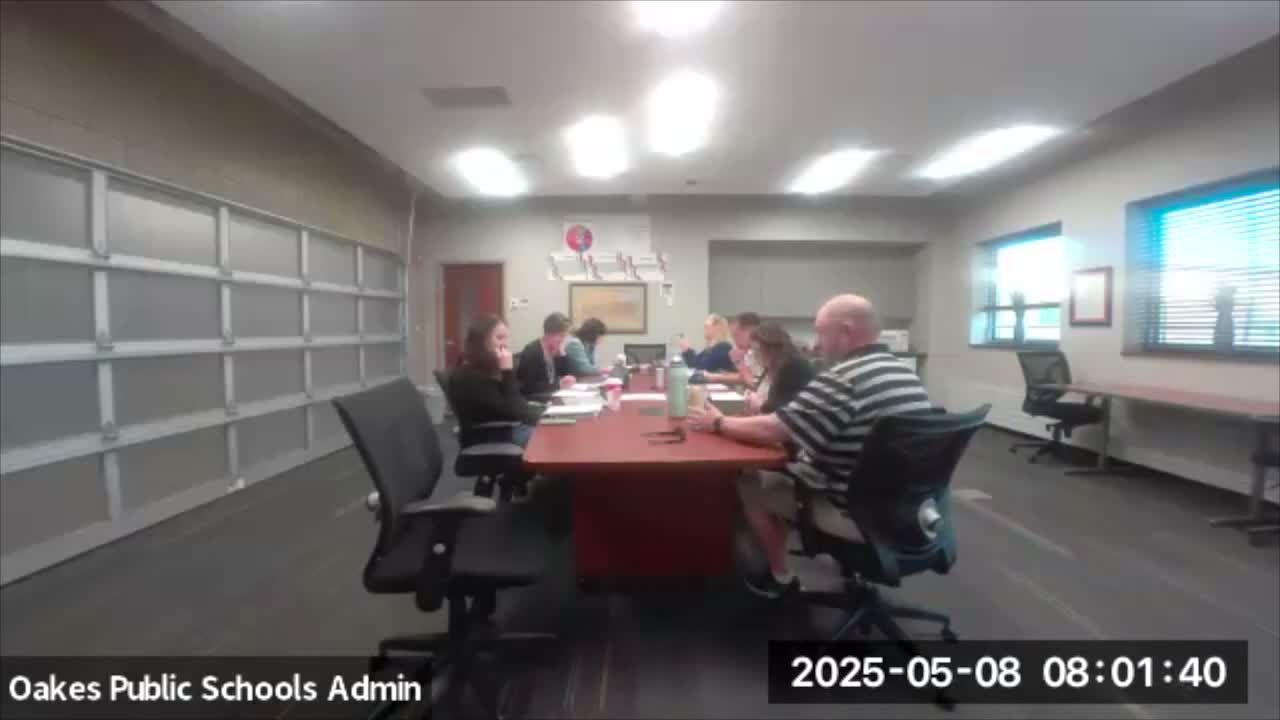
The OPS negotiations committee met May 8 at the central office to continue contract bargaining with employee negotiators, focusing primarily on health insurance design and how any savings would affect pay proposals.
The Chair said the district is exploring a high-deductible health plan to lower premium growth and proposed seeding employees' HSAs to ease the transition. "The first year an employee elects a high-deductible, they automatically get $1,800 dumped in," the Chair said, describing the district's opening proposal for an initial HSA contribution.
Negotiators responded that eliminating the traditional plan "period" would be unacceptable to a sizable portion of employees. One Committee member said negotiators would not proceed if the traditional family plan were removed without a workable compensation or buy-up option. "If the proposal is traditional off the table, period, the answer to that is no," the Committee member said.
Both sides discussed compromise options: offer a high-deductible plan as the baseline with the district paying the high-deductible premium and allow employees to buy up to traditional coverage by paying the difference; or provide targeted caps on district-paid deductibles and coinsurance. The Chair said the district will review whether employees may pay the difference to retain traditional plans and noted the district currently pays single coverage for employees under the traditional plan.
On cost-sharing details, negotiators pressed for concrete caps. The Chair asked negotiators for a figure they could accept; negotiators proposed numbers for staff to analyze. At one point, the Chair suggested a possible cap of $3,000 on district outlays for deductibles/coinsurance as a starting number for discussion.
Both sides also discussed the mechanics of matching HSA contributions. The Chair said the $1,800 HSA seed in year one is a guaranteed one-time deposit and does not automatically carry forward year to year.
Why it matters: Health-plan design affects both individual employees' out-of-pocket costs and the district's long-term budget. The district's negotiators said any savings from insurance changes will likely be redirected to other compensation elements, including TFFR-related pay, and both sides agreed to keep insurance and TFFR discussions linked at the next meeting.
Next steps: Negotiators agreed to mark (initial) any language they can accept on a printed draft so staff can circulate it by email; the parties plan to reconvene after running numbers on proposed caps and HSA matches.
The Chair said the district is exploring a high-deductible health plan to lower premium growth and proposed seeding employees' HSAs to ease the transition. "The first year an employee elects a high-deductible, they automatically get $1,800 dumped in," the Chair said, describing the district's opening proposal for an initial HSA contribution.
Negotiators responded that eliminating the traditional plan "period" would be unacceptable to a sizable portion of employees. One Committee member said negotiators would not proceed if the traditional family plan were removed without a workable compensation or buy-up option. "If the proposal is traditional off the table, period, the answer to that is no," the Committee member said.
Both sides discussed compromise options: offer a high-deductible plan as the baseline with the district paying the high-deductible premium and allow employees to buy up to traditional coverage by paying the difference; or provide targeted caps on district-paid deductibles and coinsurance. The Chair said the district will review whether employees may pay the difference to retain traditional plans and noted the district currently pays single coverage for employees under the traditional plan.
On cost-sharing details, negotiators pressed for concrete caps. The Chair asked negotiators for a figure they could accept; negotiators proposed numbers for staff to analyze. At one point, the Chair suggested a possible cap of $3,000 on district outlays for deductibles/coinsurance as a starting number for discussion.
Both sides also discussed the mechanics of matching HSA contributions. The Chair said the $1,800 HSA seed in year one is a guaranteed one-time deposit and does not automatically carry forward year to year.
Why it matters: Health-plan design affects both individual employees' out-of-pocket costs and the district's long-term budget. The district's negotiators said any savings from insurance changes will likely be redirected to other compensation elements, including TFFR-related pay, and both sides agreed to keep insurance and TFFR discussions linked at the next meeting.
Next steps: Negotiators agreed to mark (initial) any language they can accept on a printed draft so staff can circulate it by email; the parties plan to reconvene after running numbers on proposed caps and HSA matches.
Don't Miss a Word: See the Full Meeting!
Go beyond summaries. Unlock every video, transcript, and key insight with a Founder Membership.
✓
Get instant access to full meeting videos
✓
Search and clip any phrase from complete transcripts
✓
Receive AI-powered summaries & custom alerts
✓
Enjoy lifetime, unrestricted access to government data
30-day money-back guarantee
