Absecon district lays out 2025–26 goals and credits targeted intervention for student growth
November 22, 2025 | Absecon Public Schools District, School Districts, New Jersey
This article was created by AI summarizing key points discussed. AI makes mistakes, so for full details and context, please refer to the video of the full meeting. Please report any errors so we can fix them. Report an error »
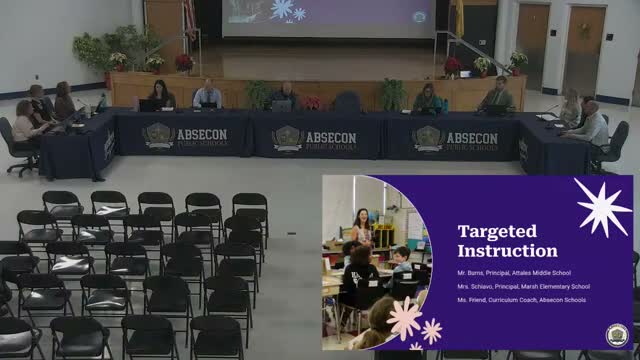
Absecon Public Schools District leaders presented the district’s three goals for 2025–26 and summarized early evidence that targeted, data‑driven supports have improved short‑term benchmark performance.
At the middle school, Principal Kevin Burns described a multi‑phase Reinforcement and Intervention Teachers (RIT) model that assigns certified specialists in math and language arts to small groups of students for the full school year. Burns said the program uses short pre‑ and post‑assessments over 5–6 week windows to measure impact and that, in comparison with similar middle schools, his students showed higher growth on those measures and on the state growth metric when the district’s preliminary results were returned. "You'll see that there's significant growth between the pre and the post assessment," Burns said.
Leslie Shivo, principal of the Marsh School, described WIN, a redesigned 40‑minute personalized learning block for grades K–4 focused on targeted intervention, flexible grouping and enrichment. Shivo presented benchmark figures showing atypical growth across several cohorts: for one cited cohort, fall→winter benchmark growth averaged 1.9 levels (typical growth is 1 level) and winter→spring averaged 1.7 levels; other grade cohorts posted 2.1–3.0 levels across benchmark periods. Shivo also said the district saw a 27% drop in discipline referrals from 2023–24 to 2024–25 and attributed part of that decline to students’ increased success and engagement during WIN.
Instructional coach Haley Friend said the district will continue RIT and WIN while strengthening math supports (ReadyPro, i‑Ready Standards Mastery, IXL) and after‑school interventions (SOAR). The district also reported expanded use of DIBELS for K–3 literacy screening and Newsela for grades 4–8, plus ongoing professional development through the ETTC, the New Jersey Department of Education and an in‑district literacy consultant.
Russ Davis, a seventh‑grade science teacher at ATLAS, described adopting the Open SciEd curriculum to align instruction with the Next Generation Science Standards and said teachers will use pre‑teaching and targeted reinforcement to close content gaps, particularly in eighth grade. Davis cited a statewide 2024 figure that 18.8% of eighth‑graders were proficient or better on standardized science tests; he said the district hopes the new approach will improve proficiency over time.
Why it matters: district leaders framed these initiatives as part of an eight‑year turnaround in which previously declining performance in language arts and math has reversed. Administrators said early benchmark gains and the district’s internal comparisons to similar schools are promising, but they noted that final state results remain embargoed and that longer‑term trends will require continued monitoring.
What’s next: district staff said they will present full state results when embargoes lift and continue to report benchmark results and program adjustments to the board.
At the middle school, Principal Kevin Burns described a multi‑phase Reinforcement and Intervention Teachers (RIT) model that assigns certified specialists in math and language arts to small groups of students for the full school year. Burns said the program uses short pre‑ and post‑assessments over 5–6 week windows to measure impact and that, in comparison with similar middle schools, his students showed higher growth on those measures and on the state growth metric when the district’s preliminary results were returned. "You'll see that there's significant growth between the pre and the post assessment," Burns said.
Leslie Shivo, principal of the Marsh School, described WIN, a redesigned 40‑minute personalized learning block for grades K–4 focused on targeted intervention, flexible grouping and enrichment. Shivo presented benchmark figures showing atypical growth across several cohorts: for one cited cohort, fall→winter benchmark growth averaged 1.9 levels (typical growth is 1 level) and winter→spring averaged 1.7 levels; other grade cohorts posted 2.1–3.0 levels across benchmark periods. Shivo also said the district saw a 27% drop in discipline referrals from 2023–24 to 2024–25 and attributed part of that decline to students’ increased success and engagement during WIN.
Instructional coach Haley Friend said the district will continue RIT and WIN while strengthening math supports (ReadyPro, i‑Ready Standards Mastery, IXL) and after‑school interventions (SOAR). The district also reported expanded use of DIBELS for K–3 literacy screening and Newsela for grades 4–8, plus ongoing professional development through the ETTC, the New Jersey Department of Education and an in‑district literacy consultant.
Russ Davis, a seventh‑grade science teacher at ATLAS, described adopting the Open SciEd curriculum to align instruction with the Next Generation Science Standards and said teachers will use pre‑teaching and targeted reinforcement to close content gaps, particularly in eighth grade. Davis cited a statewide 2024 figure that 18.8% of eighth‑graders were proficient or better on standardized science tests; he said the district hopes the new approach will improve proficiency over time.
Why it matters: district leaders framed these initiatives as part of an eight‑year turnaround in which previously declining performance in language arts and math has reversed. Administrators said early benchmark gains and the district’s internal comparisons to similar schools are promising, but they noted that final state results remain embargoed and that longer‑term trends will require continued monitoring.
What’s next: district staff said they will present full state results when embargoes lift and continue to report benchmark results and program adjustments to the board.
Don't Miss a Word: See the Full Meeting!
Go beyond summaries. Unlock every video, transcript, and key insight with a Founder Membership.
✓
Get instant access to full meeting videos
✓
Search and clip any phrase from complete transcripts
✓
Receive AI-powered summaries & custom alerts
✓
Enjoy lifetime, unrestricted access to government data
30-day money-back guarantee
