Scarborough officials recommend delaying cohort enrollment while planning to absorb preschool special‑education duties from CDS
February 27, 2026 | Scarborough Public Schools, School Districts, Maine
This article was created by AI summarizing key points discussed. AI makes mistakes, so for full details and context, please refer to the video of the full meeting. Please report any errors so we can fix them. Report an error »
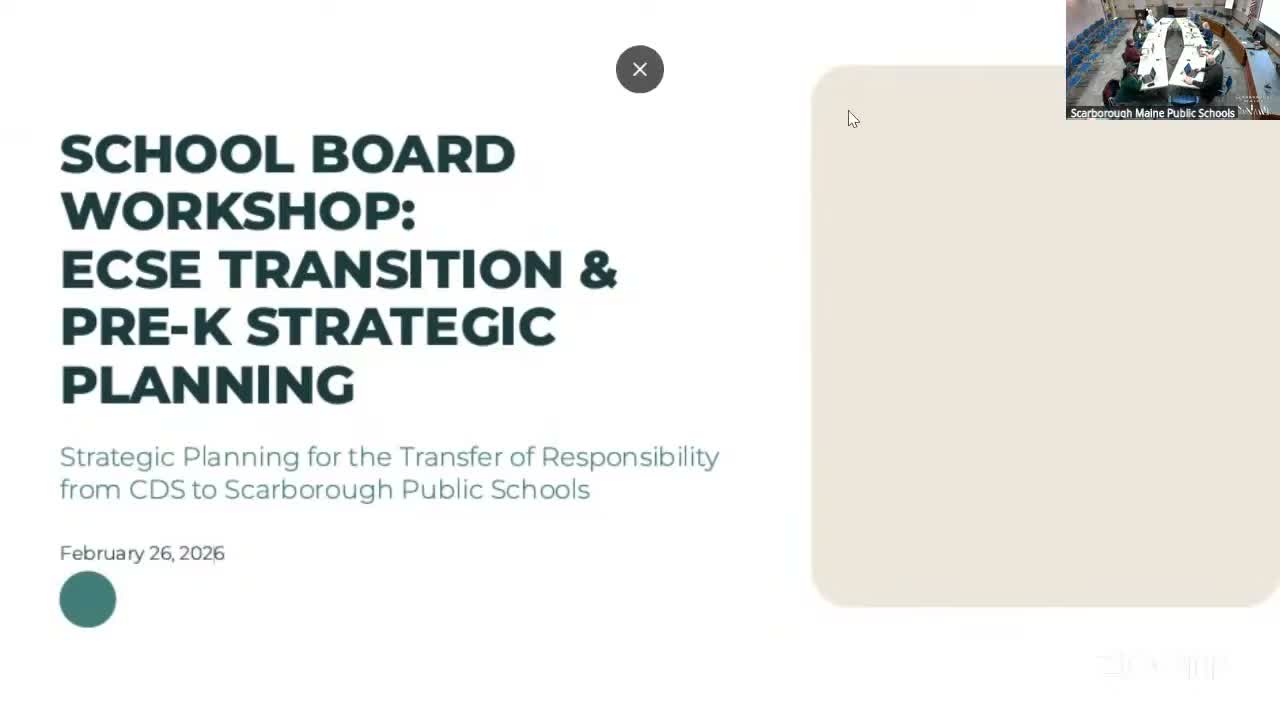
Scarborough school administrators told the board Thursday that a 2023 state law requires local districts to assume responsibility for early‑childhood special‑education services now handled by Child Development Services (CDS), and they outlined options for expanding pre‑K seats while protecting students’ right to a free and appropriate public education (FAPE).
Diane (presenter) told the board the statutory change means districts must provide special‑education services beginning at age 2 years, 9 months (the start of child‑find obligations) and supply direct services by age 3. “FAPE is something that we always talk about in regards to our K‑12 students, but now that’s being brought into this preschool conversation,” she said.
The district detailed three scenarios for pre‑K expansion. Scenario 1 would preserve the status quo (keeping the grant‑funded Shooting Stars classroom and the existing set‑aside funds), producing minimal general‑purpose aid (GPA) gains. Scenario 2 (moderate growth) would add about 32 students using a half‑day rotational model, producing roughly $355,000 in additional GPA over time. Scenario 3 (robust growth) would add about 64 students and is projected to generate roughly $700,000 in new funding, after the state’s two‑year averaging rules apply.
The administrators cautioned that while the state intends the CDS‑related special‑education services to be 100% state funded, operational costs such as facility leases, certain transportation arrangements and other site‑related expenses are not automatically covered. "This is intended to be funded at 100% from the state with no local share required," Diane said, but she also noted some recent guidance from the Department of Education left reimbursement details — including whether administrative positions would be fully covered — unclear.
Chris Rodia, introduced as the district’s special services director, said the district expects rolling referrals to increase the number of identified preschool‑age children over the year and emphasized the administrative workload: "We would need at least a full‑time administrative position and probably a full‑time administrative assistant to coordinate IEP meetings, partner sites and scheduling," he said.
Given Scarborough’s size, facility constraints and the risk of financial liability if the district cannot timely provide services specified on individual education plans, administrators recommended the board defer signing up for the state cohort this year and instead join a later cohort. Diane summarized the rationale: "We can, in good faith, have Chris sit in an IEP meeting in April and sign all these 4‑year‑olds on with no location for them to go to. With no concrete plan for how we’re going to address FAPE, that presents obstacles for us." The board agreed to carry further discussion to the next regular meeting and to bring a formal recommendation for a vote.
What's next: staff will refine enrollment estimates and budget scenarios, pursue community outreach to confirm family demand for half‑day versus full‑day slots, and return recommended motions and draft budget language at the board's next meeting. The district also flagged a series of open technical questions to the state about administrative reimbursements and transportation obligations that it will continue to pursue with the DOE.
Sources and attribution: Quotes and policy descriptions come directly from the district presentation and Q&A among Diane and Chris Rodia during the Feb. 26 workshop.
Diane (presenter) told the board the statutory change means districts must provide special‑education services beginning at age 2 years, 9 months (the start of child‑find obligations) and supply direct services by age 3. “FAPE is something that we always talk about in regards to our K‑12 students, but now that’s being brought into this preschool conversation,” she said.
The district detailed three scenarios for pre‑K expansion. Scenario 1 would preserve the status quo (keeping the grant‑funded Shooting Stars classroom and the existing set‑aside funds), producing minimal general‑purpose aid (GPA) gains. Scenario 2 (moderate growth) would add about 32 students using a half‑day rotational model, producing roughly $355,000 in additional GPA over time. Scenario 3 (robust growth) would add about 64 students and is projected to generate roughly $700,000 in new funding, after the state’s two‑year averaging rules apply.
The administrators cautioned that while the state intends the CDS‑related special‑education services to be 100% state funded, operational costs such as facility leases, certain transportation arrangements and other site‑related expenses are not automatically covered. "This is intended to be funded at 100% from the state with no local share required," Diane said, but she also noted some recent guidance from the Department of Education left reimbursement details — including whether administrative positions would be fully covered — unclear.
Chris Rodia, introduced as the district’s special services director, said the district expects rolling referrals to increase the number of identified preschool‑age children over the year and emphasized the administrative workload: "We would need at least a full‑time administrative position and probably a full‑time administrative assistant to coordinate IEP meetings, partner sites and scheduling," he said.
Given Scarborough’s size, facility constraints and the risk of financial liability if the district cannot timely provide services specified on individual education plans, administrators recommended the board defer signing up for the state cohort this year and instead join a later cohort. Diane summarized the rationale: "We can, in good faith, have Chris sit in an IEP meeting in April and sign all these 4‑year‑olds on with no location for them to go to. With no concrete plan for how we’re going to address FAPE, that presents obstacles for us." The board agreed to carry further discussion to the next regular meeting and to bring a formal recommendation for a vote.
What's next: staff will refine enrollment estimates and budget scenarios, pursue community outreach to confirm family demand for half‑day versus full‑day slots, and return recommended motions and draft budget language at the board's next meeting. The district also flagged a series of open technical questions to the state about administrative reimbursements and transportation obligations that it will continue to pursue with the DOE.
Sources and attribution: Quotes and policy descriptions come directly from the district presentation and Q&A among Diane and Chris Rodia during the Feb. 26 workshop.
View the Full Meeting & All Its Details
This article offers just a summary. Unlock complete video, transcripts, and insights as a Founder Member.
✓
Watch full, unedited meeting videos
✓
Search every word spoken in unlimited transcripts
✓
AI summaries & real-time alerts (all government levels)
✓
Permanent access to expanding government content
30-day money-back guarantee
