Rutland Regional Plan authors solicit public input on draft policies covering housing, land use, energy and resilience
September 27, 2024 | Rutland County, Vermont
This article was created by AI summarizing key points discussed. AI makes mistakes, so for full details and context, please refer to the video of the full meeting. Please report any errors so we can fix them. Report an error »
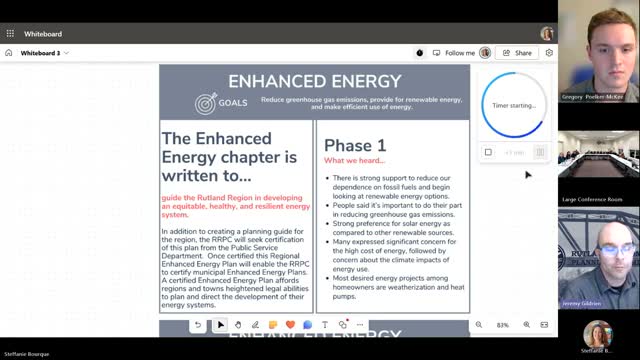
Rutland Regional Planning Commission chapter authors presented draft policies for the commission’s Phase 2 regional plan and asked residents and municipal representatives for feedback at a public session focused on the plan’s 10 chapters.
"We are here today as one of our engagement events for Phase 2 engagement for the Rutland Regional Plan," Moderator Devin said at the opening, noting the commission reached more than 500 people in person and recorded almost 1,200 survey responses during Phase 1.
Logan Solomon, the planner who led both the land use and housing presentations, said the land use chapter centers on a regional future land-use map meant to concentrate growth in compact downtowns and village centers while protecting natural and agricultural areas. He described five draft land-use policies: prioritize infill and redevelopment in planned growth areas; limit strip development on sensitive lands; encourage clustered development outside centers; prioritize public investments in growth areas; and require new development to respect local character.
On housing, Solomon said the commission’s 2023 housing needs assessment informed draft policies that aim to increase supply and preserve affordability. "What we're saying ... is that growth of housing, as well as existing or new programs or any sort of housing incentives, that those should result in people spending no more than 30% of their income on housing and not more than 15% on transportation," he said, citing federal guidance as the origin of the 30/15 metrics. Participants raised questions about where new housing would locate, whether development would be new construction or refurbishment, and how town economies would supply local jobs near housing.
Economic development chapter lead Greg urged concentrating job and business growth in downtowns and village centers and expanding training and career pathways in trades and manufacturing. Several attendees pointed to Act 250 and other regulatory processes as barriers to rapid redevelopment or industrial reuse; one participant urged using underutilized industrial land and extending sewer to create ready-to-market business parks.
Cultural-resources and natural-resources presenters sought to protect historic buildings, scenic assets and water resources. Nick, who led the cultural chapter, proposed programs to help small historical societies catalog artifacts and access preservation grants; participants supported the focus but asked for clearer definitions and measurable indicators to prevent unclear preservation criteria from slowing otherwise appropriate projects.
Transportation planner Ethan emphasized complete streets, improved sidewalk maintenance and better transit information and schedules. Multiple attendees said the bus network’s current hours and routing do not reliably serve workers returning late shifts; several towns have used local hotel and meals taxes to subsidize extended service in resort areas, they said.
Jeremy, who led the enhanced energy chapter, explained that the chapter doubles as the region’s statutory enhanced energy plan and therefore includes language intended to work within Act 250 and Section 248/PUBLIC utility siting processes. He said towns can identify "preferred locations" for renewable generation in their own enhanced energy plans and the regional plan aims to support those choices. Residents asked for clearer definitions of "preferred locations" and how coordination with town plans will work.
Speakers raised water-quality concerns repeatedly. Participants described testing that found PFAS in groundwater and urged stronger protections for drinking water and riparian buffers. One commenter warned of out-of-state interests seeking Vermont water and urged framing water as a public trust.
On public utilities and facilities, authors recommended expanding childcare networks, coordinating solid-waste districts, and investing in municipal buildings and schools to improve equity and efficiency. An attendee cited deferred maintenance: "In Rutland City alone, I believe it's 125,000,000," a figure offered as an estimate during discussion.
The climate resilience chapter advocated municipal vulnerability assessments, more natural-systems projects to moderate flooding, and measures to prepare for longer, higher-temperature heat waves. Maggie, the chapter lead, also emphasized strengthening social ties and local networks so communities can respond and recover more effectively from extreme events.
No formal votes or motions were recorded at the session; authors said comments will be incorporated into subsequent drafts and staff invited attendees to a second feedback session scheduled for Oct. 30. The plan team also pointed participants to the plan website (grudlandrpc.org/backslashplan2026) and the open survey for additional written input.
What to watch next: the RRPC will revise chapter drafts to reflect public comment and publish updated draft policies ahead of continued public engagement. Several topics flagged for follow-up by participants and staff were housing implementation details (locations and program incentives), clearer definitions for "preferred locations" for energy siting, transit schedule changes to serve shift workers, PFAS testing and water-protection measures, and targeted incentives or market-development plans to keep farmland in production or to finance reuse of industrial parcels.
Sources: public presentations and participant remarks at the Rutland Regional Plan Phase 2 feedback session (public session); RRPC staff statements and chapter summaries provided during the meeting.
"We are here today as one of our engagement events for Phase 2 engagement for the Rutland Regional Plan," Moderator Devin said at the opening, noting the commission reached more than 500 people in person and recorded almost 1,200 survey responses during Phase 1.
Logan Solomon, the planner who led both the land use and housing presentations, said the land use chapter centers on a regional future land-use map meant to concentrate growth in compact downtowns and village centers while protecting natural and agricultural areas. He described five draft land-use policies: prioritize infill and redevelopment in planned growth areas; limit strip development on sensitive lands; encourage clustered development outside centers; prioritize public investments in growth areas; and require new development to respect local character.
On housing, Solomon said the commission’s 2023 housing needs assessment informed draft policies that aim to increase supply and preserve affordability. "What we're saying ... is that growth of housing, as well as existing or new programs or any sort of housing incentives, that those should result in people spending no more than 30% of their income on housing and not more than 15% on transportation," he said, citing federal guidance as the origin of the 30/15 metrics. Participants raised questions about where new housing would locate, whether development would be new construction or refurbishment, and how town economies would supply local jobs near housing.
Economic development chapter lead Greg urged concentrating job and business growth in downtowns and village centers and expanding training and career pathways in trades and manufacturing. Several attendees pointed to Act 250 and other regulatory processes as barriers to rapid redevelopment or industrial reuse; one participant urged using underutilized industrial land and extending sewer to create ready-to-market business parks.
Cultural-resources and natural-resources presenters sought to protect historic buildings, scenic assets and water resources. Nick, who led the cultural chapter, proposed programs to help small historical societies catalog artifacts and access preservation grants; participants supported the focus but asked for clearer definitions and measurable indicators to prevent unclear preservation criteria from slowing otherwise appropriate projects.
Transportation planner Ethan emphasized complete streets, improved sidewalk maintenance and better transit information and schedules. Multiple attendees said the bus network’s current hours and routing do not reliably serve workers returning late shifts; several towns have used local hotel and meals taxes to subsidize extended service in resort areas, they said.
Jeremy, who led the enhanced energy chapter, explained that the chapter doubles as the region’s statutory enhanced energy plan and therefore includes language intended to work within Act 250 and Section 248/PUBLIC utility siting processes. He said towns can identify "preferred locations" for renewable generation in their own enhanced energy plans and the regional plan aims to support those choices. Residents asked for clearer definitions of "preferred locations" and how coordination with town plans will work.
Speakers raised water-quality concerns repeatedly. Participants described testing that found PFAS in groundwater and urged stronger protections for drinking water and riparian buffers. One commenter warned of out-of-state interests seeking Vermont water and urged framing water as a public trust.
On public utilities and facilities, authors recommended expanding childcare networks, coordinating solid-waste districts, and investing in municipal buildings and schools to improve equity and efficiency. An attendee cited deferred maintenance: "In Rutland City alone, I believe it's 125,000,000," a figure offered as an estimate during discussion.
The climate resilience chapter advocated municipal vulnerability assessments, more natural-systems projects to moderate flooding, and measures to prepare for longer, higher-temperature heat waves. Maggie, the chapter lead, also emphasized strengthening social ties and local networks so communities can respond and recover more effectively from extreme events.
No formal votes or motions were recorded at the session; authors said comments will be incorporated into subsequent drafts and staff invited attendees to a second feedback session scheduled for Oct. 30. The plan team also pointed participants to the plan website (grudlandrpc.org/backslashplan2026) and the open survey for additional written input.
What to watch next: the RRPC will revise chapter drafts to reflect public comment and publish updated draft policies ahead of continued public engagement. Several topics flagged for follow-up by participants and staff were housing implementation details (locations and program incentives), clearer definitions for "preferred locations" for energy siting, transit schedule changes to serve shift workers, PFAS testing and water-protection measures, and targeted incentives or market-development plans to keep farmland in production or to finance reuse of industrial parcels.
Sources: public presentations and participant remarks at the Rutland Regional Plan Phase 2 feedback session (public session); RRPC staff statements and chapter summaries provided during the meeting.
Don't Miss a Word: See the Full Meeting!
Go beyond summaries. Unlock every video, transcript, and key insight with a Founder Membership.
✓
Get instant access to full meeting videos
✓
Search and clip any phrase from complete transcripts
✓
Receive AI-powered summaries & custom alerts
✓
Enjoy lifetime, unrestricted access to government data
30-day money-back guarantee
