ACUS committee drops plan to formalize ‘no-comment’ rule category, debates temporary-rule guidance
October 30, 2024 | Administrative Conference of the United States (ACUS), Independent Establishments and Government Corporations, Executive, Federal
This article was created by AI summarizing key points discussed. AI makes mistakes, so for full details and context, please refer to the video of the full meeting. Please report any errors so we can fix them. Report an error »
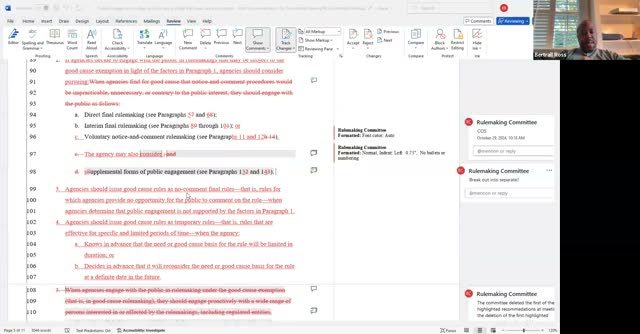
The Administrative Conference of the United States (ACUS) Committee on Rulemaking voted on edits to draft recommendations about agency public engagement when invoking the Administrative Procedure Act’s good cause exemption and agreed to remove a proposed Recommendation 3 that would have created a discrete category of “no-comment” final rules.
Bertrall, who led the meeting’s discussion of the draft, summarized the debate as a tension between naming a distinct class of rules that agencies sometimes use and avoiding language that would appear to bar public comment. Multiple committee members said the phrase “no-comment” looked unhelpful in a document about public engagement. “I really don't like creating another category called no comment rules,” said Jeff Lubbers, who argued the label was off-putting and unnecessary. After extended discussion of alternatives — including moving explanatory material to the preamble or folding the concept into other recommendations — Bertrall told the group, “We will delete recommendation 3.”
Those who opposed deletion urged the committee to acknowledge that agencies sometimes issue final rules without prior notice-and-comment because of classification, technical noncontroversial edits or statutory constraints. Mark (the committee’s outside consultant) said such rules exist in practice and that the committee could either call them out or address them in a broader preamble explanation. Others said acknowledging the practice without endorsing or normalizing it would be sufficient.
The committee also debated whether discussion of short-term “temporary final rules” belongs in the recommendations or is better treated in a separate report. Members offered examples ranging from Coast Guard short-duration actions—sometimes hours or days—to Department of Transportation temporary rules lasting months or years, and said the key distinction is whether a rule has a specific expiration. Several members suggested that, if referenced, the draft should narrow the scope to temporary final rules that are time-limited and would not otherwise go through notice-and-comment.
The committee did not, as part of this meeting, adopt new binding language on temporary final rules; it directed staff and the drafting subgroup to revise wording and to return with updated text and style edits at the next session. The committee scheduled its next meeting for Monday, November 4 at 10 a.m.
What’s next: staff will redline the draft to reflect the deletion of Recommendation 3, consider moving definitional material to the preamble, and circulate revised language before the next meeting.
Bertrall, who led the meeting’s discussion of the draft, summarized the debate as a tension between naming a distinct class of rules that agencies sometimes use and avoiding language that would appear to bar public comment. Multiple committee members said the phrase “no-comment” looked unhelpful in a document about public engagement. “I really don't like creating another category called no comment rules,” said Jeff Lubbers, who argued the label was off-putting and unnecessary. After extended discussion of alternatives — including moving explanatory material to the preamble or folding the concept into other recommendations — Bertrall told the group, “We will delete recommendation 3.”
Those who opposed deletion urged the committee to acknowledge that agencies sometimes issue final rules without prior notice-and-comment because of classification, technical noncontroversial edits or statutory constraints. Mark (the committee’s outside consultant) said such rules exist in practice and that the committee could either call them out or address them in a broader preamble explanation. Others said acknowledging the practice without endorsing or normalizing it would be sufficient.
The committee also debated whether discussion of short-term “temporary final rules” belongs in the recommendations or is better treated in a separate report. Members offered examples ranging from Coast Guard short-duration actions—sometimes hours or days—to Department of Transportation temporary rules lasting months or years, and said the key distinction is whether a rule has a specific expiration. Several members suggested that, if referenced, the draft should narrow the scope to temporary final rules that are time-limited and would not otherwise go through notice-and-comment.
The committee did not, as part of this meeting, adopt new binding language on temporary final rules; it directed staff and the drafting subgroup to revise wording and to return with updated text and style edits at the next session. The committee scheduled its next meeting for Monday, November 4 at 10 a.m.
What’s next: staff will redline the draft to reflect the deletion of Recommendation 3, consider moving definitional material to the preamble, and circulate revised language before the next meeting.
View the Full Meeting & All Its Details
This article offers just a summary. Unlock complete video, transcripts, and insights as a Founder Member.
✓
Watch full, unedited meeting videos
✓
Search every word spoken in unlimited transcripts
✓
AI summaries & real-time alerts (all government levels)
✓
Permanent access to expanding government content
30-day money-back guarantee
