ACUS committee sharpens guidance on direct final rules; members back 30-day solicitation to surface adverse comments
October 30, 2024 | Administrative Conference of the United States (ACUS), Independent Establishments and Government Corporations, Executive, Federal
This article was created by AI summarizing key points discussed. AI makes mistakes, so for full details and context, please refer to the video of the full meeting. Please report any errors so we can fix them. Report an error »
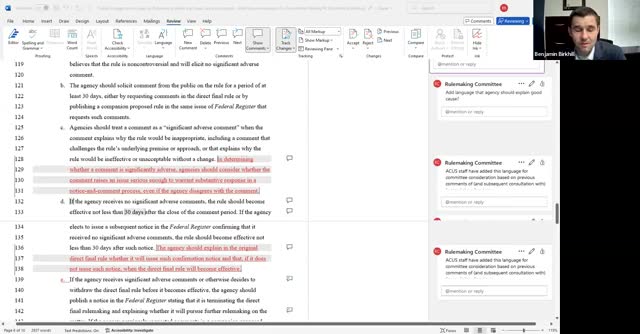
The Administrative Conference of the United States (ACUS) Committee on Rulemaking spent substantial time updating guidance on direct final rulemaking (DFR), a mechanism agencies use to expedite noncontroversial rules. The committee debated when agencies should ‘consider’ versus ‘should’ use DFR, what preamble explanation is appropriate, and how to solicit public objections that would trigger the fallback proposal process.
Bill Funk proposed specific language to require a solicitation window: “For a period of at least 30 days, the agency should ask persons whether they have substantial adverse comments,” drawing support from members seeking a bright-line period to surface objections. Ron Levin cautioned that the wording should make clear the solicitation is to identify significant adverse objections that would defeat a DFR — not to convert the DFR into an ordinary notice-and-comment proceeding. “What you’re asking for is comments to go to the question of whether it is, indeed, uncontroversial, and whether they're adverse comments,” Ron said, emphasizing the limited purpose of the solicitation.
Members discussed the common agency practices of (1) requesting comments in the direct final rule text, (2) publishing a companion proposed rule or (3) combining documents so the direct final rule will be treated as a proposed rule if adverse comments are received (a practice DOT and EPA sometimes use). Miriam (Federal Register staff perspective) noted that labeling a rule 'temporary' depends on whether it carries an explicit expiration date, and that the legal classification of temporary rules does not automatically exempt them from statutory requirements.
On preamble explanation, speakers divided over whether agencies should provide only a brief rationale (e.g., identify the action as technical and noncontroversial) or a fuller reasoned explanation of why notice-and-comment is unnecessary. Some favored retaining a short statement of why a DFR is appropriate to reduce gaming of the process; others warned against requiring an onerous justification that would undercut the DFR's speed benefits.
The committee did not adopt final text at this meeting but instructed staff to draft revised language that (a) keeps the DFR framework tied to the APA good-cause considerations, (b) includes a clear solicitation period (committee discussion flagged 30 days as a working draft), and (c) clarifies the companion-proposal alternatives and the standard for assessing adverse comments.
Bill Funk proposed specific language to require a solicitation window: “For a period of at least 30 days, the agency should ask persons whether they have substantial adverse comments,” drawing support from members seeking a bright-line period to surface objections. Ron Levin cautioned that the wording should make clear the solicitation is to identify significant adverse objections that would defeat a DFR — not to convert the DFR into an ordinary notice-and-comment proceeding. “What you’re asking for is comments to go to the question of whether it is, indeed, uncontroversial, and whether they're adverse comments,” Ron said, emphasizing the limited purpose of the solicitation.
Members discussed the common agency practices of (1) requesting comments in the direct final rule text, (2) publishing a companion proposed rule or (3) combining documents so the direct final rule will be treated as a proposed rule if adverse comments are received (a practice DOT and EPA sometimes use). Miriam (Federal Register staff perspective) noted that labeling a rule 'temporary' depends on whether it carries an explicit expiration date, and that the legal classification of temporary rules does not automatically exempt them from statutory requirements.
On preamble explanation, speakers divided over whether agencies should provide only a brief rationale (e.g., identify the action as technical and noncontroversial) or a fuller reasoned explanation of why notice-and-comment is unnecessary. Some favored retaining a short statement of why a DFR is appropriate to reduce gaming of the process; others warned against requiring an onerous justification that would undercut the DFR's speed benefits.
The committee did not adopt final text at this meeting but instructed staff to draft revised language that (a) keeps the DFR framework tied to the APA good-cause considerations, (b) includes a clear solicitation period (committee discussion flagged 30 days as a working draft), and (c) clarifies the companion-proposal alternatives and the standard for assessing adverse comments.
View the Full Meeting & All Its Details
This article offers just a summary. Unlock complete video, transcripts, and insights as a Founder Member.
✓
Watch full, unedited meeting videos
✓
Search every word spoken in unlimited transcripts
✓
AI summaries & real-time alerts (all government levels)
✓
Permanent access to expanding government content
30-day money-back guarantee
