ACUS panel: nationwide injunctions have risen, agencies say unclear orders cause most operational strain
September 28, 2024 | Administrative Conference of the United States (ACUS), Independent Establishments and Government Corporations, Executive, Federal
This article was created by AI summarizing key points discussed. AI makes mistakes, so for full details and context, please refer to the video of the full meeting. Please report any errors so we can fix them. Report an error »
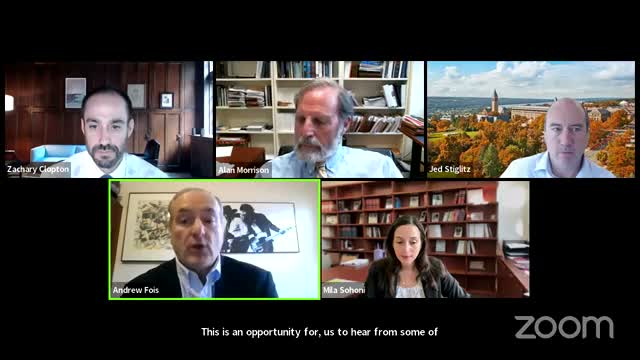
Panelists who wrote a June ACUS‑commissioned report on nationwide (or "universal") injunctions told an Administrative Conference of the United States forum that such remedies have become more frequent in recent administrations and that federal agencies are more burdened by unclear language and ambiguous scope in court orders than by the orders’ nationwide reach.
The authors — Zachary Compton of Northwestern University, Jeff Stieglitz of Cornell Law School, Mila Sohoney of Stanford Law School and Jed (surname not provided) — presented quantitative and qualitative findings on remedies that bar federal action beyond the named parties. Jed summarized the quantitative results as: "Have nationwide injunction has been increasing? Yes. By the search terms and the like that we use, the grants, have been increasing over time." The panel said grant rates and the incidence of nationwide relief have risen especially since the later years of the Obama administration into the Trump and Biden presidencies.
Why it matters: universal remedies can immediately affect entire regulatory programs and may alter litigation dynamics and agency behavior. But the report’s qualitative interviews with officials at 11 agencies — including USDA, Commerce, Energy, EPA, FCC, Office of the Federal Register, HHS, HUD, Interior, DOJ and IRS — found that agencies most commonly described implementation problems caused by ambiguity about what the court actually required.
"I'm more focused on the clarity of the decision than the nature of the court order," one panelist quoted an agency official as saying, summarizing interview responses in the report. Panelists said that when an order arrives agencies often "put pencils down," pause work on the affected action, and coordinate with DOJ (and sometimes OMB/OIRA) to determine what concrete steps are required.
Quantitative highlights: the authors used targeted legal database searches (including citations to APA §706 for vacatur claims) and human coding to measure frequency and outcomes. They reported a historical grant rate near 40% that rose in later administrations and noted agency‑level variation: DHS, USDA, HHS and DOJ appeared frequently in the dataset and in some cases were disproportionately affected.
Qualitative findings: the team conducted semi‑structured interviews and surveys, secured interviews at 11 agencies, and received survey responses from FTC, GSA, MSPB, NLRB and NRC; five agencies declined to participate. Interviewees generally described earnest, good‑faith efforts to comply with court orders. Several agencies told the researchers that non‑universal remedies — orders that apply only to particular parties or jurisdictions — could produce difficult implementation "patchworks," though some interviewees said plaintiff‑specific relief could, in certain cases, be easier to operationalize.
Panel recommendations and open questions: authors urged further research on what makes court orders unclear and experimental work to test what drafting features improve implementability. They also suggested comparative study of "channeling statutes" (which route disputes to courts of appeals) to evaluate whether broader use of channeling could preserve benefits of uniform outcomes while reducing district‑court variability.
The forum concluded with audience questions about whether the uptick reflects more cases being filed or changes in plaintiffs’ litigation strategy. Panelists said their empirical approach captured an increase in final orders in their dataset but did not directly measure complaint filing rates or plaintiffs’ pleading choices and encouraged further research with plaintiffs and state attorneys general.
The panelists said the full report and the forum video are available on the ACUS website; ACUS announced a follow‑up session scheduled for Wednesday, Oct. 2 at 12:00 p.m.
The authors — Zachary Compton of Northwestern University, Jeff Stieglitz of Cornell Law School, Mila Sohoney of Stanford Law School and Jed (surname not provided) — presented quantitative and qualitative findings on remedies that bar federal action beyond the named parties. Jed summarized the quantitative results as: "Have nationwide injunction has been increasing? Yes. By the search terms and the like that we use, the grants, have been increasing over time." The panel said grant rates and the incidence of nationwide relief have risen especially since the later years of the Obama administration into the Trump and Biden presidencies.
Why it matters: universal remedies can immediately affect entire regulatory programs and may alter litigation dynamics and agency behavior. But the report’s qualitative interviews with officials at 11 agencies — including USDA, Commerce, Energy, EPA, FCC, Office of the Federal Register, HHS, HUD, Interior, DOJ and IRS — found that agencies most commonly described implementation problems caused by ambiguity about what the court actually required.
"I'm more focused on the clarity of the decision than the nature of the court order," one panelist quoted an agency official as saying, summarizing interview responses in the report. Panelists said that when an order arrives agencies often "put pencils down," pause work on the affected action, and coordinate with DOJ (and sometimes OMB/OIRA) to determine what concrete steps are required.
Quantitative highlights: the authors used targeted legal database searches (including citations to APA §706 for vacatur claims) and human coding to measure frequency and outcomes. They reported a historical grant rate near 40% that rose in later administrations and noted agency‑level variation: DHS, USDA, HHS and DOJ appeared frequently in the dataset and in some cases were disproportionately affected.
Qualitative findings: the team conducted semi‑structured interviews and surveys, secured interviews at 11 agencies, and received survey responses from FTC, GSA, MSPB, NLRB and NRC; five agencies declined to participate. Interviewees generally described earnest, good‑faith efforts to comply with court orders. Several agencies told the researchers that non‑universal remedies — orders that apply only to particular parties or jurisdictions — could produce difficult implementation "patchworks," though some interviewees said plaintiff‑specific relief could, in certain cases, be easier to operationalize.
Panel recommendations and open questions: authors urged further research on what makes court orders unclear and experimental work to test what drafting features improve implementability. They also suggested comparative study of "channeling statutes" (which route disputes to courts of appeals) to evaluate whether broader use of channeling could preserve benefits of uniform outcomes while reducing district‑court variability.
The forum concluded with audience questions about whether the uptick reflects more cases being filed or changes in plaintiffs’ litigation strategy. Panelists said their empirical approach captured an increase in final orders in their dataset but did not directly measure complaint filing rates or plaintiffs’ pleading choices and encouraged further research with plaintiffs and state attorneys general.
The panelists said the full report and the forum video are available on the ACUS website; ACUS announced a follow‑up session scheduled for Wednesday, Oct. 2 at 12:00 p.m.
Don't Miss a Word: See the Full Meeting!
Go beyond summaries. Unlock every video, transcript, and key insight with a Founder Membership.
✓
Get instant access to full meeting videos
✓
Search and clip any phrase from complete transcripts
✓
Receive AI-powered summaries & custom alerts
✓
Enjoy lifetime, unrestricted access to government data
30-day money-back guarantee
