Public commenters say District 70 president abandoned Feb. 10 meeting and later appointed member without recorded vote
February 26, 2026 | Pueblo County School District 70, School Districts , Colorado
This article was created by AI summarizing key points discussed. AI makes mistakes, so for full details and context, please refer to the video of the full meeting. Please report any errors so we can fix them. Report an error »
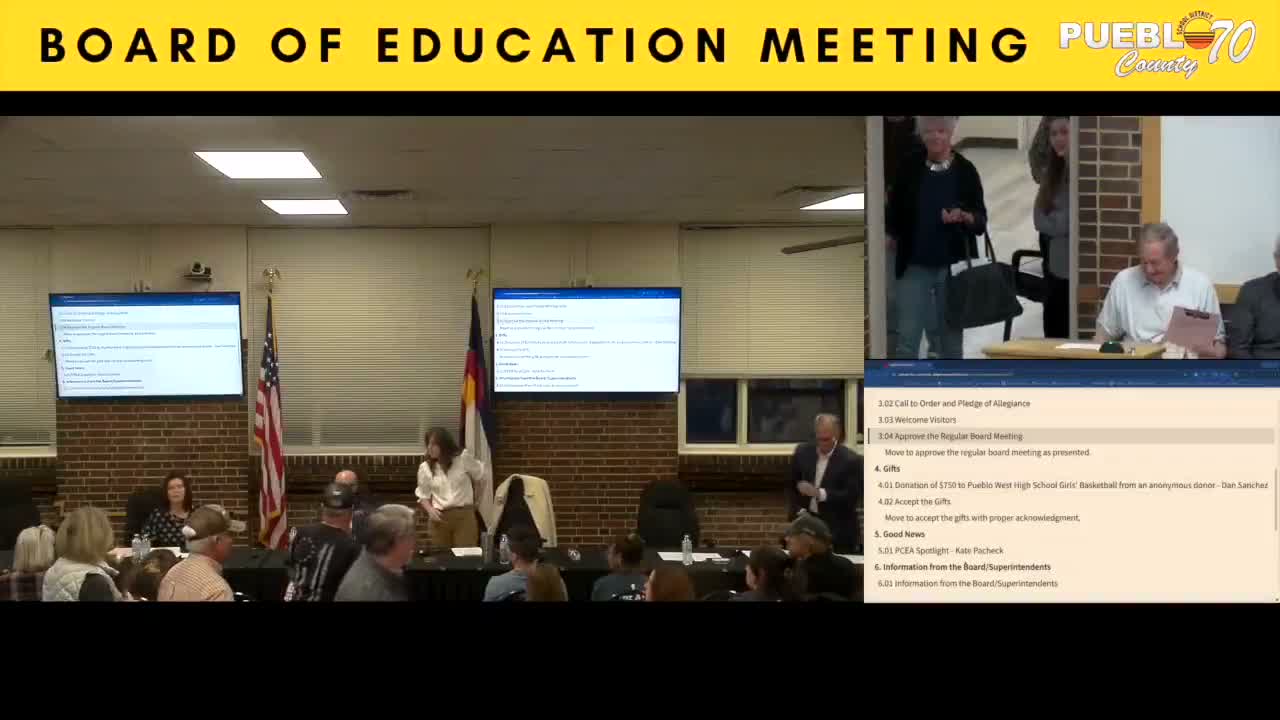
Public commenters at a Pueblo County School District 70 meeting accused the board president of abandoning the Feb. 10 session and later appointing a replacement without following the board’s adopted appointment process or recording the action in the minutes. “The meeting is not adjourned because we did not vote,” one speaker said; another said, “The meeting was abandoned.”
Why it matters: Speakers argued the sequence of events raises legal and transparency concerns. Commenters repeatedly cited a state statute—repeated in public remarks as “Colorado revised statute 22 31 1 29”—saying appointments must be recorded in meeting minutes and that an abandoned meeting’s business should be resumed at the next session.
What speakers said: A commenter who identified themself as a board director or director’s colleague recounted the timeline of work sessions on Jan. 27 and Feb. 3 for applicant review and the Feb. 10 regular board meeting where the group conducted multiple rounds of voting. According to that account, the board took about 10 rounds of voting, a medical emergency prompted a recess, and after the recess the board president left the meeting, breaking quorum. Later in the week the president communicated she would appoint a candidate by letter, an action commenters said occurred on Feb. 15.
Multiple residents and an interviewed candidate described feeling shut out of a fair process. “I come here without a personal agenda. I want a community agenda,” candidate Adolf E. Hill said, recounting his interview and expressing surprise at the selection process. Other commenters asked whether the board followed its own application requirements, naming documents discussed in public comment like resumes, cover letters and at least one letter of recommendation, and noting the board used seven standardized interview questions, the commenter said.
Allegations of a conflict of interest were also raised. A speaker asked whether an alliance between the Miller Farmer law firm and Riverstone Academy, and a lawsuit filed by Miller Farmer since the last meeting, posed a risk to the district; the request was for clarification rather than an outcome.
District response and next steps: A district official said the district must continue essential business, including February payroll and items on the consent agenda, ‘‘with or without a full board.’’ Public commenters urged the board to provide meeting records, to resume the Feb. 10 business at a subsequent meeting, and to cure any procedural irregularities. The board scheduled a follow-up meeting (announced in the session) for March 3.
What the record shows: Speakers repeatedly asked whether an appointment was recorded in minutes as required by the statute cited in public remarks, and said the president announced she would appoint a candidate by letter. The meeting transcript does not record a roll‑call vote or a motion taking place in the session under review that finalized the appointment.
What’s next: Commenters asked the board to clarify the appointment record and to comply with applicable rules governing abandoned meetings and minutes. The board set a subsequent meeting date; the public asked for full transparency and for records that would substantiate whether the district followed its stated appointment procedures.
Why it matters: Speakers argued the sequence of events raises legal and transparency concerns. Commenters repeatedly cited a state statute—repeated in public remarks as “Colorado revised statute 22 31 1 29”—saying appointments must be recorded in meeting minutes and that an abandoned meeting’s business should be resumed at the next session.
What speakers said: A commenter who identified themself as a board director or director’s colleague recounted the timeline of work sessions on Jan. 27 and Feb. 3 for applicant review and the Feb. 10 regular board meeting where the group conducted multiple rounds of voting. According to that account, the board took about 10 rounds of voting, a medical emergency prompted a recess, and after the recess the board president left the meeting, breaking quorum. Later in the week the president communicated she would appoint a candidate by letter, an action commenters said occurred on Feb. 15.
Multiple residents and an interviewed candidate described feeling shut out of a fair process. “I come here without a personal agenda. I want a community agenda,” candidate Adolf E. Hill said, recounting his interview and expressing surprise at the selection process. Other commenters asked whether the board followed its own application requirements, naming documents discussed in public comment like resumes, cover letters and at least one letter of recommendation, and noting the board used seven standardized interview questions, the commenter said.
Allegations of a conflict of interest were also raised. A speaker asked whether an alliance between the Miller Farmer law firm and Riverstone Academy, and a lawsuit filed by Miller Farmer since the last meeting, posed a risk to the district; the request was for clarification rather than an outcome.
District response and next steps: A district official said the district must continue essential business, including February payroll and items on the consent agenda, ‘‘with or without a full board.’’ Public commenters urged the board to provide meeting records, to resume the Feb. 10 business at a subsequent meeting, and to cure any procedural irregularities. The board scheduled a follow-up meeting (announced in the session) for March 3.
What the record shows: Speakers repeatedly asked whether an appointment was recorded in minutes as required by the statute cited in public remarks, and said the president announced she would appoint a candidate by letter. The meeting transcript does not record a roll‑call vote or a motion taking place in the session under review that finalized the appointment.
What’s next: Commenters asked the board to clarify the appointment record and to comply with applicable rules governing abandoned meetings and minutes. The board set a subsequent meeting date; the public asked for full transparency and for records that would substantiate whether the district followed its stated appointment procedures.
Don't Miss a Word: See the Full Meeting!
Go beyond summaries. Unlock every video, transcript, and key insight with a Founder Membership.
✓
Get instant access to full meeting videos
✓
Search and clip any phrase from complete transcripts
✓
Receive AI-powered summaries & custom alerts
✓
Enjoy lifetime, unrestricted access to government data
30-day money-back guarantee
