Pinetop Lakeside hears bids for roughly $500,000 CDBG allocation; council to pick one project by April
February 26, 2026 | Lakeside, Navajo County, Arizona
This article was created by AI summarizing key points discussed. AI makes mistakes, so for full details and context, please refer to the video of the full meeting. Please report any errors so we can fix them. Report an error »
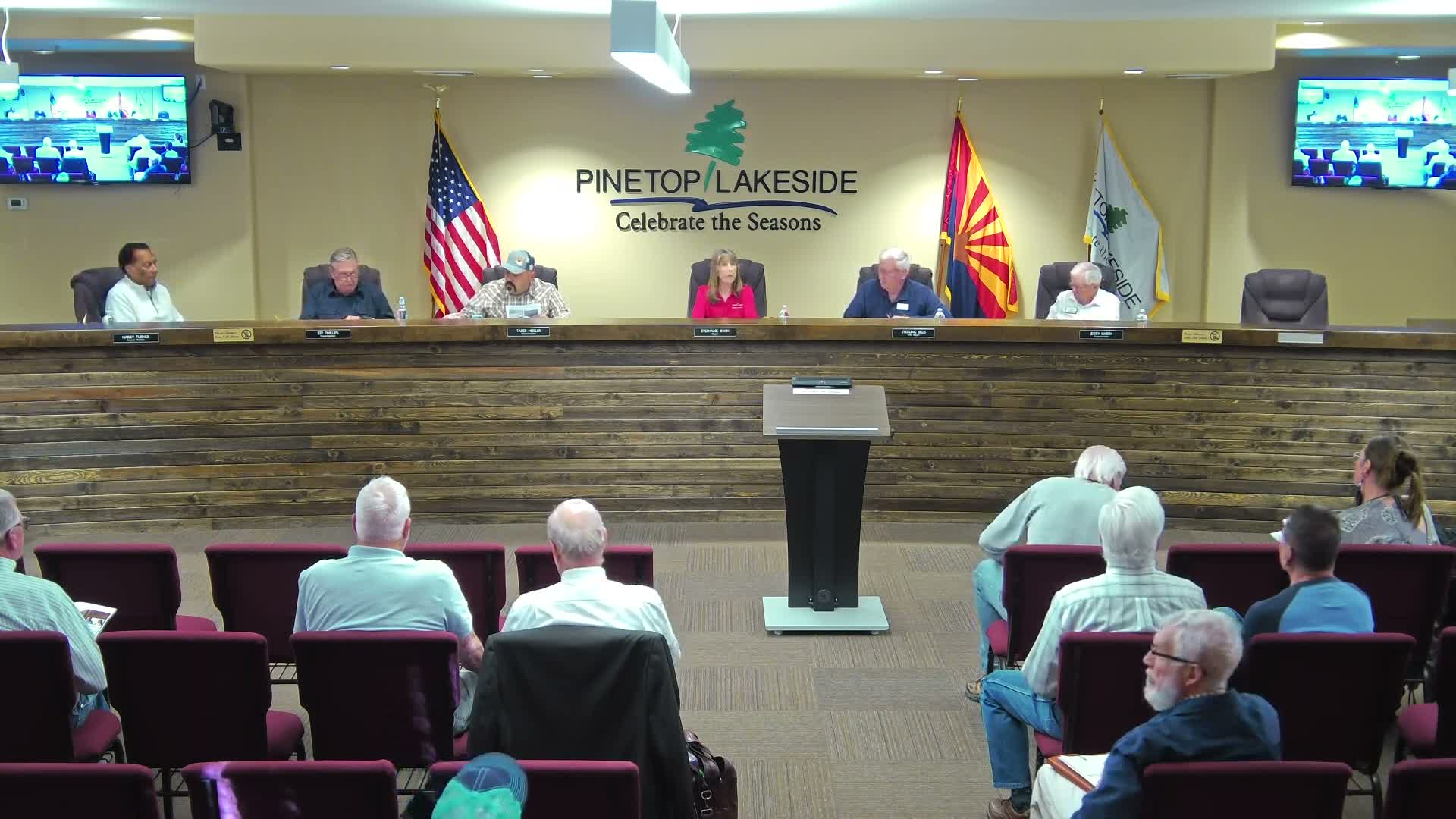
Pinetop Lakeside officials and residents gathered at a public hearing to solicit proposals for an anticipated Community Development Block Grant (CDBG) allocation of about $500,000 administered through the Arizona Department of Housing and routed by the Northern Arizona Council of Governments (NACOG). Rich Ormond, NACOG program manager, told the council the money is a rotating allocation to the region and that communities must choose and prioritize their projects by April 24 to be considered for this cycle.
Why it matters: CDBG money can fund roads, water and wastewater work, senior centers, food banks, accessibility improvements and certain public services, but HUD rules require projects to meet one of three national objectives. Ormond emphasized the most-used objective: at least 51% of beneficiaries must be low- or moderate-income. That requirement shaped council questions and public proposals throughout the hearing.
Proposals and who spoke: Residents and local organizations presented a range of ideas. Dave of White Mountain Meals on Wheels asked for operating support for local service, saying the program serves about 22 home-delivery clients and 13 congregate clients in the Pinetop-Lakeside area, delivers four days per week and "it costs our program $77,220 to service Pine Top Lakes." Megan Campbell, director of the White Mountain Community Center, requested roughly $75,000 to renovate a damaged kitchen and replace a failing walk-in refrigerator so the center could expand meal production and operate a local Meals on Wheels hub.
Other residents and council members pitched larger infrastructure and community projects. Eric Kramer suggested drilling a well to refill Woodland Lake and said local drillers estimated about $3,350,000 for the work; councilors and staff cautioned that dam repairs and the HUD 51% test could complicate a lake project. Ralph proposed investigating a combined senior-and-youth center modeled on a facility in Apache County. Town staff (Milena, Christy) had prepared a long list of candidate projects including library roof/addition, neighborhood revitalization in Lakeside, snowplows and multiuse equipment, road repairs (Porter Mountain Road, Springer Mountain Road), a Mountain Meadow Recreation Complex master plan, and additional buses for the Four Seasons transit connection.
Rules, constraints and options: Ormond reiterated that ADOH generally allows one main project per municipality. There are limited exceptions—communities can sometimes add a planning or design project or purchase eligible equipment (fire vans, defibrillators, delivery vans) alongside a primary project—but the council must not propose two full infrastructure projects as separate main projects. Councilors discussed whether to use the full allocation for a sizable community-center rebuild or to pick a smaller project and return unused funds.
Deadlines and next steps: Ormond and staff laid out the timeline: funding-request forms are available on the back table and must be returned to Milena by March 13; NACOG will help vet proposals and submit regional materials by June 5; NACOG regional-council review is expected in mid-June and ADOH-ready applications should be complete by Aug. 1; actual fund availability commonly arrives later in the year, often around November. The council emphasized that any project not mentioned at this public hearing cannot be considered in the April selection.
What the council must decide: No formal vote or selection occurred at the hearing. The council will use staff-vetted funding-request forms to narrow options ahead of an April public meeting where it must prioritize and select one project to submit. Councilors said they want to balance immediate senior-service needs against longer-term infrastructure investments, and to consider projects that can reliably demonstrate the HUD 51% low/moderate-income benefit.
Bottom line: The hearing surfaced broad community support for senior services and kitchen upgrades, transit and safety equipment, local infrastructure and an ambitious Woodland Lake proposal; procedural constraints—especially the single-project rule and the 51% beneficiary test—will strongly shape which ideas move forward. The town staff and NACOG will vet submissions and return with a narrowed list in time for the council’s April 24 selection.
Why it matters: CDBG money can fund roads, water and wastewater work, senior centers, food banks, accessibility improvements and certain public services, but HUD rules require projects to meet one of three national objectives. Ormond emphasized the most-used objective: at least 51% of beneficiaries must be low- or moderate-income. That requirement shaped council questions and public proposals throughout the hearing.
Proposals and who spoke: Residents and local organizations presented a range of ideas. Dave of White Mountain Meals on Wheels asked for operating support for local service, saying the program serves about 22 home-delivery clients and 13 congregate clients in the Pinetop-Lakeside area, delivers four days per week and "it costs our program $77,220 to service Pine Top Lakes." Megan Campbell, director of the White Mountain Community Center, requested roughly $75,000 to renovate a damaged kitchen and replace a failing walk-in refrigerator so the center could expand meal production and operate a local Meals on Wheels hub.
Other residents and council members pitched larger infrastructure and community projects. Eric Kramer suggested drilling a well to refill Woodland Lake and said local drillers estimated about $3,350,000 for the work; councilors and staff cautioned that dam repairs and the HUD 51% test could complicate a lake project. Ralph proposed investigating a combined senior-and-youth center modeled on a facility in Apache County. Town staff (Milena, Christy) had prepared a long list of candidate projects including library roof/addition, neighborhood revitalization in Lakeside, snowplows and multiuse equipment, road repairs (Porter Mountain Road, Springer Mountain Road), a Mountain Meadow Recreation Complex master plan, and additional buses for the Four Seasons transit connection.
Rules, constraints and options: Ormond reiterated that ADOH generally allows one main project per municipality. There are limited exceptions—communities can sometimes add a planning or design project or purchase eligible equipment (fire vans, defibrillators, delivery vans) alongside a primary project—but the council must not propose two full infrastructure projects as separate main projects. Councilors discussed whether to use the full allocation for a sizable community-center rebuild or to pick a smaller project and return unused funds.
Deadlines and next steps: Ormond and staff laid out the timeline: funding-request forms are available on the back table and must be returned to Milena by March 13; NACOG will help vet proposals and submit regional materials by June 5; NACOG regional-council review is expected in mid-June and ADOH-ready applications should be complete by Aug. 1; actual fund availability commonly arrives later in the year, often around November. The council emphasized that any project not mentioned at this public hearing cannot be considered in the April selection.
What the council must decide: No formal vote or selection occurred at the hearing. The council will use staff-vetted funding-request forms to narrow options ahead of an April public meeting where it must prioritize and select one project to submit. Councilors said they want to balance immediate senior-service needs against longer-term infrastructure investments, and to consider projects that can reliably demonstrate the HUD 51% low/moderate-income benefit.
Bottom line: The hearing surfaced broad community support for senior services and kitchen upgrades, transit and safety equipment, local infrastructure and an ambitious Woodland Lake proposal; procedural constraints—especially the single-project rule and the 51% beneficiary test—will strongly shape which ideas move forward. The town staff and NACOG will vet submissions and return with a narrowed list in time for the council’s April 24 selection.
Don't Miss a Word: See the Full Meeting!
Go beyond summaries. Unlock every video, transcript, and key insight with a Founder Membership.
✓
Get instant access to full meeting videos
✓
Search and clip any phrase from complete transcripts
✓
Receive AI-powered summaries & custom alerts
✓
Enjoy lifetime, unrestricted access to government data
30-day money-back guarantee
