Douglas County defers KDOC truancy grant application to March 11
February 26, 2026 | Douglas County, Kansas
This article was created by AI summarizing key points discussed. AI makes mistakes, so for full details and context, please refer to the video of the full meeting. Please report any errors so we can fix them. Report an error »
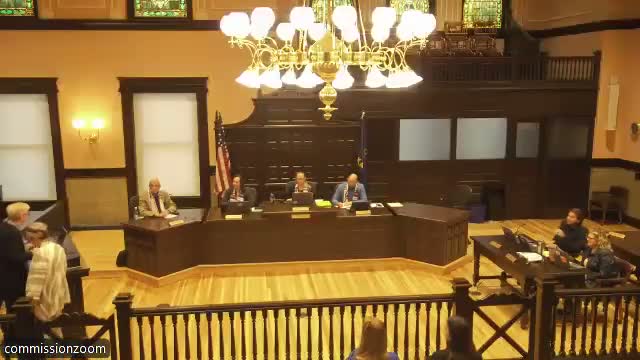
The Douglas County Board of Commissioners on Feb. 25 voted 4–0 to defer action on the FY2027 Kansas Department of Corrections (KDOC) Seventh Judicial District juvenile community corrections comprehensive plan grant application until its March 11 meeting, directing staff to make the truancy-related language in the application more generic and to work with local school districts before final submission.
Pam Weijian, director of criminal justice services, told the board the division’s budget is "a little over $5,000,000," and that the specific KDOC allocation under discussion amounted to what she described as "$570,965 and $50.63 cents in youth juvenile services funds." She told commissioners the grant pays for intake and assessment, an immediate intervention diversion program, case management and juvenile community corrections; roughly $37,199 of the allocation was identified in the packet for prevention programs, including funds historically used to support truancy work and contributions to Bert Nash reporting and services.
The board’s action followed concerns raised by commissioners about language in the application that named a specific vendor and described program details on page 10 of the packet. Commission members said they wanted the county’s submission to KDOC to describe a Douglas County truancy program in generic terms so the county could work with school districts and potential providers before committing to a specific vendor. Pam Weijian said she would meet with school officials (including Kate Fitzgerald and Sarah Plinske) and edit the application; she also said KDOC typically distributes funds quarterly, requires quarterly expenditure reporting and expects the county’s materials before mid-June even though the grant runs July 1, 2026–June 30, 2027.
Two public commenters urged the county to preserve elements of a mentor-based model. Jan Sheldon, who said she helped develop the KU/Douglas County truancy-prevention and diversion program, described undergraduate mentors working weekly with students and families and presented data she said showed the approach reduced absenteeism. Dr. Irving Ku, a Lawrence psychiatrist who volunteers on citizen review boards and as a support mentor, said he had observed stronger outcomes in mentor-intensive models than in high-school case-management approaches he reviewed.
Acting chair (name not stated) made the motion to defer the grant application to the March 11 meeting; a commissioner seconded the motion and the board voted 4–0 to defer. The deferral instructs staff to remove vendor-specific references, make the truancy portion more generic, and return the revised application to the commission for approval prior to KDOC submission.
The county also approved the remainder of the consent agenda (items 2.1–2.8 less 2.4) by voice vote earlier in the meeting. The KDOC grant application remains on the consent calendar pending the revisions and the March 11 discussion.
Pam Weijian, director of criminal justice services, told the board the division’s budget is "a little over $5,000,000," and that the specific KDOC allocation under discussion amounted to what she described as "$570,965 and $50.63 cents in youth juvenile services funds." She told commissioners the grant pays for intake and assessment, an immediate intervention diversion program, case management and juvenile community corrections; roughly $37,199 of the allocation was identified in the packet for prevention programs, including funds historically used to support truancy work and contributions to Bert Nash reporting and services.
The board’s action followed concerns raised by commissioners about language in the application that named a specific vendor and described program details on page 10 of the packet. Commission members said they wanted the county’s submission to KDOC to describe a Douglas County truancy program in generic terms so the county could work with school districts and potential providers before committing to a specific vendor. Pam Weijian said she would meet with school officials (including Kate Fitzgerald and Sarah Plinske) and edit the application; she also said KDOC typically distributes funds quarterly, requires quarterly expenditure reporting and expects the county’s materials before mid-June even though the grant runs July 1, 2026–June 30, 2027.
Two public commenters urged the county to preserve elements of a mentor-based model. Jan Sheldon, who said she helped develop the KU/Douglas County truancy-prevention and diversion program, described undergraduate mentors working weekly with students and families and presented data she said showed the approach reduced absenteeism. Dr. Irving Ku, a Lawrence psychiatrist who volunteers on citizen review boards and as a support mentor, said he had observed stronger outcomes in mentor-intensive models than in high-school case-management approaches he reviewed.
Acting chair (name not stated) made the motion to defer the grant application to the March 11 meeting; a commissioner seconded the motion and the board voted 4–0 to defer. The deferral instructs staff to remove vendor-specific references, make the truancy portion more generic, and return the revised application to the commission for approval prior to KDOC submission.
The county also approved the remainder of the consent agenda (items 2.1–2.8 less 2.4) by voice vote earlier in the meeting. The KDOC grant application remains on the consent calendar pending the revisions and the March 11 discussion.
Don't Miss a Word: See the Full Meeting!
Go beyond summaries. Unlock every video, transcript, and key insight with a Founder Membership.
✓
Get instant access to full meeting videos
✓
Search and clip any phrase from complete transcripts
✓
Receive AI-powered summaries & custom alerts
✓
Enjoy lifetime, unrestricted access to government data
30-day money-back guarantee
