Tempe officials outline cautious budget outlook as retail sales rise but rental tax falls
February 27, 2026 | Tempe, Maricopa County, Arizona
This article was created by AI summarizing key points discussed. AI makes mistakes, so for full details and context, please refer to the video of the full meeting. Please report any errors so we can fix them. Report an error »
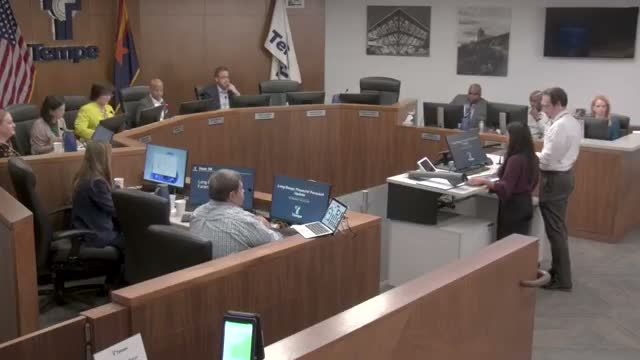
Deputy City Manager Lisette Camacho and Municipal Budget Director Robert Baer told the Tempe City Council at a work study session that the city's long-range fiscal forecast shows cautious improvement in some revenue categories but continued pressure from a decline in residential rental tax revenue.
Camacho said staff has entered a second consecutive year without supplemental budgets and has prioritized expenditure reductions and revenue-offset budget requests to maintain fund-balance targets. She highlighted increased retail sales tax, noting that online retail is up about 19% compared with the prior year, but said that growth is not sufficient to offset losses tied to residential rental tax.
The update outlined how the city is using one-time reserves to bridge gaps: drawing on public safety retirement and OPEB reserves and temporarily reducing transfers to the transportation fund and the municipal arts program. Camacho said these transfers are not legally required and could be restored in future years if capacity allows. She also flagged forecast assumptions that reduce state-shared revenues, including the incorporation of San Tan Valley and recent federal income tax conformity changes.
Baer reviewed enterprise and special revenue funds, reporting stable positions for water, wastewater and solid waste, and noting that the emergency medical transport fund continues to be refined in coordination with the fire department. He cautioned that transit faces a structural gap: expenses are growing and staff are relying on fund balance as a bridge pending adjustments in service, revenues or local match policies.
Camacho cited final FY25 audit results showing an unassigned fund balance above earlier projections (she reported the FY25 unassigned balance exceeded the prior forecast and noted a roughly $10.6 million positive variance). Officials said the city remains committed to retaining fund balances within the council's adopted 20%–30% policy range over the forecast horizon.
No formal action was taken; staff will continue to refine forecasts and present recommended budget and capital projects at upcoming budget review sessions in April and May, with tentative adoption in mid-May and final adoption in early June.
Camacho said staff has entered a second consecutive year without supplemental budgets and has prioritized expenditure reductions and revenue-offset budget requests to maintain fund-balance targets. She highlighted increased retail sales tax, noting that online retail is up about 19% compared with the prior year, but said that growth is not sufficient to offset losses tied to residential rental tax.
The update outlined how the city is using one-time reserves to bridge gaps: drawing on public safety retirement and OPEB reserves and temporarily reducing transfers to the transportation fund and the municipal arts program. Camacho said these transfers are not legally required and could be restored in future years if capacity allows. She also flagged forecast assumptions that reduce state-shared revenues, including the incorporation of San Tan Valley and recent federal income tax conformity changes.
Baer reviewed enterprise and special revenue funds, reporting stable positions for water, wastewater and solid waste, and noting that the emergency medical transport fund continues to be refined in coordination with the fire department. He cautioned that transit faces a structural gap: expenses are growing and staff are relying on fund balance as a bridge pending adjustments in service, revenues or local match policies.
Camacho cited final FY25 audit results showing an unassigned fund balance above earlier projections (she reported the FY25 unassigned balance exceeded the prior forecast and noted a roughly $10.6 million positive variance). Officials said the city remains committed to retaining fund balances within the council's adopted 20%–30% policy range over the forecast horizon.
No formal action was taken; staff will continue to refine forecasts and present recommended budget and capital projects at upcoming budget review sessions in April and May, with tentative adoption in mid-May and final adoption in early June.
Don't Miss a Word: See the Full Meeting!
Go beyond summaries. Unlock every video, transcript, and key insight with a Founder Membership.
✓
Get instant access to full meeting videos
✓
Search and clip any phrase from complete transcripts
✓
Receive AI-powered summaries & custom alerts
✓
Enjoy lifetime, unrestricted access to government data
30-day money-back guarantee
