Muncie board approves Kingdom Recovery sober-living variance with conditions, caps occupancy at 12
February 26, 2026 | Delaware County, Indiana
This article was created by AI summarizing key points discussed. AI makes mistakes, so for full details and context, please refer to the video of the full meeting. Please report any errors so we can fix them. Report an error »
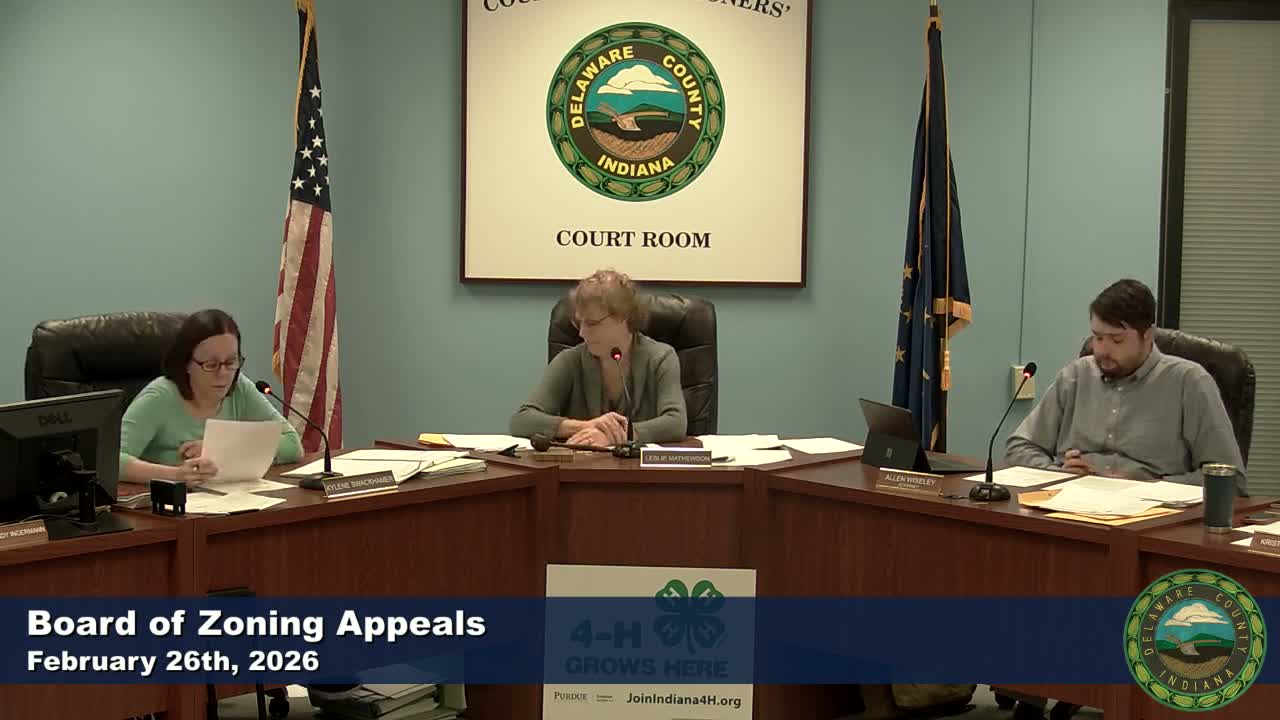
The Muncie Board of Zoning Appeals voted unanimously to approve a variance for Kingdom Recovery LLC to operate a long-term sober-living residence in a former church at 304 North Waldameer Avenue, but limited occupancy to 12 residents and attached conditions requiring fire, health and building approvals before any residents move in.
Board members approved BZA02-26 after hearing an applicant presentation and more than an hour of public comment. Applicant representatives Devin Case and Brian Blevins said they purchased the 5,200-square-foot building and proposed a peer-based sober-living program with screening that excludes sex offenders and violent felons, a 10 p.m. curfew, random drug testing and daily staff check-ins. The applicants said cameras would be installed and that they will remove residents who violate program rules and find alternative housing rather than simply locking them out.
Supporters included peer recovery coaches, a former police officer, county probation staff and the mayor, who said his office had checked complaints about prior operations and found no evidence the applicants were removed from another municipality. Several speakers described a shortage of recovery housing in Muncie and Delaware County and urged approval to expand local capacity.
Nearby residents and other neighbors urged caution, citing the building's proximity to homes and children, concerns about rear-yard surveillance, prior police calls in the area, and the short distance (about 16'30 feet reported by neighbors) between the property and adjacent yards. Neighbors questioned whether daily checks and other safeguards would prevent off-site problems and asked for stronger camera coverage and a clear plan for residents who violate curfew or appear intoxicated.
The city engineer's emailed recommendation, read into the record, noted that the ordinance requires paved lots and that existing gravel and paved area could accommodate roughly 21 parking spaces, but recommended limiting dwelling units to 12 unless the applicant installed a paved lot and stormwater controls in line with the city design manual. The board's motion adopted that recommendation: the variance was approved for the applicant only (non-transferable), all required departmental approvals must be obtained before residents occupy the building, and occupancy is limited to 12 given the parking situation.
What happens next: The board's office will provide the applicants with a certification of approval so they may pursue permits and complete required fire- and building-code corrections. If the applicants later seek to expand capacity or make parking/site improvements, they must return to the board.
Quote: "We're more than willing to comply with any boundaries you put in place," applicant Devin Case said during questioning, adding that daily supervision and background checks are core to the program.
The board recorded a 5-0 roll call in favor; the chair said the office would follow up with permitting steps.
Board members approved BZA02-26 after hearing an applicant presentation and more than an hour of public comment. Applicant representatives Devin Case and Brian Blevins said they purchased the 5,200-square-foot building and proposed a peer-based sober-living program with screening that excludes sex offenders and violent felons, a 10 p.m. curfew, random drug testing and daily staff check-ins. The applicants said cameras would be installed and that they will remove residents who violate program rules and find alternative housing rather than simply locking them out.
Supporters included peer recovery coaches, a former police officer, county probation staff and the mayor, who said his office had checked complaints about prior operations and found no evidence the applicants were removed from another municipality. Several speakers described a shortage of recovery housing in Muncie and Delaware County and urged approval to expand local capacity.
Nearby residents and other neighbors urged caution, citing the building's proximity to homes and children, concerns about rear-yard surveillance, prior police calls in the area, and the short distance (about 16'30 feet reported by neighbors) between the property and adjacent yards. Neighbors questioned whether daily checks and other safeguards would prevent off-site problems and asked for stronger camera coverage and a clear plan for residents who violate curfew or appear intoxicated.
The city engineer's emailed recommendation, read into the record, noted that the ordinance requires paved lots and that existing gravel and paved area could accommodate roughly 21 parking spaces, but recommended limiting dwelling units to 12 unless the applicant installed a paved lot and stormwater controls in line with the city design manual. The board's motion adopted that recommendation: the variance was approved for the applicant only (non-transferable), all required departmental approvals must be obtained before residents occupy the building, and occupancy is limited to 12 given the parking situation.
What happens next: The board's office will provide the applicants with a certification of approval so they may pursue permits and complete required fire- and building-code corrections. If the applicants later seek to expand capacity or make parking/site improvements, they must return to the board.
Quote: "We're more than willing to comply with any boundaries you put in place," applicant Devin Case said during questioning, adding that daily supervision and background checks are core to the program.
The board recorded a 5-0 roll call in favor; the chair said the office would follow up with permitting steps.
View the Full Meeting & All Its Details
This article offers just a summary. Unlock complete video, transcripts, and insights as a Founder Member.
✓
Watch full, unedited meeting videos
✓
Search every word spoken in unlimited transcripts
✓
AI summaries & real-time alerts (all government levels)
✓
Permanent access to expanding government content
30-day money-back guarantee
